
• English
  • Hindi
  • Punjabi
  • Marathi
  • German
  • Gujarati
  • Urdu
  • Telugu
  • Bengali
  • Kannada
  • Odia
  • Assamese
  • Nepali
  • Spanish
  • French
  • Japanese
  • Arabic
  • Home
  • Noida
  • National
    • BulletsIn
    • cliQ Explainer
    • Government Policy
    • New India
  • International
    • Middle East
    • Foreign
  • Entertainment
  • Business
    • Tender News
  • Sports
    • IPL2025
  • Services
    • Lifestyle
    • How To
    • Spiritual
      • Festival and Culture
    • Tech
Notification
  • Home
  • Noida
  • National
    • BulletsIn
    • cliQ Explainer
    • Government Policy
    • New India
  • International
    • Middle East
    • Foreign
  • Entertainment
  • Business
    • Tender News
  • Sports
    • IPL2025
  • Services
    • Lifestyle
    • How To
    • Spiritual
      • Festival and Culture
    • Tech
  • Home
  • Noida
  • National
    • BulletsIn
    • cliQ Explainer
    • Government Policy
    • New India
  • International
    • Middle East
    • Foreign
  • Entertainment
  • Business
    • Tender News
  • Sports
    • IPL2025
  • Services
    • Lifestyle
    • How To
    • Spiritual
      • Festival and Culture
    • Tech
  • Noida
  • National
  • International
  • Entertainment
  • Business
  • Sports
CliQ INDIA > Education > Scientists use AI to better understand nanoparticles: Study
Education

Scientists use AI to better understand nanoparticles: Study

cliQ India
cliQ India
Share
3 Min Read
SHARE

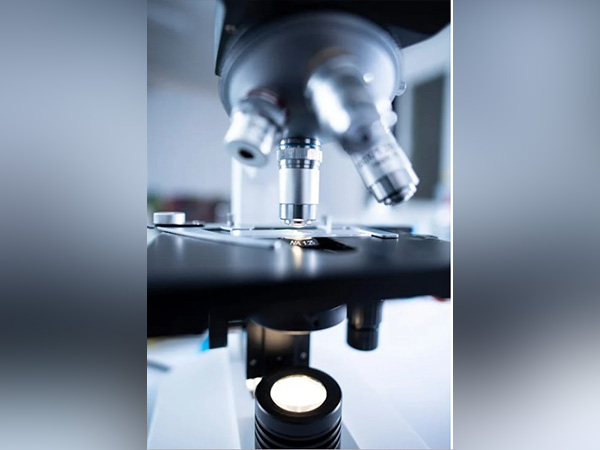
New York [US], March 3 (ANI): A group of scientists has created a way to illuminate the dynamic behavior of nanoparticles, which are essential components in the production of pharmaceuticals, electronics, and industrial and energy-conversion materials.

The breakthrough combines artificial intelligence and electron microscopy to produce images of how these tiny pieces of matter react to stimuli. “Nanoparticle-based catalytic systems have a tremendous impact on society,” explains Carlos Fernandez-Granda, director of New York University (NYU’s) Center for Data Science and a professor of mathematics and data science, one of the paper’s authors.

“It is estimated that 90 percent of all manufactured products involve catalytic processes somewhere in their production chain. We have developed an artificial-intelligence method that opens a new window for the exploration of atomic-level structural dynamics in materials.”

The work, which also included researchers from Arizona State University, Cornell University, and the University of Iowa, blends electron microscopy with AI to enable scientists to see the structures and movements of molecules that are one-billionth of a meter in size at an unprecedented time resolution.

“Electron microscopy can capture images at a high spatial resolution, but because of the velocity at which the atomic structure of nanoparticles changes during chemical reactions, we need to gather data at a very high speed to understand their functionality,” explains Peter A. Crozier, a professor of materials science and engineering at Arizona State University and one of the paper’s authors. “This results in extremely noisy measurements. We have developed an artificial-intelligence method that learns how to remove this noise–automatically–enabling the visualization of key atomic-level dynamics.”

Observing the movement of atoms on a nanoparticle is crucial to understanding functionality in industrial applications. The problem is that the atoms are barely visible in the data, so scientists cannot be sure how they are behaving–the equivalent of tracking objects in a video taken at night with an old camera. To address this challenge, the paper’s authors trained a deep neural network, AI’s computational engine, that is able to “light up” the electron microscope images, revealing the underlying atoms and their dynamic behavior.

“The nature of changes in the particle is exceptionally diverse, including fluxional periods, manifesting as rapid changes in atomic structure, particle shape, and orientation; understanding these dynamics requires new statistical tools,” explains David S. Matteson, a professor and associate chair of Cornell University’s Department of Statistics and Data Science, director of the National Institute of Statistical Sciences, and one of the paper’s authors. “This study introduces a new statistic that utilizes topological data analysis to both quantify fluxionality and to track the stability of particles as they transition between ordered and disordered states.” (ANI)


You Might Also Like

Researchers discover long colds may exist as long as Covid
Indian Navy Bharti | Direct recruitment of officers in Navy through this entry scheme, will get salary of Rs 1.77 lakh.
National Education Day
Join Indian Army Common Entrance Exam CEE Exam 2024 Apply Online Form
AP Eamcet 2024 counselling: First seat allotment list to be released today | CliqExplainer

Sign Up For Daily Newsletter

Be keep up! Get the latest breaking news delivered straight to your inbox.
By signing up, you agree to our Terms of Use and acknowledge the data practices in our Privacy Policy. You may unsubscribe at any time.
Share This Article
Facebook Whatsapp Whatsapp Telegram Copy Link Print
Share
What do you think?
Love0
Sad0
Happy0
Angry0
Wink0
Previous Article Oscars: Priyanka Chopra, Guneet Monga-backed 'Anuja' loses Best Live Action Short award to 'I'm Not A Robot'
Next Article EAM S Jaishankar meets with Belgium's foreign minister, Maxime Prevot, at Hyderabad House

Stay Connected

FacebookLike
XFollow
InstagramFollow
YoutubeSubscribe
TelegramFollow
- Advertisement -
Ad imageAd image

Latest News

Bengal Falta Repoll 2026: Massive Security Deployment After Election Controversy | Cliq Latest
National
May 21, 2026
Peddi Promotion Event In Bhopal: Ram Charan And AR Rahman Ready For Mega Show | Cliq Latest
Entertainment
May 21, 2026
Junior NTR Dragon Teaser Out: NTR Stuns Fans With Intense Assassin Avatar | Cliq Latest
Entertainment
May 21, 2026
KKR Vs MI IPL 2026: Manish Pandey And Bowlers Revive Kolkata Playoff Dream | Cliq Latest
Sports
May 21, 2026

//

We are rapidly growing digital news startup that is dedicated to providing reliable, unbiased, and real-time news to our audience.

We are rapidly growing digital news startup that is dedicated to providing reliable, unbiased, and real-time news to our audience.

Sign Up for Our Newsletter

Sign Up for Our Newsletter

Subscribe to our newsletter to get our newest articles instantly!

Follow US

Follow US

© 2026 cliQ India. All Rights Reserved.

CliQ INDIA
  • English – अंग्रेज़ी
  • Hindi – हिंदी
  • Punjabi – ਪੰਜਾਬੀ
  • Marathi – मराठी
  • German – Deutsch
  • Gujarati – ગુજરાતી
  • Urdu – اردو
  • Telugu – తెలుగు
  • Bengali – বাংলা
  • Kannada – ಕನ್ನಡ
  • Odia – ଓଡିଆ
  • Assamese – অসমীয়া
  • Nepali – नेपाली
  • Spanish – Española
  • French – Français
  • Japanese – フランス語
  • Arabic – فرنسي
Welcome Back!

Sign in to your account

Username or Email Address
Password

Lost your password?



