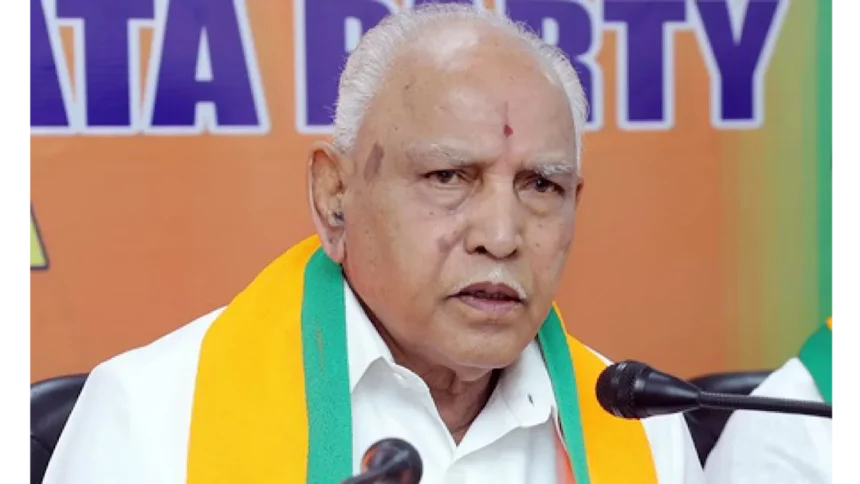
The Supreme Court on Tuesday stayed all trial proceedings against former Karnataka chief minister BS Yediyurappa in a sexual-harassment case registered under the Protection of Children from Sexual Offences (POCSO) Act. The interim relief came as the apex court admitted his petition challenging the Karnataka High Court’s refusal to quash the criminal case and the subsequent proceedings initiated by a special POCSO court.
Supreme Court Questions High Court Approach
A bench of Chief Justice Surya Kant and Justice Joymalya Bagchi issued notice to the complainant and the Karnataka government, indicating that the top court intends to re-examine whether the matter should be remanded to the High Court for fresh consideration. “Issue notice. Meanwhile, trial proceedings shall remain stayed,” the CJI said during the hearing.
The court’s remarks came in response to arguments advanced by senior advocate Sidharth Luthra, who appeared for Yediyurappa. Luthra argued that the High Court “ignored key evidence” and did not consider several statements that, according to the defence, suggested that “nothing as such happened” during the alleged incident. He claimed that the prosecution had suppressed crucial material which, if examined, would have altered the High Court’s reasoning.
The bench questioned whether the High Court could be compelled to conduct what would effectively become a “mini-trial” at the stage of considering a plea for quashing. CJI Kant observed that the purpose of issuing notice was to determine whether the High Court’s approach required reconsideration in light of the material allegedly overlooked.
Background of the Case and Procedural Developments
The case stems from a complaint filed on March 14, 2024, by a woman—now deceased—who alleged that Yediyurappa molested her 17-year-old daughter when the two visited the former Karnataka CM’s residence seeking assistance. The complainant also alleged that Yediyurappa later attempted to suppress the matter by offering money, a charge that the defence strongly denies.
Based on the woman’s complaint, the police registered an FIR under several sections of the POCSO Act involving charges of sexual assault and harassment. As the investigation progressed, a trial court on July 4, 2024, took cognisance not only of the offences attributed to Yediyurappa but also of offences allegedly committed by three other individuals for destruction of evidence and attempts to suppress the case.
However, the Karnataka High Court later set aside the July 4 order, describing it as “cryptic,” and directed the trial court to reconsider the matter. Acting on this directive, the Fast-Track Special Court issued a fresh cognisance order on February 28, 2025, summoning Yediyurappa and other accused persons to appear on March 15.
Yediyurappa challenged both the fresh cognisance order and the original complaint before the High Court, calling the allegations inconsistent, politically motivated, and unsupported by material evidence. The High Court, however, refused to quash the proceedings last month, prompting him to move the Supreme Court.
With the Supreme Court’s stay now in place, further steps in the trial—including the appearance of the accused before the POCSO court—remain suspended pending the apex court’s next hearing.