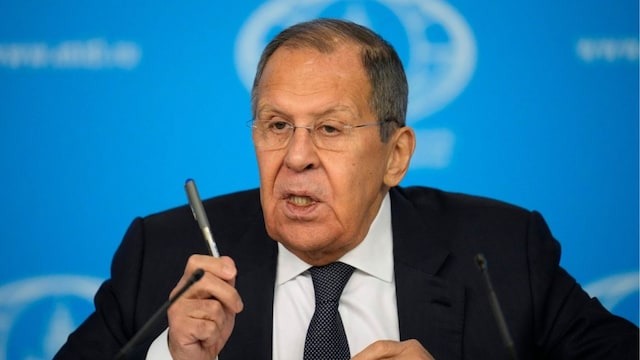
Russian Foreign Minister Sergei Lavrov recently expressed concerns that India’s involvement in the Quad—a group consisting of the United States, Japan, Australia, and India—is being pushed beyond its stated economic and trade goals. Lavrov highlighted that while India joined the Quad citing peaceful cooperation, member nations have increasingly been coordinating military and naval exercises, which he views as an attempt to militarize the alliance and pressure India into deeper military commitments. At the same time, he urged for the revival of the Russia-India-China (RIC) trilateral dialogue, emphasizing a need to ease regional tensions.
Lavrov’s remarks came at a security conference in Perm, Eurasia, where he clarified India’s original stance regarding the Quad. He said Indian officials had emphasized that their interest was focused on economic and trade cooperation rather than military alignment. However, he noted that the Quad nations have been pushing naval and military drills outside the official framework, aiming to involve all four countries, including India, in these exercises.
He warned this shift represents a provocative attempt to draw India into a military alliance that may complicate its strategic autonomy. Lavrov indicated that India is aware of these provocations and is carefully navigating the situation. His comments suggest a clear skepticism about the Quad’s evolving role, seeing it increasingly as a security bloc rather than purely an economic grouping.
At the same time, Lavrov called for the revival of the trilateral Russia-India-China (RIC) format, which has been inactive since the border clashes between India and China in Galwan Valley in 2020. He stressed that the time is ripe to restart RIC meetings, which were originally initiated in the late 1990s and had met more than 20 times at ministerial levels. Lavrov believes that India and China have made progress toward easing border tensions, which could facilitate renewed trilateral cooperation.
Lavrov’s renewed push for the RIC platform reflects Russia’s shifting diplomatic priorities amid changing global alignments. Earlier, he had accused Western powers of trying to drive a wedge between India and China by stoking tensions in the Asia-Pacific region. He noted that the West’s rebranding of the region as the “Indo-Pacific” aims to emphasize an anti-China stance, potentially sowing discord between the two Asian neighbors.
This set of remarks underscores Russia’s effort to position itself as a diplomatic bridge in the region, while warning India against being drawn into militarized alliances that could affect regional stability and its strategic autonomy.