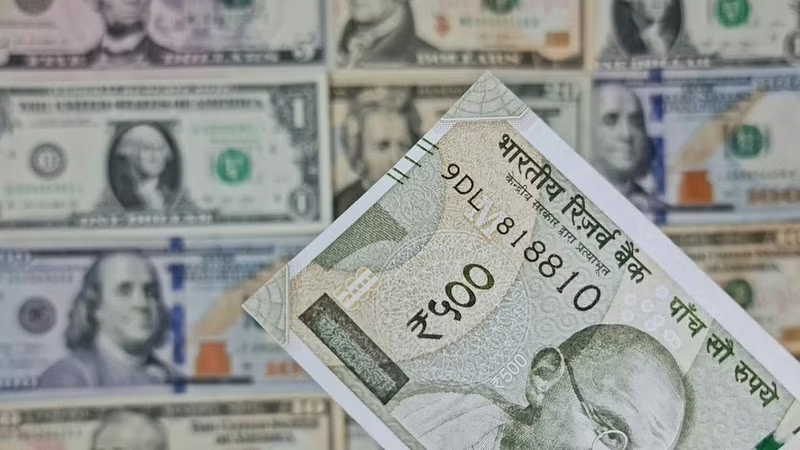
The Indian rupee plunged to an all-time low of 87.29 against the US dollar in early trade on Monday, depreciating by 67 paise, as global markets reacted sharply to fresh tariff impositions by US President Donald Trump. The aggressive trade stance, targeting Canada, Mexico, and China, has sparked fears of a wider global trade war, putting pressure on emerging market currencies and driving investors towards safe-haven assets like the US dollar.
President Donald Trump’s decision to impose 25 per cent duties on Canada and Mexico, along with a 10 per cent tariff on China, has rattled financial markets, with forex traders warning that this could be the beginning of a prolonged trade conflict with far-reaching economic consequences. The rupee, which opened at 87.00 at the interbank foreign exchange market, saw a rapid decline to 87.29 in initial deals, reflecting a sharp selloff in risk-sensitive assets. This comes after the rupee had closed flat at 86.62 on Friday.
Market experts attributed the rupee’s weakness to sustained foreign fund outflows and the relentless strength of the American currency in overseas markets, driven by robust dollar demand from oil importers and a general aversion to riskier assets. The ongoing trade tensions have exacerbated concerns, fueling a strong rally in the dollar, which surged to 109.50 levels. The broader impact of the tariff move was evident in global forex markets, with major currencies witnessing steep declines. The euro slid to 1.0224, the British pound dropped to 1.2261, and the Japanese yen weakened to 155.54 against the US dollar.
Asian currencies were also hit hard, with China’s yuan plunging to 7.3551, Indonesia’s rupiah slipping to 16,448, and South Korea’s won tumbling to 1,470. The US dollar index, which measures the strength of the greenback against a basket of six major currencies, jumped 1.30 per cent to 109.77. This sudden surge in the dollar’s value reflects the prevailing uncertainty in global financial markets, with investors flocking to safer assets amid heightened trade war fears.
Brent crude prices, the global oil benchmark, also climbed 0.71 per cent to USD 76.21 per barrel in futures trading, further adding to concerns over inflationary pressures and worsening external balances for oil-importing economies like India. The rise in crude prices, coupled with the rupee’s depreciation, is likely to exert additional strain on India’s trade deficit and current account balance, raising concerns for policymakers.
Domestic equity markets mirrored the global sentiment, with the benchmark indices witnessing significant losses in early trading. The 30-share BSE Sensex fell by 575.89 points, or 0.74 per cent, to trade at 76,930.07, while the broader NSE Nifty declined by 206.40 points, or 0.88 per cent, to 23,275.75. The bearish momentum in equities was largely driven by foreign institutional investors (FIIs), who offloaded equities worth Rs 1,327.09 crore in the capital markets on Saturday, as per exchange data.
Despite the sharp depreciation in the rupee, market participants expect some intervention from the Reserve Bank of India (RBI) to prevent excessive volatility. Experts suggest that the central bank could step in to curb dollar demand, with the rupee’s trading range anticipated to be between 86.65 and 87.00 for the day. However, given the broader global developments, the overall pressure on the currency is expected to persist in the near term.
India’s foreign exchange reserves, which serve as a crucial buffer against external shocks, saw an increase of USD 5.574 billion, reaching USD 629.557 billion in the week ending January 24, according to the RBI. This rise comes after a previous drop of USD 1.888 billion, which had brought reserves down to USD 623.983 billion. The recent fluctuations in reserves have been attributed to a mix of forex market interventions by the RBI and valuation adjustments. The central bank has been actively managing the rupee’s volatility, but the increasing global headwinds could pose fresh challenges in stabilizing the currency.
With trade tensions escalating and markets pricing in a prolonged period of uncertainty, all eyes are now on how policymakers and central banks react to the evolving global economic landscape. The rupee’s trajectory in the coming days will largely depend on further developments in US trade policy, the Federal Reserve’s monetary stance, and global risk sentiment. As markets brace for continued volatility, investors and businesses remain on high alert for any signs of further escalation in the trade war narrative.