BYLINE: Christina Nunez
Newswise — Used as a versatile material in industry and health care, magnesium oxide may also be a good candidate for quantum technologies. Research led by the U.S. Department of Energy’s (DOE) Argonne National Laboratory and published in npj Computational Materials reveals a defect in the mineral that could be useful for quantum applications.
Researchers are exploring possible building blocks, known as qubits, for systems that could exploit quantum properties. These systems could operate in various devices that may outperform classical supercomputers, form unhackable networks or detect the faintest signals. Unlocking the potential of qubits for applications such as quantum computing, sensing and communications requires an understanding of materials on the atomic scale.
“We calculated several different electronic and optical properties in this study, which gave us deep insight into the magnesium oxide host and the nitrogen-vacancy qubit. But of course, this is just the start.” — Maria Goeppert Mayer Fellow Vrindaa Somjit
Qubits can be engineered using many different materials and strategies. One such strategy is a “spin defect,” where an irregularity in a material’s atomic structure can host information. An irregularity can be in the form of missing atoms or “foreign” atoms (also called dopants) added to the material.
Silicon carbide and diamond, among other materials, have well-studied spin defects. For example, the “nitrogen-vacancy center” in diamond is a prototypical spin defect where a nitrogen atom (the dopant) lies next to a missing carbon atom (the vacancy). Although promising, silicon carbide and diamond have some drawbacks that warrant exploring the use of other solids as hosts for spin defects. Moreover, identifying spin defects in new hosts could expand the potential of quantum applications.
Magnesium oxide enters the quantum arena
Besides a wide variety of applications in construction, health care, wastewater treatment and other sectors, magnesium oxide is commonly used in microelectronics. Microelectronic devices power innumerable systems, such as smartphones and sensors. In this research, scientists sought to extend magnesium oxide’s use even further and explore its promise for quantum technologies.
When exploring qubit materials, the name of the game is coherence: the amount of time a qubit can hold on to its state before its surroundings disrupt it. A 2022 study predicted that magnesium oxide could possess long coherence times for spin defects. Researchers on that study included Giulia Galli, an Argonne senior scientist and Liew Family Professor of Electronic Structure and Simulation in the Pritzker School of Molecular Engineering and the chemistry department at the University of Chicago.
In the new study, Argonne materials scientist and Maria Goeppert Mayer Fellow Vrindaa Somjit and Galli, with colleagues at the University of Chicago and Linköping University in Sweden, set out to explore the potential flagged in the earlier research.
“Any material can have countless possible defects,” Somjit said. “Although the 2022 study pointed to magnesium oxide as having a potentially long spin qubit coherence time, we didn’t know which particular defect would be promising.”
From thousands of defects to one promising qubit
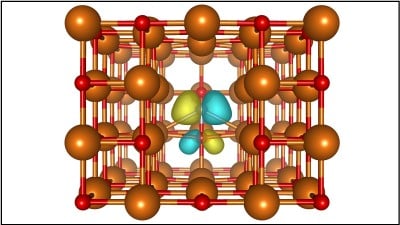
Using high-throughput screening, which evaluates candidates quickly through automated filters on a high performance computer, the team sifted through nearly 3,000 defects in magnesium oxide. Among the characteristics they looked for, two of them are of particular interest for qubits — how the defect interacts with light and the defect’s spin properties. Identifying those characteristics brought the number of potential spin defects down to 40. Of those, the team further sought defects that could be most likely synthesized experimentally. The winner: a nitrogen-vacancy center similar to the one studied in diamond. The nitrogen-vacancy center in magnesium oxide consists of a nitrogen atom (the dopant) next to a missing magnesium atom (the vacancy).
That first round of screening amounted to a low-accuracy picture of the spin defect candidate’s properties in magnesium oxide. To get a more accurate characterization, Somjit and team carried out calculations using high-level theories and open-source codes developed by the Midwest Integrated Center for Computational Materials, a computational materials science center headquartered at Argonne, funded by DOE and led by Galli.
The team performed their calculations on high performance computers at two DOE Office of Science user facilities, the Argonne Leadership Computing Facility (specifically the Polaris supercomputer) and the National Energy Research Scientific Computing Center (NERSC) at Lawrence Berkeley National Laboratory.
With these calculations, the team was able to characterize and understand the optical properties of the defect and how it interacts with the surrounding magnesium and oxygen atoms. The properties predicted through theory and computation will be useful in guiding future experimental characterization of this defect.
“Using our integrated set of software, which implements accurate electronic structure methods efficiently, we were able to elucidate the properties of a new spin qubit in a new host oxide material. We look forward to extending it to other spin defects and hosts,” Galli said.
Now that the paper’s calculations have borne out the idea that a nitrogen-vacancy center in magnesium oxide could be used as a qubit to store information, the next step is to collaborate with experimental scientists to synthesize such a qubit in the lab, Somjit said.
The research also revealed the potential to use the same computational protocol to explore other promising defects in magnesium oxide and other materials.
“We calculated several different electronic and optical properties in this study, which gave us deep insight into the magnesium oxide host and the nitrogen-vacancy qubit. But of course, this is just the start,” Somjit said. “There are many more properties that can be calculated that would lend themselves to designing better qubits in oxide materials.”
This research was supported by the U.S. Air Force Office of Scientific Research, the Midwest Integrated Center for Computational Materials, the Swedish e-science Research Centre, the Knut and Alice Wallenberg Foundation, and the Swedish Research Council. The computational resources were provided by Argonne and NERSC. The Maria Goeppert Mayer fellowship is funded through Argonne’s Laboratory Directed Research and Development program.
The Argonne Leadership Computing Facility provides supercomputing capabilities to the scientific and engineering community to advance fundamental discovery and understanding in a broad range of disciplines. Supported by the U.S. Department of Energy’s (DOE’s) Office of Science, Advanced Scientific Computing Research (ASCR) program, the ALCF is one of two DOE Leadership Computing Facilities in the nation dedicated to open science.
Argonne National Laboratory seeks solutions to pressing national problems in science and technology by conducting leading-edge basic and applied research in virtually every scientific discipline. Argonne is managed by UChicago Argonne, LLC for the U.S. Department of Energy’s Office of Science.
The U.S. Department of Energy’s Office of Science is the single largest supporter of basic research in the physical sciences in the United States and is working to address some of the most pressing challenges of our time. For more information, visit https://energy.gov/science.
https%3A%2F%2Fwww.newswise.com%2Farticles%2Fresearchers-zero-in-on-a-new-material-for-quantum-information-storage%2F%3Fsc%3Drsla