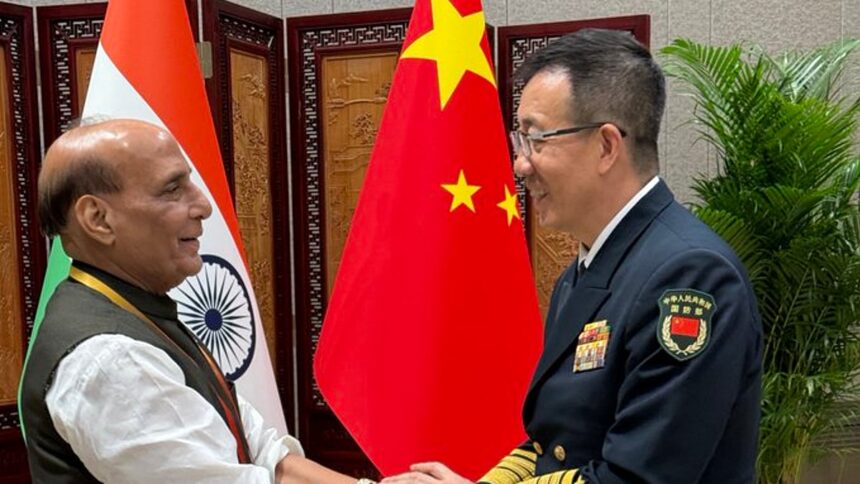
Defence Minister Rajnath Singh, during his visit to Qingdao, China, urged both India and China to avoid creating new tensions and to sustain the improving momentum in their bilateral ties. His remarks came after a constructive meeting with Chinese Defence Minister Admiral Dong Jun on the sidelines of the Shanghai Cooperation Organisation (SCO) defence ministers’ conclave, where discussions reflected cautious optimism amid historical tensions and recent progress, including the resumption of the Kailash Mansarovar Yatra and the disengagement at key border friction points.
A Cautious but Forward-Looking Engagement
Rajnath Singh’s visit to Qingdao, where he was welcomed by Admiral Dong Jun, marked a significant moment in India-China ties, with both leaders engaging in what was described as a “constructive and forward-looking exchange” on bilateral relations. Rajnath Singh emphasised that it is “incumbent on both sides” to maintain the current positive momentum while refraining from actions that could introduce “new complexities” into the relationship.
During the meeting, Rajnath Singh gifted a Madhubani painting to Admiral Dong, symbolising India’s cultural outreach during the diplomatic engagement. The Defence Minister’s message highlighted the need to maintain open channels of dialogue, particularly given the sensitivities surrounding the India-China border, where historical tensions have often overshadowed cooperation efforts.
Positive Signs After Border Disengagement
Relations between India and China, strained by previous border stand-offs, saw a thaw in 2024 when both countries completed disengagement of their troops from Depsang and Demchok in eastern Ladakh. This breakthrough has been crucial in creating an environment conducive to dialogue and has paved the way for further cooperation in regional forums such as the SCO.
Adding to these positive developments, India recently announced the resumption of the Kailash Mansarovar Yatra, which had been suspended since 2020 due to the Covid-19 pandemic. Rajnath Singh expressed his satisfaction regarding the resumption of this significant pilgrimage, underscoring its importance for people-to-people ties and regional connectivity. The first group of pilgrims is scheduled to enter China via Lipulekh Pass on July 10, with the final group returning by August 22.
Earlier, on June 23, India’s National Security Adviser Ajit Doval met with Chinese Foreign Minister Wang Yi in Beijing, where both sides underlined the need for fostering greater bilateral cooperation, including facilitating exchanges that promote stronger people-to-people relationships.
Rajnath Singh’s visit to Qingdao and his measured remarks come at a time when both countries are working to stabilise their complex relationship while navigating challenges of regional security and broader geopolitical shifts. His call to avoid adding new complexities reflects India’s cautious approach, aiming to preserve the gains achieved through hard-fought diplomatic and military negotiations, while ensuring continued engagement on unresolved issues.