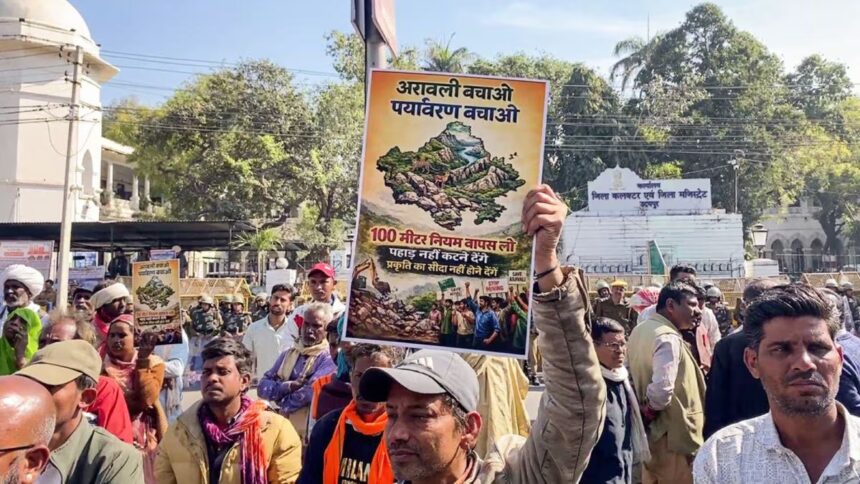
Rajasthan saw widespread protests erupt across several cities as political parties, environmentalists, and social organisations took to the streets demanding urgent protection of the Aravalli hills, turning the issue into a flashpoint marked by clashes with police, sharp political exchanges, and growing public concern over the future of the ancient mountain range.
The demonstrations unfolded simultaneously in multiple districts, reflecting how the Aravalli issue has evolved from an environmental debate into a mass political and social movement. Protesters gathered at symbolic locations, government offices, and ecologically significant sites, raising slogans and warning of long-term ecological disaster if what they described as threats to the hills were not reversed. The protests also highlighted deep divisions between the ruling establishment and opposition leaders over interpretations of recent judicial decisions and government policies affecting the Aravalli range.
Protests spread across districts as leaders warn of irreversible environmental damage
One of the most visible flashpoints of the day was Udaipur, where Congress workers and members of several social organisations assembled outside the collectorate to oppose policies they believe endanger the Aravalli hills. The protest quickly escalated into a scuffle when police attempted to control the gathering, leading to heated exchanges, sloganeering, and the detention of several activists. Barricades were erected around the collectorate as authorities tried to prevent the situation from spiralling further.
In Sikar, environmentalists and local activists climbed Harsh Parvat, a prominent peak rising around 945 metres above sea level, to draw attention to the ecological importance of the Aravalli range. The symbolic act was meant to underline the physical and environmental presence of the hills, which protesters describe as central to Rajasthan’s climate, biodiversity, and water systems. Speakers at the site warned that decisions redefining what qualifies as protected Aravalli land could expose large portions of the range to mining and commercial exploitation.
Alwar emerged as another major centre of protest, where Leader of the Opposition Tika Ram Jully described the Aravalli hills as the “lungs of Rajasthan.” He warned that any move perceived as weakening their protection would be met with sustained and intensified agitation. Jully asserted that the movement had gone beyond party politics and had become a broader public campaign involving environmentalists, farmers, and citizens concerned about the state’s future.
Similar scenes were reported from Ajmer, Jodhpur, Bhilwara, and other districts, where Congress leaders accused the government of prioritising commercial interests over ecological balance. In Jodhpur, NSUI workers climbed police barricades and refused to disperse despite repeated warnings, prompting police to use mild force to clear the area. In Ajmer, state Congress president Govind Singh Dotasra alleged that the Aravalli range was being targeted to benefit powerful interests, calling it the lifeline of Rajasthan and accusing the government of acting under pressure from illegal mining networks.
Environmentalists participating in the protests repeatedly emphasised the Aravalli hills’ role in regulating rainfall, preventing desertification, and sustaining wildlife. Speakers warned that weakening protections could have cascading effects on groundwater levels, agriculture, and regional climate patterns. Some activists invoked stark imagery, saying that if the hills were stripped away, Rajasthan could face conditions resembling extreme desert regions.
The protests also saw creative expressions of dissent. In Udaipur, a local chef carved the image of the Aravalli hills on a watermelon as part of the Save Aravalli campaign, using art to convey the fragility and beauty of the range. The gesture quickly drew attention on social media, symbolising how the movement has extended beyond conventional political protests into cultural and artistic spaces.
As the day progressed, warnings of further agitation emerged. Environmental groups in the Hadoti region announced plans to begin protests in Kota, with activists arguing that the Aravalli range supports the ecological balance of multiple states. They warned that if areas below a certain height were opened up following recent decisions, large sections of the hills could be irreversibly damaged.
Political confrontation intensifies as leaders clash over court decisions and public messaging
The protests were accompanied by a sharp political exchange between opposition leaders and ministers from the ruling establishment, turning the Aravalli issue into a major point of contention. Congress leader Sachin Pilot said the party would urge the Supreme Court to reconsider its decision, arguing that the governments of Rajasthan, Gujarat, Haryana, and Delhi are all led by the same political formation and questioning whether environmental concerns were being adequately represented.
Tika Ram Jully escalated his criticism, accusing the government of signing what he described as “death warrants” for the Aravalli range. He alleged that selective decisions had been taken that affected farmers’ land while excluding mining areas, suggesting a deliberate attempt to favour commercial interests. Jully said the people of Rajasthan might be politically naive at times but would rise to protect the hills when their survival was at stake.
Other Congress leaders echoed these sentiments. Former minister Ramlal Jat warned that environmental destruction would lead to serious health consequences for future generations, accusing the government of sacrificing natural heritage for short-term economic gains. He stressed that experts had long cautioned against disturbing the Aravalli ecosystem and said the protests were driven by environmental responsibility rather than political ambition.
In contrast, Union minister Bhupender Yadav issued a clarification, urging people not to spread confusion or misinformation about the Aravalli issue. He stated that out of the total Aravalli region, only a very small percentage was eligible for mining, asserting that the overwhelming majority of the range remained protected and safe. According to him, the Supreme Court’s decision was balanced, taking into account environmental protection, the prevention of illegal mining, and the need for development.
Water resources minister Suresh Rawat supported this position, claiming that some groups were misleading the public through social media narratives. He said assurances had been given at the highest level that the Aravalli region would be safer than ever and highlighted government efforts such as large-scale tree plantation drives. Rawat insisted that the government would not compromise on environmental protection while pursuing development.
Despite these assurances, environmentalists remained unconvinced. They argued that redefining the criteria for what constitutes protected Aravalli land could leave more than 90 percent of the hills outside the scope of conservation. Activists warned that once such land is opened to mining or construction, the damage would be permanent and impossible to reverse.
Speakers at various protest sites stressed that the Aravalli range is home to millions of animals and plant species, asking where wildlife would go if hills were cut down. They pointed out that while humans can relocate or rebuild, ecosystems cannot simply be replaced. Environmentalists also highlighted the role of the hills in influencing monsoon patterns, warning that their destruction could drastically reduce rainfall and accelerate desertification across large parts of Rajasthan.
As protests continued through the day, opposition leaders declared that the Save Aravalli movement would intensify if demands were not met. They said the issue had united political workers, environmental groups, and ordinary citizens, transforming it into a mass campaign that would not fade quietly. The government, meanwhile, maintained that protections remained in place and accused critics of misrepresenting facts for political gain.
The unfolding events underscored how environmental issues in Rajasthan are increasingly intersecting with politics, public sentiment, and questions of development. With warnings of further protests and legal challenges ahead, the Aravalli hills have become the centre of a growing confrontation that reflects broader tensions between conservation and development in one of India’s most ecologically sensitive regions.
Political clash intensifies over environment, mining, and court decisions.