The political storm in India is expected to escalate as senior Congress leader Rahul Gandhi prepares to reveal a so-called “hydrogen bomb” of voter fraud allegations. In response, the ruling BJP will launch a strong counterattack, targeting Congress spokesperson Pawan Khera for allegedly holding two active voter identification numbers. This confrontation will intensify the ongoing debate over voter list irregularities, election integrity, and political accountability, drawing nationwide attention. As both parties prepare to defend and challenge claims, the upcoming days will witness heightened scrutiny of electoral records, legal interpretations, and strategic maneuvers across national and state-level politics.
BJP Allegations Against Pawan Khera and Election Law Concerns
Senior BJP leader Amit Malviya will assert that Pawan Khera, Congress’s media and publicity head, will hold two active EPIC numbers in the New Delhi and Jangpura Assembly constituencies, raising questions about potential multiple voting violations. Photographs of voter lists from the respective constituencies will be shared widely to support these claims. Malviya will argue that Khera’s dual registration contradicts the legal requirement to hold a single active voter ID and reflects a broader pattern of electoral misconduct alleged against Congress leaders.
The BJP will emphasize that the Election Commission will be required to investigate how Khera maintains dual EPIC numbers and whether he has voted in multiple constituencies, representing a clear breach of the Representation of People Act. Malviya will further contend that Khera will conduct press conferences in Bihar to deliberately mislead voters, creating dissonance in public perception and undermining faith in India’s robust democratic system. By linking Khera’s actions to larger systemic issues, the BJP will seek to portray Congress as a party that has historically manipulated electoral processes to its advantage.
In addition, Malviya will highlight historical claims regarding Rahul Gandhi’s family, noting that Sonia Gandhi had reportedly enlisted in India’s voter list before obtaining citizenship, using this example to question Congress’s broader electoral legitimacy. These allegations will be framed within a narrative of institutional neglect and manipulation, emphasizing that multiple voter registrations and unverified claims will demand stringent scrutiny. The BJP will insist that these issues must be addressed to ensure fair elections and protect democratic integrity.
Rahul Gandhi’s Hydrogen Bomb Warning and Political Retaliation
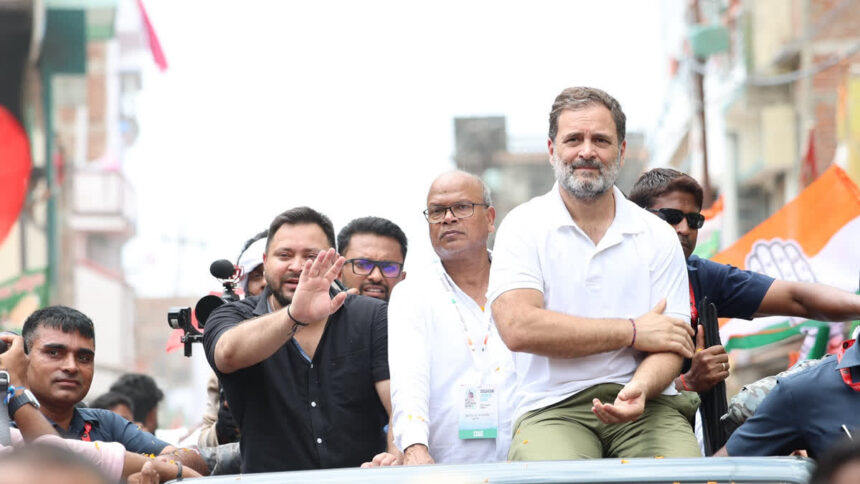
Following his yatra in Mahadevapura with allies including Tejashwi Yadav, Rahul Gandhi will warn of an impending “hydrogen bomb” of revelations regarding alleged BJP vote theft. Gandhi will claim that previous disclosures, described as an “atom bomb,” represented only a fraction of systemic irregularities. He will assert that this larger set of disclosures will expose the ruling party’s alleged collusion with election authorities, framing the narrative as a fight against entrenched political power and institutional complicity.
Congress will stress that these forthcoming revelations will target evidence of fraudulent voter registration, manipulation of electoral rolls, and irregularities in vote counting. Gandhi will argue that these revelations will clarify voter disenfranchisement and alleged abuse of administrative processes in multiple constituencies. By employing dramatic metaphors, he will aim to capture public attention and increase pressure on both state and central election authorities to act decisively.
Meanwhile, the BJP will respond by framing Gandhi’s rhetoric as politically motivated, designed to distract from legitimate questions regarding Congress’s internal compliance with electoral laws. Malviya will point out that Gandhi will not submit formal complaints under oath regarding previous allegations in Mahadevapura or Maharashtra, framing these past cases as dismissed by the Supreme Court or lacking substantive legal basis. By juxtaposing Gandhi’s dramatic claims with procedural inaction, the BJP will reinforce its narrative of Congress employing theatrics rather than adhering to legal norms.
The BJP will also project that Congress’s broader campaign of alleging “vote chori” will face increasing skepticism as administrative scrutiny intensifies. Both parties will likely escalate their campaigns through social media platforms, public rallies, and regional press engagements to influence public perception. With voter rolls, electoral laws, and accountability processes under the microscope, India’s electorate will be expected to witness a high-stakes contest of political narratives, legal interpretations, and strategic posturing over the coming weeks.
The Congress, for its part, will maintain that the BJP has historically exploited state mechanisms to distort voter records, aiming to suppress opposition votes and consolidate political power. Gandhi’s forthcoming disclosures will be framed as a corrective measure to restore electoral fairness and public confidence. By combining data-backed allegations with strategic communication, Congress will plan to present its case to the electorate, asserting that a robust investigation will validate claims of widespread voter manipulation.
As the debate unfolds, Pawan Khera will prepare to respond to BJP allegations regarding his voter registration, asserting that he had formally applied to surrender his old EPIC number upon acquiring a new voter card. Congress sources will emphasize that this procedural compliance will clarify the legal status of Khera’s registrations, framing the BJP’s allegations as politically opportunistic. This exchange will underscore the complex interplay between administrative procedures, electoral laws, and political messaging in contemporary Indian politics.
Overall, the coming days will witness heightened media attention, legal scrutiny, and public debate around voter list management, political accountability, and the broader implications of high-profile electoral allegations. Both parties will leverage the unfolding narrative to influence voters, shape public discourse, and fortify strategic positions ahead of upcoming elections. The combination of dramatic political rhetoric, legal interpretations, and procedural clarifications will define the trajectory of this intense political confrontation, signaling that India’s electoral landscape will remain highly dynamic and closely watched.