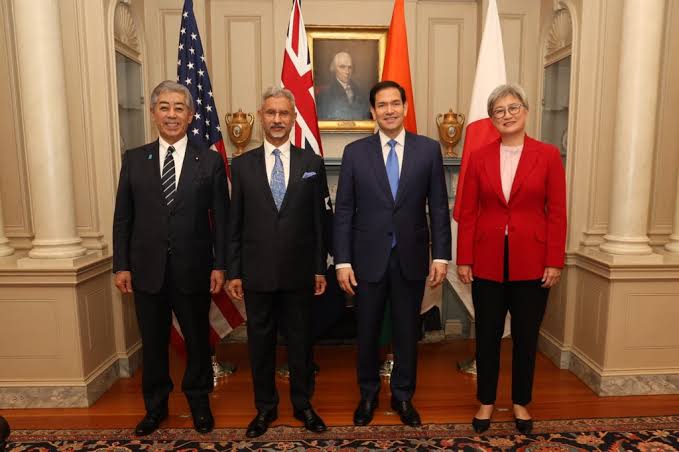
In a strong diplomatic backing for India, the Quad foreign ministers have jointly condemned the April 22 terror attack in Pahalgam, Jammu and Kashmir, where 26 civilians lost their lives, calling for immediate action to bring the perpetrators to justice. The statement, issued after their meeting in Washington, also reaffirmed the Quad’s commitment to fighting cross-border terrorism and violent extremism, underscoring the need for global cooperation in addressing such threats to peace and security.
Quad’s Strong Message on Terrorism
The joint statement by the foreign ministers of India, the United States, Japan, and Australia condemned the “reprehensible” attack and urged that the perpetrators, organisers, and financiers of the attack be held accountable without delay. The ministers called upon all United Nations member states to fulfil their obligations under international law and relevant UN Security Council resolutions by actively cooperating with authorities investigating the attack.
Expressing their condolences to the families of the victims and wishing a swift recovery to those injured, the Quad reiterated its stance against all forms of terrorism, including cross-border terrorism, while renewing its commitment to counterterrorism cooperation as a core element of its agenda. The foreign ministers’ strong condemnation signals a united approach to counterterror efforts, particularly in the South Asian region, where India has consistently raised concerns about cross-border terrorism.
India’s Stand and Operation Sindoor
During the meeting, India’s External Affairs Minister S Jaishankar highlighted India’s recent counterterrorism operations, including ‘Operation Sindoor’ launched in response to the Pahalgam attack. The operation, conducted on May 7, targeted nine terror infrastructure sites across Pakistan and Pakistan-Occupied Kashmir with precision strikes, signalling India’s intent to respond firmly to acts of terror emanating from across the border.
S Jaishankar emphasised that the world must adopt a zero-tolerance policy on terrorism, asserting that victims and perpetrators should never be equated and that India would exercise its right to defend its people against terrorism. He also underscored that India expects its Quad partners to understand and appreciate this position.
In the backdrop of these discussions, S Jaishankar met US Secretary of State Marco Rubio separately on the sidelines of the Quad meeting to discuss key elements of the India-US strategic partnership and to exchange views on global and regional developments. Their talks reflected the alignment of both countries on security concerns, including the need for stronger counterterrorism cooperation and shared strategies to address emerging threats in the Indo-Pacific region.
The Pahalgam attack, where terrorists opened fire at tourists in the Baisaran meadow area, killing 26 and injuring several others, was linked to Pakistan-based terror groups, according to ongoing investigations. In response to India’s operation, Pakistan retaliated with drone and artillery strikes on Indian positions in Jammu and Kashmir and Punjab, to which India responded with counterstrikes, eventually leading to Islamabad seeking a ceasefire.
As the Quad continues to strengthen its position on counterterrorism, its unequivocal condemnation of the Pahalgam attack and demand for accountability are seen as a significant diplomatic win for India, reinforcing its call for global cooperation in tackling terrorism while ensuring justice for the victims of such attacks.