In a sobering turn of events, India’s camel population is rapidly diminishing, with a controversial law intended to protect the animals instead exacerbating their decline. This paradoxical situation is deeply troubling to camel keepers, conservationists, and local communities who once thrived on the camel trade. What was once a thriving aspect of rural life in Rajasthan, India’s desert state, is now facing severe repercussions due to government regulations.
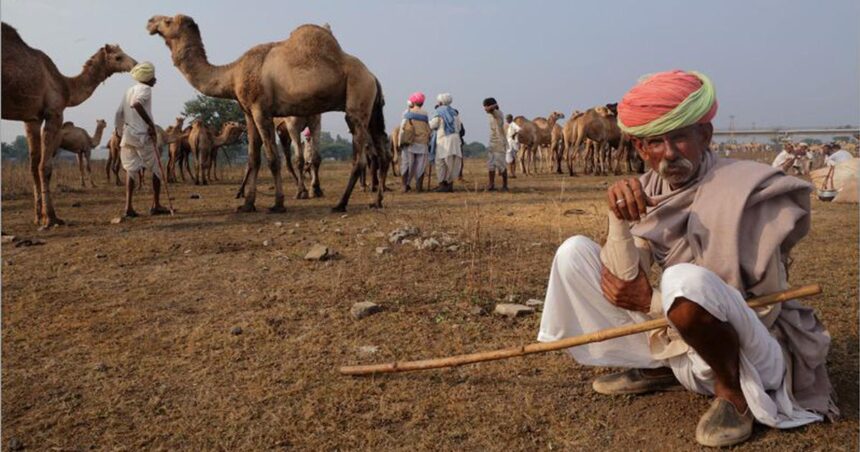
Jeetu Singh, a 65-year-old camel keeper from Jaisalmer, Rajasthan, stands with a melancholic expression as he watches his herd graze under the sun. Singh, who has been tending camels since his youth, has witnessed a dramatic reduction in the number of camels his family owns. His once-thriving herd of over 200 camels has now dwindled to a mere 25. “Rearing camels was no less than a competitive affair when we were children,” Singh recalls. “I used to think my camels should be more beautiful than those reared by my peers.” The camels were adorned with mustard oil and colorful beads, and they would traverse the desert landscapes in picturesque symmetry. But now, Singh finds little joy in his remaining camels, as their economic value has sharply diminished. “I only keep camels now because I am attached to them. Otherwise, there is no financial benefit,” he adds.
Globally, the camel population has been steadily rising. According to the Food and Agriculture Organization (FAO) of the United Nations, camel numbers worldwide have surged from about 13 million in the 1960s to over 35 million today. This rise has brought attention to camels’ role in the lives of millions of people across more than 90 countries. However, in India, the situation is starkly different. The camel population has plummeted dramatically, from nearly 1 million in 1961 to approximately 200,000 today, with Rajasthan seeing a particularly sharp decline.
The 2007 livestock census revealed that Rajasthan had about 420,000 camels, but by 2012, that number had dropped to 325,000, and by 2019, only 210,000 camels remained in the state—a 35% reduction in just seven years. This decline is most acutely felt in rural areas, where the camel was once an essential part of life. In villages like Anji Ki Dhani, where there were over 7,000 camels in the 1990s, only 200 camels remain today. In the Barmer district’s Dandi village, camel keeper Bhanwarlal Chaudhary has seen his herd shrink from 150 camels to just 30 over the last two decades. “Camels are connected to the language of our survival, our cultural heritage and our everyday life,” Chaudhary says. “Without them, our language, our being has no meaning at all.”
One of the most significant contributors to this decline is the Rajasthan Camel (Prohibition of Slaughter and Regulation of Temporary Migration or Export) Act, passed by the state government in 2015. The law, which prohibits the transport, illegal possession, and slaughter of camels, was framed with the intention of protecting the animal and boosting its population. However, it has instead dealt a devastating blow to the camel trade.
The law was introduced under the Bharatiya Janata Party (BJP)-led government, which claimed that the practice of camel slaughter had led to a sharp decrease in their numbers. While the law aimed to stop the slaughter of camels, it unintentionally harmed camel breeders by criminalizing the sale and transport of camels. “Even decorating them could amount to causing them harm,” says Chaudhary, explaining how the law’s broad and ambiguous language has made even everyday camel care an offense.
Under the law, breeders are subject to imprisonment ranging from six months to five years and fines between 3,000 rupees ($35) and 20,000 rupees ($235) if they are found guilty. The law also turns traditional camel markets into illegal venues, as traders selling camels become labeled as “smugglers.” The law assumes that the slaughter of camels is the primary cause of their decline, but experts like Chaudhary argue that the loss of traditional markets for camels has had a far more detrimental effect.
Before the law came into effect, camel breeders would sell their camels in fairs like the ones held in Pushkar, Nagore, and Tilwara, where the animals fetched between 40,000 to 80,000 rupees ($466 to $932). But once the law was enforced, the price of camels plummeted, and breeders could only sell their camels for as little as 500 to 1,000 rupees ($6 to $12). The sudden drop in price and the legal constraints on selling camels left breeders with no incentive to continue their profession.
Ecologist Sumit Dookia, who teaches at a university in New Delhi, questions why the camel population is still shrinking despite the law designed to protect them. The answer, according to camel experts like Chaudhary and Sadri, lies in the loss of camel markets and the lack of financial viability for camel keepers. “Without a market or a fair price, keeping such huge animals is not an easy task,” says Sadri. The situation has worsened with the fear that, in an atmosphere of increasing anti-Muslim sentiment under the BJP government, the primarily Muslim buyers of camels at fairs like Pushkar now risk being targeted.
The political climate, marked by rising incidents of lynching and mob violence against Muslims and Dalits over allegations of cow slaughter, has made camel breeding a highly risky endeavor. “Given such a situation, why will there be a buyer?” asks Chaudhary. The fear of legal repercussions, combined with the lack of a proper market, has driven buyers away.
While former Minister Maneka Gandhi, who pushed for the law, insists that the law has had no negative effects and blames the continued smuggling of camels, others, including retired bureaucrat Narendra Mohan Singh, acknowledge that the law’s unintended consequences were only realized after it was enacted. Singh, who was involved in drafting the law, explains that it was hastily formulated without proper consultation with camel breeders. “A law meant to protect camels ended up doing the opposite,” he admits.
Amir Ali, an academic at Jawaharlal Nehru University, also criticizes the law for its lack of understanding of the complexities of livestock herding. “The excessive concern that Hindu politics expresses towards animals ends up demonizing and dehumanizing groups like Dalits and Muslims,” he says.
As the sun sets in Jaisalmer, Jeetu Singh reflects on the future of his camels. With the population of camels dwindling and the law still in place, he wonders if the next generation of camels will ever thrive in Rajasthan. Conservationists like Sadri and Singh are not optimistic. Sadri predicts that the camel, much like the dinosaurs, may eventually disappear from India if the situation continues. Singh shares a similarly grim outlook, stating, “If not extinct, it will eventually become a zoo animal.”
As the camel population continues to decline in Rajasthan, the once-thriving camel trade seems poised to become a part of history, driven into extinction by a law meant to save them.