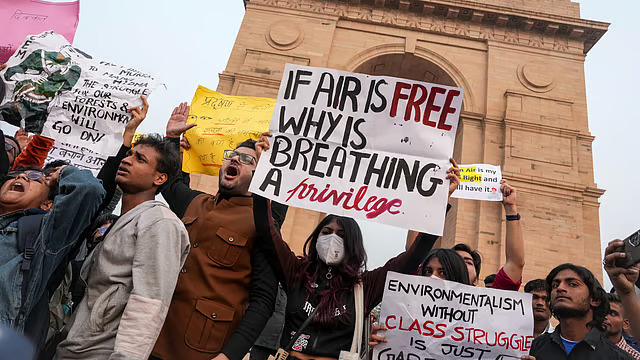
The shocking appearance of posters featuring slain Naxal commander Madvi Hidma at India Gate during an anti-pollution protest triggered chaos, clashes with police and a wave of political and security concerns across Delhi on Sunday evening. What began as a demonstration over deteriorating air quality escalated into a volatile confrontation, raising troubling questions about extremist symbolism appearing at a high-security public space amid a civic protest.
Hidma Posters and Slogans Turn Peaceful Protest into a Security Flashpoint
The events unfolded when a group of demonstrators displayed large posters of Madvi Hidma, one of India’s most wanted and feared Naxal commanders, killed recently in an encounter with security forces. The posters drew immediate attention as they portrayed Hidma not as a militant leader responsible for deadly insurgent attacks, but as a “protector of water, forests and land,” drawing a controversial comparison to tribal freedom fighter Birsa Munda. This provocative framing marked a dramatic shift in the narrative traditionally associated with Hidma, whose decades-long involvement in Maoist operations left a trail of bloodshed across central India.
Witnesses stated that slogans such as “Madvi Hidma Amar Rahe” and “Madvi Hidma Ko Lal Salaam” echoed through the protest site as participants attempted to link environmental struggles with alleged resistance movements in forest regions. One of the posters declared, “From Birsa Munda to Madvi Hidma, our forest and environment struggle will continue,” an assertion that police officials said risked glorifying an outlawed extremist ideology under the guise of environmental activism.
The situation rapidly deteriorated when police moved in to disperse the swelling crowd after reports emerged that protesters had blocked the movement of ambulances and emergency medical teams near the C-Hexagon area. According to officials, the crowd became aggressive during the intervention, provoking a physical scuffle. In an unprecedented act, some demonstrators allegedly used chilli powder spray directly on law-and-order personnel, injuring at least three to four officers. This marked the first time such a tactic had been used against police in Delhi, according to senior officers.
Delhi Police quickly registered multiple FIRs across two police stations and launched an identification drive using CCTV footage. As of late Sunday night, 22 individuals had been detained. The authorities described the incident as a “grave security breach” and “an attempt to hijack a public protest,” raising concerns that groups unaffiliated with the environmental movement may have infiltrated the demonstration.
The Shadow of Hidma’s Legacy and the Intensifying Debate Around Naxal Symbolism
Madvi Hidma, who carried a reward of ₹1 crore, was widely considered one of the most dangerous Maoist commanders in the country. His influence extended across Chhattisgarh’s Bastar region, where he operated for nearly twenty-five years and became the alleged mastermind of at least twenty-six major Naxal attacks. Investigations over the years have linked him to high-profile ambushes and coordinated Maoist offensives against Indian security forces, making him one of the most feared figures in the insurgent hierarchy.
His death in an encounter on November 18 in Andhra Pradesh’s Alluri Sitarama Raju district marked a significant achievement for counter-insurgency forces, who had been tracking him for years using intelligence networks, aerial surveillance and coordinated state-level operations. Officials described his killing as a major setback to the Maoist movement, particularly its operational capacities in the deep forests of Bastar.
However, Hidma has also remained a deeply polarizing figure, especially among certain tribal communities who claim he symbolized resistance against exploitation of forest resources. Security officials maintain that such narratives romanticize an armed insurgency that has led to the deaths of both civilians and personnel, while analysts warn that projecting Hidma as an environmental defender risks creating dangerous ideological overlaps between extremism and socio-environmental activism.
The sudden appearance of Hidma’s posters in the heart of the national capital, especially at a location as iconic and sensitive as India Gate, has amplified these concerns. Given the monument’s long-standing association with national martyrs and military remembrance, police officials said the presence of posters glorifying a militant leader amounted to a highly sensitive provocation.
The slogans raised—“Hidma Amar Rahe” and “Lal Salaam”—have historically been associated with Maoist movements. Their sudden re-emergence during a civilian protest in Delhi has triggered alarm among intelligence agencies, who now fear attempts to revive Naxal symbolism in urban settings by linking it to mainstream public issues such as pollution or environmental degradation.
New Delhi DCP Devesh Kumar Mahla confirmed to reporters that the use of chilli spray was unprecedented and posed a threat to both civilian and police safety. Injured personnel are undergoing treatment at the Ram Manohar Lohia Hospital. Senior officials are now examining whether the protest was organized with hidden intentions or was hijacked mid-way by extremist-sympathetic groups.
Delhi Police sources revealed that surveillance teams are reviewing hours of footage from CCTV networks, mobile recordings and traffic cameras near India Gate to identify those responsible for carrying and distributing the posters. Several seized materials are being sent for forensic analysis, while specialized units are examining whether the language and imagery used resemble known Maoist propaganda templates.
The unexpected convergence of environmental activism and radical symbolism at the protest also raises questions about the vulnerability of civic movements to ideological infiltration. Experts argue that while India’s environmental crisis warrants urgent attention, the blending of extremist narratives with legitimate grievances risks delegitimizing public movements and complicating policy responses.
Escalating Air Pollution Crisis Pushes Delhi Into a Health Emergency as Civic Anger Mounts
Even as the controversy over the protest intensifies, Delhi’s air pollution crisis continues to deepen, pushing the capital into what health experts describe as a severe public health emergency. The Delhi Coordination Committee for Clean Air, which has been issuing repeated warnings about pollution levels, stated that the city’s declining air quality constitutes an immediate threat to human life. Committee members criticized authorities for implementing short-term measures such as water sprinkling, cloud seeding trials, and misting devices near AQI monitoring stations, claiming that these steps have little long-term impact.
Delhi’s air quality has deteriorated sharply in recent weeks, culminating in an alarming Air Quality Index (AQI) reading of 506 on November 20—an extremely hazardous level that far exceeds safe limits. According to global air-quality tracking data, Delhi ranked as the most polluted city in the world on that day, surpassing other densely populated urban centers that often struggle with severe smog.
The toxic air has triggered a surge in respiratory cases across hospitals in the National Capital Region. Doctors report a steep rise in patients suffering from asthma attacks, severe bronchitis, viral lung infections and pollution-triggered cardiac complications. Physicians have warned that sustained exposure to AQI levels above 500 can cause irreversible lung damage, especially among children, the elderly and individuals with pre-existing health conditions.
Other Indian metros have fared poorly as well. Kolkata recorded an AQI of 211, placing it in the “very unhealthy” category, while Mumbai—usually less affected by northern smog—logged an AQI of 160, ranking it ninth globally among the most polluted cities on the same day. Environmentalists argue that this trend signifies a nationwide escalation of air-quality degradation, especially in densely populated cities with expanding construction activity, vehicular emissions and industrial output.
The Delhi Coordination Committee for Clean Air stated that the government must shift focus from temporary solutions to long-term reforms, including stricter emissions standards, urban reforestation, decentralized waste management, and improved public transport networks. Critics have accused successive administrations of responding to pollution spikes with symbolic gestures instead of structural policy changes.
As pollution levels remain dangerously high, the city’s health infrastructure faces mounting pressure. Hospitals are witnessing a rise in both outpatient and emergency respiratory cases. Several private facilities report shortages in respiratory support devices due to increased demand. Public health experts have urged residents to minimize outdoor activity, use medically approved masks and deploy air purifiers if possible, while also appealing to the government for immediate large-scale interventions.
Meanwhile, officials have begun investigating whether the anti-pollution demonstration at India Gate—initially intended to highlight this very air crisis—was deliberately disrupted or opportunistically exploited to push a different narrative. The convergence of environmental anger, public health concerns and unexpected extremist symbolism has created a complex situation with far-reaching social and security implications.
The Delhi air crisis, intertwined with the shocking events at India Gate, underscores the increasingly volatile intersection of public dissent, environmental urgency and ideological infiltration. The situation continues to evolve as authorities investigate the protest, treat injured officers and attempt to manage one of the worst pollution phases the capital has witnessed in recent years.