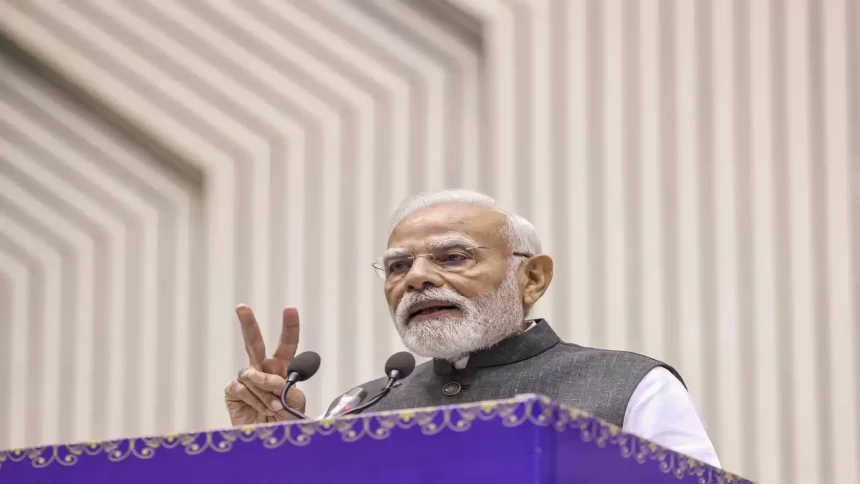
Prime Minister Narendra Modi marked a significant milestone on Tuesday, completing 25 years in public office. In a reflective social media post, he recalled the momentous morning of October 2001 when he took the oath as the Chief Minister of Gujarat, stepping into public governance for the first time. Modi’s journey from a surprise choice for Gujarat’s top post to the Prime Minister of India has been defined by ambitious reforms, developmental initiatives, political challenges, and public scrutiny. On that day, the state was still recovering from the devastating Bhuj earthquake, political instability was rife, and Modi, a lifelong RSS member with no prior public office experience, assumed leadership amid high expectations and urgent administrative needs. His mother’s simple advice—serve the poor and avoid corruption—remained a guiding principle throughout his career.
The Gujarat Years: Reconstruction, Innovation, and Controversy
Modi’s early tenure as Gujarat’s Chief Minister was shaped by crisis management and the rebuilding of a state reeling from natural disasters. Villages faced routine power shortages, agriculture suffered from irregular rainfall and salinity in groundwater, and industrial recovery was slow following the earthquake. Modi immediately prioritized field visits across affected districts, ensuring direct oversight of relief operations and reconstruction efforts. These initial months set the foundation for the administrative framework later identified as the “Gujarat model,” emphasizing centralized governance, infrastructure expansion, and investor-friendly policies.
Programs like the Jyotigram Yojana and Sujalam Sufalam were pioneering in their approach. The Jyotigram initiative separated electricity supply for agricultural and rural household use, ensuring uninterrupted power for homes, while Sujalam Sufalam focused on recharging groundwater through check dams, canals, and rainwater harvesting networks. Both schemes became templates for national-level programs like Saubhagya and Jal Jeevan Mission. Industrial policies were revamped quietly but effectively, with the first Vibrant Gujarat Summit in 2003 serving as a modest yet influential platform for attracting global investors. Ports along the Kutch and Saurashtra coasts were modernized, special economic zones were notified, and industrial corridors were mapped, enabling a transformation in the state’s economic profile.
Despite these achievements, Modi’s Gujarat tenure was marked by one of India’s most tragic episodes of communal violence. The Godhra train coach burning in February 2002 triggered riots that claimed over a thousand lives, predominantly from minority communities. The administration’s handling of these events became a national debate for years, with Modi eventually being cleared of wrongdoing by the Supreme Court. Nevertheless, the episode left an indelible mark on his political journey and shaped public perception alongside his developmental narrative.
By 2011, Gujarat had achieved one of the highest growth rates among Indian states. Power supply had stabilized, industrial investment deepened, and transportation infrastructure expanded. Roads, ports, and industrial hubs had transformed the state’s landscape, enabling it to emerge as a self-confident and efficient economy. These successes set the stage for Modi’s elevation as the Bharatiya Janata Party’s Prime Ministerial candidate in 2013, at a time when the nation was grappling with trust deficits, governance crises, and corruption scandals. Campaigning with the promise of reform and economic growth under the slogan “Acche Din Aane Wale Hain,” Modi’s political trajectory positioned him as an outsider capable of transforming the national governance landscape.
National Leadership: Structural Reforms, Global Engagement, and Socio-Economic Initiatives
After the 2014 election, Modi’s administration embarked on a series of structural reforms that reshaped India’s economic and administrative landscape. Demonetization in 2016 sought to address unaccounted money, while the Goods and Services Tax, launched in 2017, unified the indirect taxation system, replacing a fragmented structure of state and central levies. The Aadhaar system, originally introduced under the previous government, was expanded to link millions of citizens with banking, welfare, and subsidy schemes. The Jan Dhan Yojana further brought unbanked populations into the financial system, creating the “JAM trinity” of Jan Dhan, Aadhaar, and mobile connectivity for direct benefit transfers.
Modi’s second term, beginning in 2019, coincided with pivotal political and administrative developments, including the revocation of Jammu and Kashmir’s special status and the introduction of the Citizenship Amendment Act. The COVID-19 pandemic posed an unprecedented challenge, testing administrative efficiency through nationwide lockdowns and one of the world’s largest vaccination campaigns. Modi emphasized poverty reduction and economic self-reliance, noting that over 25 crore people had been lifted from poverty and that India was emerging as a resilient economy with a self-reliant agricultural and industrial sector.
On the international stage, Modi’s leadership sought to position India as a key voice of the Global South. Hosting the G20, championing renewable energy initiatives such as the International Solar Alliance, and strengthening bilateral and multilateral relations became central to India’s global strategy. At the same time, his tenure has been marked by political criticism, including allegations of shrinking democratic space, targeting of political opponents, and consolidation of executive authority.
Throughout his 25-year journey, Modi has framed governance as a duty intertwined with gratitude and purpose. His focus on constitutional values, policy-driven reform, and developmental priorities has guided his approach across state and national leadership roles. In his social media message, he emphasized that serving the nation is “the highest honour,” reinforcing the importance of public service, policy vision, and collective national development. The journey reflects not only administrative milestones but also the complexities of navigating political controversies, implementing ambitious reforms, and shaping India’s trajectory in the 21st century.
From the earthquake-stricken districts of Gujarat to international summits, Modi’s career has been characterized by a blend of infrastructural development, socio-economic innovation, and political strategy. Programs initiated at the state level have often scaled to national schemes, underscoring his approach of using regional experiments to inform broader policy. Economic growth, financial inclusion, infrastructure expansion, and administrative centralization have remained consistent pillars, even as India faced diverse challenges, from natural disasters to pandemics and complex socio-political dynamics.
Modi’s narrative emphasizes the link between governance and citizen welfare. Policy initiatives aim to address both structural issues, such as energy distribution and water conservation, and socio-economic inclusion, such as financial accessibility and poverty reduction. His tenure demonstrates the interplay between state-level innovation and national-level policymaking, reflecting an evolution from pragmatic governance in Gujarat to strategic leadership on the world stage.
Over the years, Modi’s leadership has combined technological adoption, financial reform, and infrastructural development. Initiatives like digitization of governance, biometric identification, and integration of financial systems have sought to make administration more efficient, transparent, and accountable. Internationally, the focus has been on enhancing India’s role in global economic, environmental, and diplomatic spheres. Domestically, economic growth, poverty alleviation, and infrastructural development have remained central to the narrative of progress.
Modi’s reflections on completing 25 years in public service highlight a trajectory defined by ambition, challenges, reforms, and strategic leadership. His journey underscores the transformation of Gujarat under his leadership, the subsequent national reforms as Prime Minister, and India’s evolving role on the global stage. Through social media messages and public engagement, Modi has consistently communicated a vision of development, self-reliance, and governance reform, projecting a narrative of India moving toward a developed and prosperous future.
This 25-year journey from a first-time Chief Minister to the Prime Ministership encapsulates not only the personal and political evolution of Narendra Modi but also reflects India’s economic, administrative, and international growth over the last quarter-century. The trajectory underscores the balancing act between development, political challenges, public perception, and policy innovation, illustrating a leadership style focused on results, governance reform, and national progress.