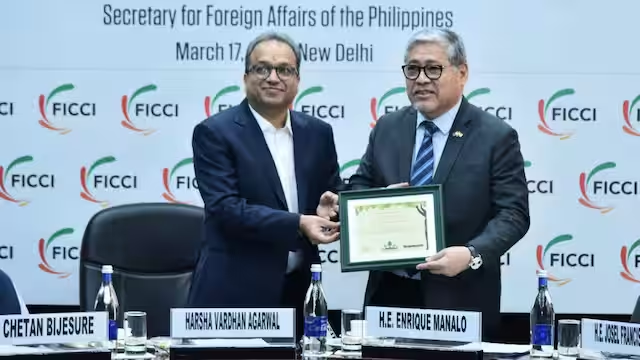
The Philippines is positioning itself to become a key supplier of nickel to India as part of its broader export diversification strategy. With the country accounting for 11% of global nickel production and ranking as the second-largest producer of the commodity in 2023, Filipino officials are keen to expand their market beyond traditional Chinese buyers. Foreign Minister Enrique Manalo emphasized that India, which currently sources nickel from nations like Russia, Norway, and Japan, stands to benefit from a more diversified supply chain—especially as it seeks to boost battery production for electric vehicles.
Manalo noted that the Philippines is the world’s largest exporter of nickel ore, with exports valued at approximately $1.95 billion, largely used in manufacturing lithium-ion batteries. “Nearly 98% of our nickel exports go to China, with Japan receiving the remaining portion. We are very interested in having India as a partner in our nickel sector, not just to diversify our export markets, but also to help build a value chain through processing and development,” he stated.
At a recent interaction with the Federation of Indian Chambers of Commerce and Industry (FICCI), Manalo also underscored the importance of accelerating negotiations for a preferential trade agreement (PTA) between the Philippines and India. This agreement is expected to deepen engagement across various sectors including automobiles, battery production, value-added IT and ITES services, pharmaceuticals, healthcare, and agriculture. Such a framework would not only streamline trade but also enhance economic cooperation between the two nations.
India has been actively pursuing measures to ramp up its battery production as part of a larger push towards green energy and the adoption of electric vehicles. With China dominating the global supply of critical minerals needed for batteries, India’s strategy to secure alternative sources is gaining momentum. In this context, a partnership with the Philippines could serve as a natural complement, ensuring a steadier supply of competitively priced nickel essential for India’s energy transition.
The proposed collaboration is seen as mutually beneficial: the Philippines would reduce its heavy reliance on Chinese markets, while India gains access to a vital resource at a time when its demand for battery components is surging. Moreover, negotiations for the PTA could pave the way for broader commercial ties, boosting bilateral trade and fostering greater industrial synergy between the two economies.
As discussions continue, both nations remain optimistic about the potential for a long-term strategic partnership that could transform the global nickel supply landscape and accelerate the shift towards sustainable energy solutions.