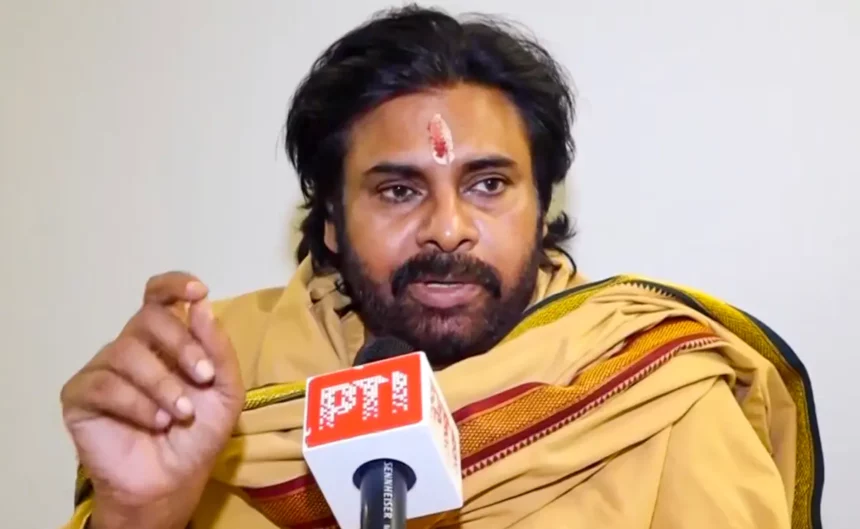
Amid the ongoing language controversy between the Union government and Tamil Nadu, Janasena Party chief and Andhra Pradesh Deputy Chief Minister Pawan Kalyan has underscored the importance of linguistic diversity in India. Speaking at his party’s foundation day event on Friday, Pawan Kalyan asserted that India needs multiple languages, including Tamil, rather than being limited to just two.
Addressing party workers in Pithapuram, Kakinada district, Pawan Kalyan emphasized that embracing linguistic diversity is crucial not only for maintaining national integrity but also for fostering unity among citizens. His remarks come at a time when Tamil Nadu Chief Minister MK Stalin has strongly opposed the Union government’s alleged push for Hindi, rejecting the National Education Policy (NEP)’s three-language formula.
Without directly naming any political party, Pawan Kalyan took a veiled jab at Tamil Nadu’s Dravida Munnetra Kazhagam (DMK), accusing its leaders of hypocrisy. He pointed out that while Tamil Nadu politicians resist Hindi, they readily allow Tamil films to be dubbed in Hindi for commercial success.
“I do not understand why some criticize Sanskrit. Why do Tamil Nadu politicians oppose Hindi while benefiting financially from dubbing their movies in Hindi? They want Bollywood’s money but refuse to accept Hindi—what kind of logic is that?” Pawan Kalyan questioned.
The language debate has been a long-standing issue in Tamil Nadu, where political leaders have strongly resisted the imposition of Hindi. The DMK has consistently opposed the three-language formula proposed by the NEP, arguing that Tamil Nadu students should not be forced to learn Hindi. However, critics like Pawan Kalyan argue that the stance is inconsistent, given the widespread use of Hindi-dubbed Tamil content in the entertainment industry.
On the same day, Tamil Nadu BJP President K Annamalai reiterated the party’s stance on language policy, stating that while people of Tamil Nadu do not want a third language forced upon them, many are open to learning one voluntarily. He cited a petition signed by over 14 lakh people supporting the idea of an optional third language.
K Annamalai also accused the DMK of double standards, pointing out that private schools run by DMK leaders offer Hindi as a third language, while government schools under their administration do not.
“People are willing to learn an optional third language. Tamil Nadu is ready for this, but the DMK is not. Their own private schools teach Hindi, but government school students are deprived of this choice,” K Annamalai said.
The language debate continues to be a sensitive issue in Tamil Nadu, with both political and cultural implications, fueling discussions on linguistic identity and educational policies.