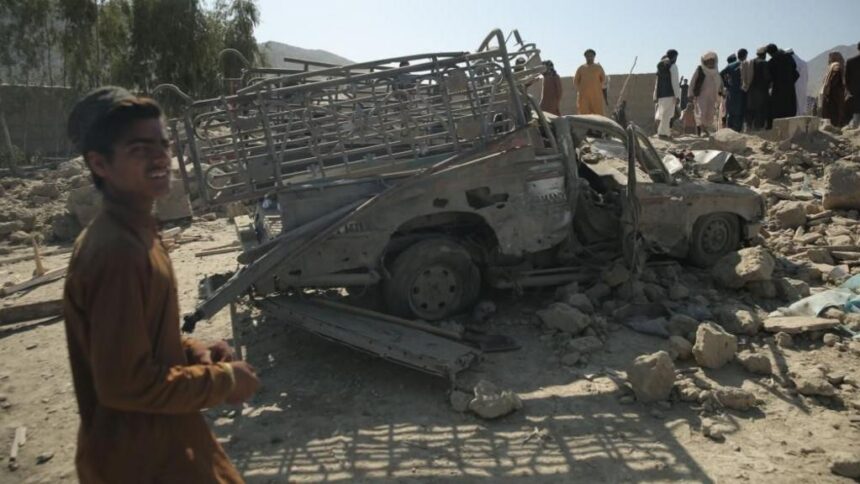
Pakistan carried out strikes on the Afghan cities of Kabul and Kandahar in the early hours of Friday, marking a sharp escalation in cross-border hostilities with the Afghan Taliban. The development follows days of mounting tension along the volatile frontier, with both sides accusing each other of initiating attacks and inflicting heavy casualties. The renewed violence has raised concerns about the collapse of a fragile ceasefire agreed in October after previous deadly clashes.
Pakistani government officials described the strikes as “counter strikes” carried out in response to what they called unprovoked Afghan attacks on military positions inside Pakistan. According to Islamabad, the Afghan Taliban had launched operations targeting security installations in the north-western province of Khyber Pakhtunkhwa late on Thursday. Pakistan said two soldiers were killed and three others injured in the exchange of fire, prompting what it termed an immediate and effective response.
Residents in Kabul reported hearing loud explosions across the city during the night, while similar blasts were reported in Kandahar. Although precise details of the targets remain unclear, the strikes signal an expansion of the conflict beyond border skirmishes into major Afghan urban centres. The Afghan Taliban acknowledged renewed fighting along the shared frontier, stating that its forces had launched retaliatory operations against Pakistani troops.
The Taliban’s chief spokesperson Zabihullah Mujahid claimed that its offensive had killed numerous Pakistani soldiers and captured others. He also alleged that several Pakistani military posts had been seized during the operation. These claims were swiftly denied by Pakistani officials, who rejected assertions of territorial losses and disputed reports of captured positions.
A spokesperson for Pakistan’s prime minister dismissed allegations of damage to Pakistani military infrastructure and maintained that any aggression would receive an immediate response. Pakistan’s Ministry of Information and Broadcasting stated that early reports indicated heavy casualties on the Afghan side, along with the destruction of multiple posts and equipment.
The current escalation comes just months after both countries agreed to a ceasefire in October following intense cross-border clashes. That truce, while reducing large-scale confrontations, did not fully eliminate sporadic exchanges of fire. The frontier between Pakistan and Afghanistan has long been a flashpoint, shaped by security concerns, militant activity, and political mistrust.
Taliban military spokesman Mawlawi Wahidullah Mohammadi said the latest operation had begun around 20:00 local time on Thursday as a response to earlier Pakistani strikes this week, which Kabul claimed had killed at least 18 people. Islamabad said those earlier operations targeted militant camps and hideouts believed to be linked to attacks inside Pakistan.
The narrative from both sides underscores a cycle of accusation and retaliation. Pakistan argues that militant groups operating from Afghan territory have carried out attacks on its soil, including recent suicide blasts. Afghan authorities, in turn, accuse Pakistan of violating Afghan sovereignty through air strikes and cross-border incursions.
In Pakistan’s border regions, particularly near the town of Torkham, residents reported hearing heavy exchanges of fire. Authorities advised civilians to move to safer areas as security forces responded to the escalating violence. The Torkham border crossing, a critical trade and transit point, was closed amid the clashes. Officials also suspended the repatriation of deported Afghan nationals through the crossing, citing safety concerns.
The closure of the border has immediate humanitarian and economic implications. Thousands of people rely on the crossing for daily trade, travel, and access to services. Any prolonged disruption could exacerbate economic strain in already fragile communities along both sides of the frontier.
The escalation also unfolds against a broader regional backdrop of instability. Pakistan has repeatedly expressed concerns about militant groups using Afghan territory as a base for attacks. The Afghan Taliban, which returned to power in 2021, has denied allowing its territory to be used against neighbouring states but has struggled to fully address Islamabad’s security complaints.
Diplomatic channels between the two governments have remained active in recent months, though progress has been uneven. The October ceasefire was seen as a tentative step toward stabilising the border, yet the latest violence suggests underlying tensions remain unresolved. Each flare-up risks undermining efforts at confidence-building and deepening mistrust.
Security analysts note that cross-border operations carry significant risks, particularly when conducted near densely populated urban centres. Civilian casualties, even if unintended, can inflame public sentiment and complicate diplomatic engagement. Both governments have emphasised their right to defend territorial integrity, but the escalation raises questions about proportionality and long-term strategy.
The Pakistani government has stated that it will take all necessary measures to safeguard its citizens and territorial integrity. Afghan officials, meanwhile, have framed their actions as defensive responses to repeated violations. The exchange of strong rhetoric alongside military action reflects the high stakes involved for both administrations.
As the situation evolves, regional actors and international observers are closely monitoring developments. Stability along the Pakistan-Afghanistan border is critical not only for bilateral relations but also for broader regional security. Trade routes, refugee movements, and counterterrorism cooperation are all affected by the trajectory of the conflict.
For residents living near the frontier, the immediate concern remains safety. Reports of explosions and artillery exchanges have heightened anxiety, and temporary evacuations have disrupted daily life. Whether the latest confrontation remains limited or expands further will depend on political decisions taken in the coming days.
The fragile ceasefire that once offered a measure of calm now appears under severe strain. With both sides entrenched in their positions and public statements reflecting hardened attitudes, the path toward de-escalation may require renewed diplomatic engagement alongside careful management of military operations.