Tensions between Pakistan and Afghanistan have escalated dramatically after Islamabad declared an “open war” against the Taliban following a deadly cross-border assault along the Kunar frontier, with both sides issuing sharply conflicting casualty figures and claiming significant battlefield gains.
Border assault sparks escalation and competing casualty claims
The latest confrontation unfolded late Thursday night along the volatile Kunar border region, an area that has long been marked by mistrust and sporadic violence between the two neighboring countries. According to Afghan broadcaster TOLOnews, citing Taliban spokesperson Zabihullah Mujahid, 55 Pakistani soldiers were killed during the cross-border attack.
In response to the reported assault, Pakistan’s Defence Minister declared what he described as an “open war” against the Taliban, signaling a decisive and forceful posture from Islamabad. The announcement, reported by international news agencies, marked one of the strongest official statements issued amid the recurring tensions between the two sides.
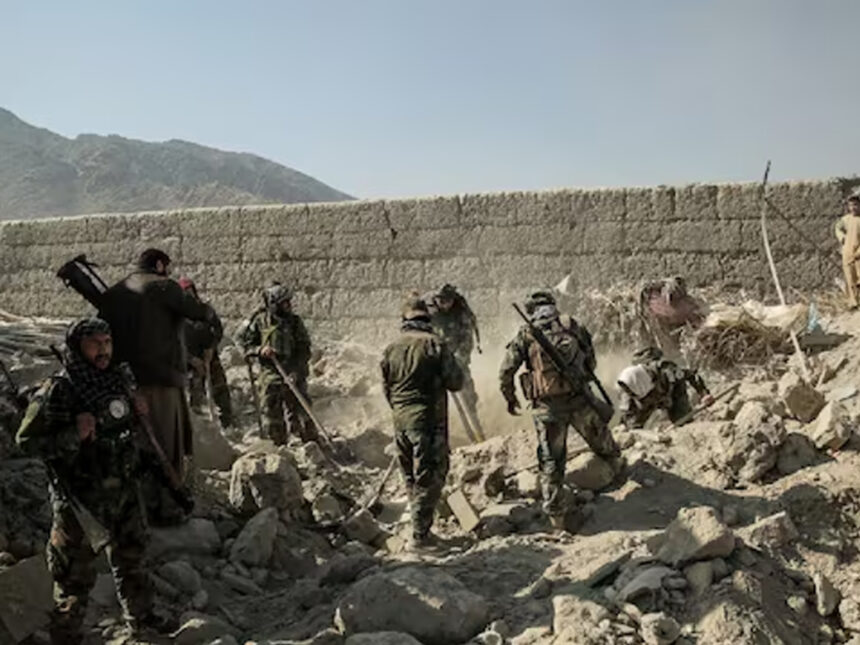
Afghan authorities have claimed that, in addition to the reported fatalities, they are in possession of the bodies of 23 Pakistani soldiers. Kabul has further alleged that Taliban fighters captured a Pakistani army headquarters and seized control of 19 outposts during the operation. Afghan Deputy Spokesperson Hamdullah Fitrat stated that some Pakistani soldiers were taken alive, while a cache of military equipment was confiscated, including dozens of weapons, a tank, and a harvester.
These claims paint a picture of a coordinated and large-scale offensive, suggesting that the attack was not merely a limited skirmish but a deliberate and strategic assault on Pakistani military infrastructure. However, Pakistani authorities have not publicly confirmed the extent of territorial losses described by Afghan officials.
The Kunar border has historically been a flashpoint, characterized by rugged terrain and porous crossings that complicate surveillance and control. The latest incident underscores how fragile the security situation remains, particularly in areas where militant groups operate with relative mobility. Cross-border accusations have frequently intensified after such clashes, with each side alleging violations of sovereignty and aggression.
Pakistan has long accused elements within Afghanistan of providing safe haven to militants responsible for attacks inside Pakistani territory. Conversely, Afghan authorities have often alleged that Pakistan interferes in internal Afghan affairs and supports factions hostile to Kabul. The recent exchange of fire and subsequent declarations appear to have reignited these longstanding grievances, pushing the situation into a new and more dangerous phase.
The narrative emerging from Kabul emphasizes tactical success and significant damage inflicted on Pakistani forces. Afghan officials have framed the incident as a defensive response to cross-border tensions, while Pakistan’s leadership has portrayed the attack as an act of aggression warranting strong retaliation. The stark contrast in accounts illustrates the deep mistrust and absence of a shared factual framework between the two governments.
The situation has drawn widespread attention across the region, with analysts expressing concern that a prolonged escalation could destabilize not only the immediate border areas but also broader diplomatic relations in South Asia. With both sides presenting high casualty figures and battlefield claims, independent verification remains difficult amid the fog of conflict.
*Operation Ghazab Lil Haq and widening military response
In retaliation for the reported attack, Pakistan launched a military operation titled Operation Ghazab Lil Haq. As part of this response, the Pakistan Air Force carried out airstrikes targeting multiple locations, including areas in Kabul and Nangarhar Province. According to Pakistani officials, the strikes were aimed at Taliban positions believed to be linked to the cross-border assault.
The Pakistani government has claimed that 133 Afghan Taliban fighters have been killed so far, with more than 200 injured in the air and ground operations. Officials further stated that 27 Taliban outposts were destroyed and nine were captured as part of the counteroffensive. These figures, like those issued by Kabul, have not been independently confirmed.
Video footage circulating on social media platforms, including posts shared by Pakistan’s Information Minister, purportedly shows airstrikes conducted in Kabul, Kandahar, and Baktika. The authenticity and full context of these clips remain subject to scrutiny, but they have fueled intense debate online and heightened public anxiety in both countries.
The escalation follows a pattern of retaliatory strikes that has periodically defined relations between Islamabad and Kabul. Notably, Pakistan carried out an airstrike in a residential area in Kabul on October 9 last year, an incident that was widely criticized and contributed to deteriorating diplomatic ties. The recurrence of air operations over Afghan territory underscores the volatility of the security dynamic.
The declaration of “open war” carries significant symbolic weight. While it may not constitute a formal declaration in the traditional sense, it signals a readiness for sustained military engagement rather than isolated skirmishes. Such language suggests that Pakistan views the latest attack as crossing a threshold that demands a comprehensive response.
For Afghanistan’s Taliban leadership, the confrontation presents both military and political challenges. Domestically, projecting strength in the face of external pressure may bolster internal cohesion. Internationally, however, escalating conflict with a neighboring state risks further isolation and economic strain.
The border regions affected by the clashes are home to civilian populations already grappling with economic hardship and security uncertainties. Airstrikes and ground engagements increase the risk of displacement and humanitarian concerns, particularly if hostilities persist. The exchange of heavy weaponry and the seizure of outposts point to a scale of engagement that extends beyond limited skirmishes.
Regional observers note that the absence of effective diplomatic backchannels heightens the danger of miscalculation. Historically, crises between Pakistan and Afghanistan have sometimes been defused through quiet negotiations or third-party mediation. Whether similar mechanisms will be activated in the current scenario remains uncertain.
The competing narratives, high casualty claims, and cross-border strikes collectively illustrate a deepening crisis. With each side asserting battlefield successes and accusing the other of aggression, the potential for further escalation remains significant. Military mobilization, air operations, and public rhetoric have combined to create one of the most serious confrontations between the two countries in recent years.
As developments continue to unfold, the security landscape along the Kunar border and beyond remains tense, with both governments signaling determination to defend their positions amid a rapidly evolving and highly volatile conflict.