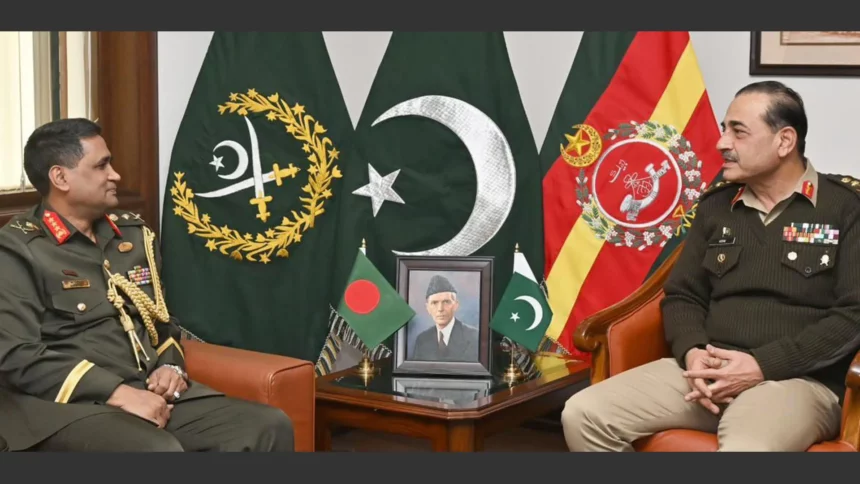
In a significant shift in South Asian geopolitics, Pakistan and Bangladesh appear to be setting aside decades of historical animosity and re-engaging with each other. This development comes in the wake of political changes in Bangladesh, particularly after the ousting of Prime Minister Sheikh Hasina, and is marked by a series of high-level military exchanges between the two nations. The most recent of these exchanges took place when Pakistan’s army chief, General Asim Munir, met with Lieutenant General SM Kamrul Hassan of the Bangladesh Army in Islamabad. During their meeting, both sides expressed a desire to strengthen military ties and insulate their partnership from any external disruptions, a sentiment reflected in the Pakistani military’s media wing, which referred to the two countries as “brotherly nations.”
The relationship between Pakistan and Bangladesh has long been strained, particularly since Bangladesh’s liberation from Pakistan in 1971. After the brutal war of independence, which saw Pakistan’s military fighting Bengali rebels and committing widespread atrocities, the relationship between Dhaka and Islamabad soured. Despite Pakistan officially recognizing Bangladesh’s independence in 1974, unresolved issues such as the lack of an apology for the atrocities committed during the war and the repatriation of Urdu-speaking people from Bangladesh have continued to fuel tensions between the two nations.
The situation was further complicated during the nearly 16-year tenure of Sheikh Hasina, who, until her ouster in August 2024, had a highly contentious relationship with Pakistan. During her rule, Bangladesh became more closely aligned with India, which supported her government in the face of mass protests. However, after Hasina’s departure, which was marked by her fleeing to India, Bangladesh’s political landscape has begun to shift. The interim government led by Muhammad Yunus is seeking to recalibrate Bangladesh’s foreign policy, possibly moving away from India and towards Pakistan, as both countries share a growing anti-India sentiment.
General Munir and General Hassan’s meeting underscored the renewed military cooperation between Pakistan and Bangladesh, with both parties keen on strengthening their defense ties. Pakistan’s foreign minister, Ishaq Dar, is also scheduled to visit Bangladesh next month, marking the first such visit since 2012, further signaling a thaw in relations. This shift in diplomacy is occurring amidst broader geopolitical changes in South Asia, with India and Pakistan both recalibrating their foreign policies.
One of the key issues driving this rapprochement is the shared concern over India. Bangladesh has increasingly become wary of India’s growing influence in the region, particularly following New Delhi’s consistent backing of Hasina’s autocratic regime. The interim government in Bangladesh has even called on India to extradite Hasina for a “judicial process,” accusing her of overseeing human rights violations during her tenure. While India has not yet responded to this request, the issue reflects the growing distance between Dhaka and New Delhi.
Additionally, there have been concerns about the status of Hindus in Bangladesh, a minority group traditionally supportive of Hasina’s Awami League party. India has expressed concerns about the persecution of Hindus in Bangladesh, though Dhaka has rejected these claims, accusing Indian media of spreading disinformation.
The recalibration of Bangladesh’s foreign policy is further influenced by its strained relationship with India, which is pushing the country to consider Pakistan as a viable alternative. Ashraf Qureshi, a former Pakistani envoy to Bangladesh, noted that with the declining ties between Bangladesh and India, Pakistan has emerged as an attractive partner for Dhaka. However, analysts caution against reading too much into the recent rapprochement, as historical tensions between the two countries remain significant. While both countries may share some common ground, particularly in their concerns about India, the enduring geopolitical realities mean that Bangladesh cannot afford to adopt an overtly anti-India stance. The country shares a long border with India, relies on Indian water sources, and has deeply intertwined economic interests with its neighbor.
The improving relationship between Pakistan and Bangladesh also comes amidst broader regional shifts. Notably, India’s engagement with Afghanistan’s Taliban government has raised concerns in Pakistan, which has historically had close ties with the Taliban. While Islamabad has lost much of its influence over the Taliban, India’s engagement with Afghanistan is seen as a counterbalance to Pakistan’s longstanding support for the group. These developments further complicate the regional dynamics, as both India and Pakistan navigate their shifting foreign policies.
At the same time, Bangladesh’s economic growth is another factor in the evolving diplomatic ties between Dhaka and Islamabad. With a growth rate of 6 percent since 2021, Bangladesh is one of South Asia’s fastest-growing economies, while Pakistan lags behind with only 2.5 percent growth last year. This economic disparity has pushed Pakistan to seek new trade partners, and Bangladesh, with its rapidly expanding market, has emerged as an important potential partner. Bilateral trade between the two nations remains relatively small, but it is expected to increase as both countries work to ease the barriers to direct engagement, such as flight restrictions and visa issues.
The shifting dynamics between Pakistan and Bangladesh reflect a broader trend of changing alliances and recalibrated foreign policies in South Asia. While the two nations are moving closer to one another in the face of shared concerns over India, their historical tensions and divergent interests still pose significant challenges to a full reconciliation. However, the recent exchanges and diplomatic engagements signal a potential new chapter in the relationship between Dhaka and Islamabad, one that could reshape the geopolitical landscape of South Asia in the coming years.