As global elites gather in the Swiss Alpine resort of Davos for the World Economic Forum (WEF), Oxfam, a leading international charity, has raised alarm over the growing influence of an “aristocratic oligarchy” that is becoming increasingly entrenched in global politics and economies. This warning comes as the elites convene just as Donald Trump begins his presidency in the United States. Although Trump will not attend the forum in person, he is expected to make an online appearance later in the week, further highlighting the intertwining of wealth and political power in the modern global landscape.
Oxfam’s annual pre-Davos report titled “Takers Not Makers” calls attention to the rapid concentration of wealth, particularly following Trump’s election and the tax-cut plans that have disproportionately benefited the richest individuals. According to the report, the wealth of billionaires has increased by a staggering $2 trillion in just the past year, bringing their collective wealth to a total of $15 trillion. Oxfam contends that the policies enacted by Trump have only accelerated this trend, creating an oligarchy of the ultra-wealthy that wields unprecedented influence over both political decisions and the global economy.
The charity expressed concerns that “trillions are being gifted in inheritance, creating a new aristocratic oligarchy” that has a disproportionate impact on political processes, while the majority of the world’s population continues to suffer under the weight of systemic inequality. Oxfam’s statement echoes similar concerns raised by outgoing U.S. President Joe Biden, who recently warned of a “dangerously wealthy oligarchy” that poses a threat to democratic institutions.
Elon Musk, CEO of Tesla and owner of X (formerly Twitter), is highlighted in the Oxfam report as one of the key backers of Trump’s presidential campaign, further illustrating the powerful ties between business magnates and political figures. Amitabh Behar, Oxfam’s Executive Director, emphasized that the growing concentration of wealth in the hands of a few individuals is having severe consequences for ordinary people around the world. “We present this report as a stark wake-up call that ordinary people the world over are being crushed by the enormous wealth of a tiny few,” Behar stated, underscoring the urgent need for systemic change.
The report also found that 204 new billionaires emerged last year alone, with the total number of billionaires now reaching 2,769. The wealth of these billionaires grew at a rate three times faster than in 2023, with each billionaire seeing their fortune increase by an average of $2 million per day. Oxfam’s projections suggest that, in the coming decade, we could see the rise of “five trillionaires,” further entrenching the growing divide between the super-rich and the rest of the population.
The report highlights that Trump’s policies, including tax cuts and deregulation, have provided a substantial boost to billionaire fortunes, deepening the already significant wealth gap. In the United States, Oxfam warns that the ability to purchase political influence and shape national policies poses a dire risk to the integrity of democracy. Oxfam France’s head, Cecile Duflot, stated that the situation in the U.S. is rapidly evolving into one where a handful of individuals can “buy a country,” threatening the very foundations of democratic governance.
Among the richest individuals expected to attend Trump’s inauguration are Musk, Amazon founder Jeff Bezos, and Meta’s CEO Mark Zuckerberg. However, none of these tech moguls are expected to be in Davos for the WEF gathering. Their absence highlights the way in which the global economic and political elites operate across different forums and how their influence is shaping global policies and debates.
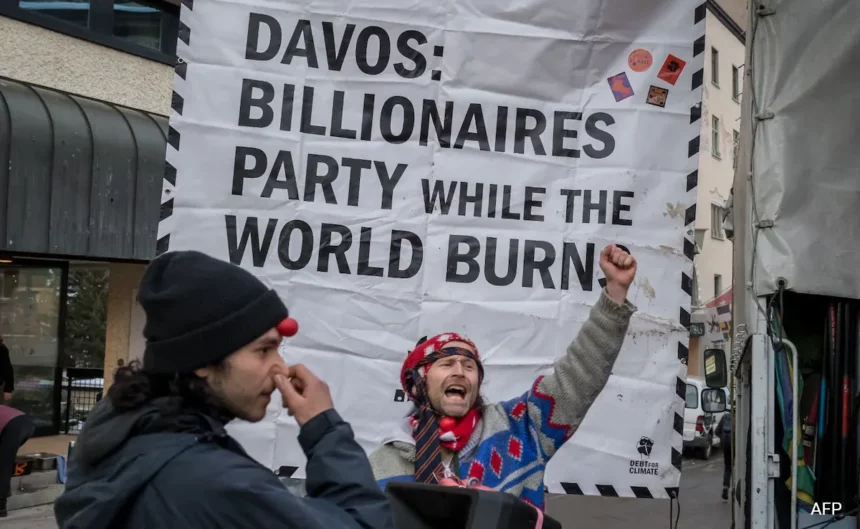
Around 3,000 participants are expected at Davos this year, including over 60 heads of state or government and more than 900 CEOs. These influential figures will gather for days of networking and behind-the-scenes negotiations. However, the elite gathering has already drawn protests, with a few hundred demonstrators blocking an access road to the venue on Sunday. The protesters, holding banners reading “Tax the Rich” and “Burn the System,” expressed outrage at the growing concentration of wealth and power in the hands of a few.
Marlene Engelhorn, an Austrian-German heiress who has given away a significant portion of her inheritance to social causes, spoke out about the inequities perpetuated by the ultra-wealthy. “The WEF symbolises how much power wealthy people like me hold,” she remarked, critiquing the ability of billionaires to shape political outcomes through their financial influence. Engelhorn’s statement highlights the growing public dissatisfaction with the concentration of wealth and the political power that comes with it.
While Trump will not be present at Davos, the policies he has set in motion during his presidency will dominate discussions at the forum. His plans to impose trade tariffs, loosen regulatory controls, extend tax cuts, and curb immigration are all expected to have far-reaching effects on global markets. Moreover, the presence of figures such as Musk, Bezos, and Zuckerberg at the inauguration signals the close ties between the world’s richest individuals and the political power structures that shape the global economy.
In response to the growing wealth inequality, discussions at the WEF are expected to focus on the possibility of imposing a global tax on the super-rich. Morris Pearl, a former managing director at investment firm BlackRock and a member of the group Patriotic Millionaires, argued that rising wealth inequality is a ticking time bomb. He stated, “I’m afraid that we’re going to have civil unrest if we don’t change things,” highlighting the potential for social upheaval if current trends continue.
As the World Economic Forum gets underway, the concerns raised by Oxfam, as well as the protests and criticisms from figures like Engelhorn and Pearl, serve as a stark reminder of the growing discontent over the power held by a small, elite group. The decisions made at this year’s Davos gathering, and the broader global economic policies that emerge from it, will likely have profound implications for how wealth and power are distributed in the coming years. For many, the growing concentration of wealth in the hands of a few represents an existential challenge to democracy, equity, and the future stability of the global economy.