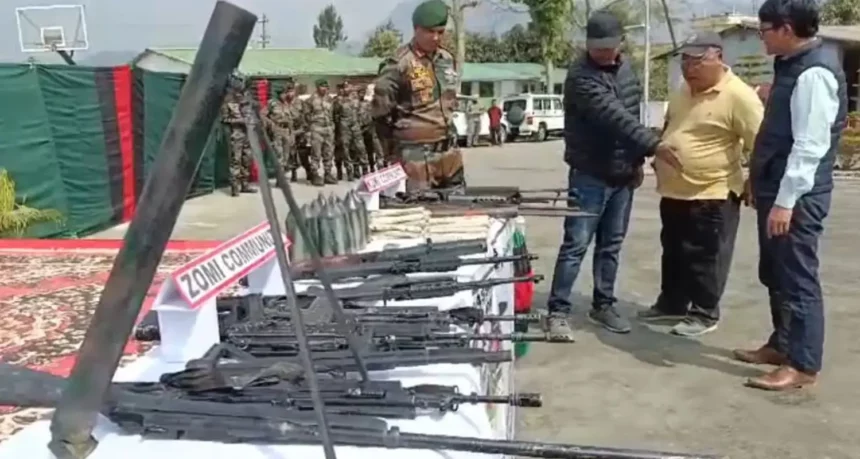
Amid the prolonged ethnic unrest in Manipur, a significant number of weapons were voluntarily surrendered by the public across four districts, marking a crucial development in the region’s volatile security situation. According to the police, a total of 109 different types of weapons, along with a substantial quantity of ammunition and various other items, were handed over to security forces and law enforcement authorities. The move follows repeated appeals by the administration for civilians to give up illegally held arms in an effort to restore normalcy.
In Kangpokpi district, weapons were surrendered at the Saikul police station, including a 9mm CB1A1 pistol, a 9mm magazine, one grenade, several cartridges, and two wireless sets. Meanwhile, in Bishnupur district, a single-barrel breech-loading (SBBL) gun was among the firearms surrendered at Phougakchao Ikhai police station. Similar actions were recorded across Imphal West and Imphal East districts, where police confirmed the receipt of arms and ammunition at multiple stations. The surrender of weapons is being seen as a positive step towards curbing the circulation of illegal firearms in the violence-hit state.
The latest development comes in response to an appeal made by Manipur’s governor Ajay Kumar Bhalla in early February. The governor had urged residents to voluntarily surrender all looted or illegally held weapons within seven days, assuring that no punitive action would be taken against those who complied during this period. This appeal was part of broader efforts to de-escalate tensions and bring the situation under control following months of ethnic strife.
Since May 2023, Manipur has witnessed intense ethnic violence between the Meitei community, largely based in Imphal Valley, and the Kuki-Zo groups, predominantly residing in the surrounding hills. The conflict has resulted in over 250 deaths and the displacement of thousands of people, exacerbating an already fragile law-and-order situation in the state. The violence has led to the proliferation of illegal firearms, raising concerns over the security and stability of the region.
In a major political development, the Centre imposed president’s rule in Manipur on February 13, just days after chief minister N Biren Singh tendered his resignation. The decision effectively placed the state under direct central administration, suspending the authority of the elected government. The Ministry of Home Affairs issued a notification confirming that the Manipur Legislative Assembly, which was due to function until 2027, has been placed under suspended animation, stripping it of legislative powers until further notice.
The imposition of president’s rule and the ongoing weapons surrender drive are seen as part of the Centre’s broader strategy to regain control over the worsening situation in Manipur. Security forces have intensified efforts to maintain law and order, conducting operations to recover illegal weapons while urging residents to cooperate with authorities. Officials believe that continued disarmament could play a crucial role in restoring peace, although concerns remain about the deep-rooted ethnic divisions that fuel the ongoing violence.
As the state remains on edge, the coming weeks will be critical in determining whether these measures lead to tangible improvements in Manipur’s security landscape. With the region still grappling with displacement and destruction caused by the violence, authorities are expected to push for further arms surrenders and increased vigilance to prevent future escalations. The people of Manipur, caught in the crossfire of a long-standing ethnic conflict, continue to hope for a resolution that brings lasting peace and stability to the state.