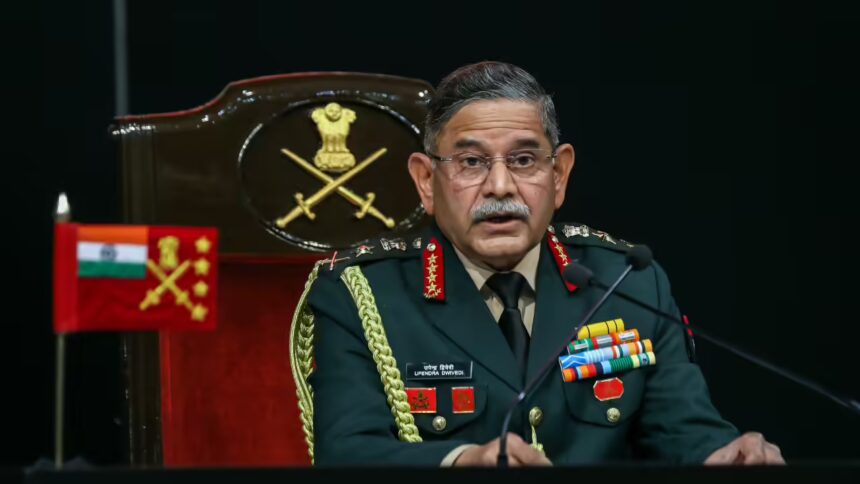
Indian Army Chief General Upendra Dwivedi has reaffirmed India’s readiness to respond strongly as Operation Sindoor continues amid persistent cross-border threats.
Army Chief Flags Active Terror Camps and Reiterates India’s Preparedness
Indian Army Chief Upendra Dwivedi has issued a firm warning that India will respond decisively to any hostile action originating from across the Pakistan border, asserting that Operation Sindoor remains ongoing and operationally effective. Speaking to the media, General Dwivedi disclosed that intelligence inputs indicate at least eight terror camps are still active close to the border, underscoring the continued threat posed by cross-border terrorism. He made it clear that the Indian armed forces are fully prepared and vigilant, and that any provocation, whether terrorist or military in nature, will invite an appropriate and strong response.
General Dwivedi described Operation Sindoor as a successful demonstration of seamless coordination among the Indian Army, the Air Force, and the Navy. According to him, the jointness displayed during the operation reflects the growing integration of India’s military forces and their ability to execute complex missions with precision. He stated that the operation resulted in the killing of around 100 Pakistani soldiers, highlighting the scale and intensity of the engagement. The Army Chief stressed that the message from India is unambiguous: attempts to destabilise the country through terror or military misadventure will not go unanswered.
Addressing concerns over recent drone sightings along the border, General Dwivedi provided clarity on the nature of these aerial intrusions. He explained that the drones observed were small in size and flew at low altitudes, making them difficult to detect consistently. He noted that such drones often switch on lights and are rarely visible for extended periods. According to official assessments, around six drones were sighted on January 10, followed by two to three sightings on January 11 and January 12. While these incidents are being closely monitored, the Army Chief assured that surveillance mechanisms remain robust and capable of responding to emerging threats.
General Dwivedi also acknowledged the extensive cooperation among various national stakeholders in ensuring the effectiveness of Operation Sindoor. He praised the coordinated efforts of central armed police forces, intelligence agencies, civic authorities, state administrations, and key ministries such as the Ministry of Home Affairs and the Railways. This whole-of-government approach, he said, has been instrumental in sustaining operational momentum and ensuring that logistical, intelligence, and civil coordination challenges are addressed in real time. The Army Chief reiterated that Operation Sindoor is not a one-time action but an ongoing commitment to national security, with the armed forces remaining alert to any future misadventure.
On the northern front, General Dwivedi offered a measured assessment of the prevailing situation, stating that while conditions remain stable, they demand constant vigilance. He referred to high-level interactions, renewed diplomatic contacts, and confidence-building measures that are gradually contributing to normalisation along sensitive areas. These steps have enabled the resumption of certain civilian activities, including grazing and hydrotherapy camps, in border regions. At the same time, he emphasised that India’s deployment along the Line of Actual Control remains balanced and robust, supported by continuous capability development and infrastructure enhancement through coordinated government efforts.
Operation Sindoor and India’s Strategic Posture Amid Regional Tensions
Reflecting on the broader context in which Operation Sindoor was conceived and executed, General Dwivedi pointed to the Pahalgam terror attack as a critical trigger that necessitated a decisive response at the highest levels of leadership. He explained that the operation was conceptualised and executed with clarity of purpose, combining speed, precision, and strategic intent. The initial phase of Operation Sindoor reportedly involved a swift 22-minute initiation on May 7, followed by an orchestration period lasting 88 hours until May 10. This tightly coordinated timeline, according to the Army Chief, showcased India’s ability to plan and execute complex operations under pressure.
General Dwivedi noted that Operation Sindoor effectively reset long-standing strategic assumptions in the region. By targeting deep terror infrastructure, the operation challenged entrenched narratives and demonstrated that India would not be constrained by rhetorical posturing or threats. He stated that the Indian Army successfully destroyed seven out of nine identified targets, playing a pivotal role in what he described as a calibrated and proportionate response to Pakistan’s actions. This outcome, he said, reinforced India’s strategic credibility and deterrence posture.
The Army Chief also placed Operation Sindoor within a global context, observing that the world is witnessing a rise in armed conflicts and security challenges. In such an environment, he remarked, nations that remain prepared are the ones that prevail. He stressed that India’s armed forces must continue to evolve, adapt, and innovate to meet emerging threats. Operation Sindoor, in his view, stands as a clear demonstration of India’s readiness, precision, and strategic clarity in dealing with cross-border terrorism and related challenges.
Turning to institutional progress, General Dwivedi expressed satisfaction with the Indian Army’s achievements in 2025, particularly under the framework of jointness, atmanirbharta, and innovation. He explained that these pillars reflect a conscious effort to integrate the services more closely, reduce dependence on foreign equipment, and encourage indigenous solutions tailored to India’s operational requirements. These initiatives, he said, are aligned with the Prime Minister’s call for greater self-reliance and with reform measures introduced by the Defence Ministry earlier in the year, as well as the Army’s long-term transformation plan.
General Dwivedi concluded his remarks by stating that the Indian Army can be justifiably satisfied with the progress achieved during the year, even as it remains focused on future challenges. He reiterated that vigilance, preparedness, and coordinated national effort will remain central to India’s security strategy. While Operation Sindoor continues, the Army Chief made it clear that India’s resolve is firm and that the armed forces stand ready to protect the nation’s sovereignty and security under all circumstances.