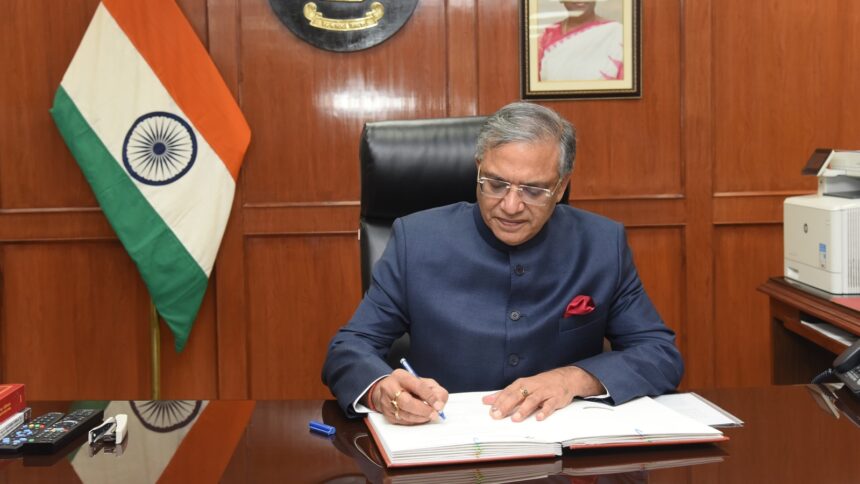
Gyanesh Kumar, newly appointed as the Chief Election Commissioner of India, officially assumed office on Wednesday, underscoring the critical role of voting in shaping the nation. In his first address, he urged all eligible citizens to actively participate in the democratic process, calling voting the foundation of nation-building.
“The first step for nation-building is voting. Every Indian citizen who has turned 18 should register as an elector and exercise their right to vote. In line with the Constitution of India, electoral laws, and related rules, the Election Commission of India has always stood by the voters and will continue to do so,” Gyanesh Kumar stated while addressing the media.
An Indian Administrative Service officer of the 1988 batch from the Kerala cadre, Gyanesh Kumar now leads the three-member Election Commission panel. He is senior to the other two Election Commissioners, Sukhbir Singh Sandhu, an officer from the Uttarakhand cadre, and Vivek Joshi, a 1989-batch officer from the Haryana cadre. Vivek Joshi also officially assumed charge as Election Commissioner following the Ministry of Law and Justice’s Gazette notification dated February 17, 2025.
The transition in leadership comes as Rajiv Kumar, the outgoing Chief Election Commissioner, stepped down on Tuesday after serving as the 25th head of the Election Commission of India. Reflecting on his tenure, he described the Commission as “the place of worship of democracy” and expressed confidence in the institution’s ability to uphold electoral integrity under its new leadership.
According to an official statement from the Election Commission, Rajiv Kumar joined the Election Commission of India as Election Commissioner on September 1, 2020, before taking over as Chief Election Commissioner on May 15, 2022. During his tenure of over four and a half years, he introduced several structural, technological, and administrative reforms that enhanced electoral processes across the country.
Under Rajiv Kumar’s leadership, the Election Commission successfully conducted elections in 31 states and Union Territories, along with the 2022 presidential and vice-presidential elections, the 2024 Lok Sabha elections, and Rajya Sabha renewals. These electoral exercises were carried out with efficiency, minimal instances of repolling, and a significant reduction in election-related violence, marking a milestone in the Commission’s efforts to strengthen democratic participation.
With Gyanesh Kumar at the helm, the Election Commission is expected to continue its focus on voter awareness, electoral transparency, and the use of technology in the voting process. His appointment signals a renewed commitment to ensuring free and fair elections, reinforcing the fundamental right of every Indian citizen to participate in the country’s democratic journey.