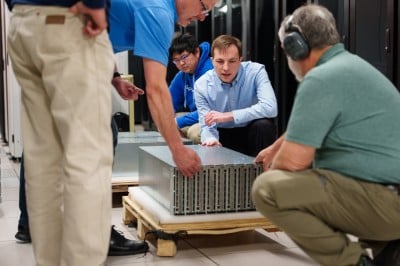
Newswise — ALBUQUERQUE, N.M. — Neuromorphic computers, inspired by the architecture of the human brain, are proving surprisingly adept at solving complex mathematical problems that underpin scientific and engineering challenges.
In a paper published in Nature Machine Intelligence, Sandia National Laboratories computational neuroscientists Brad Theilman and Brad Aimone describe a novel algorithm that enables neuromorphic hardware to tackle partial differential equations, or PDEs — the mathematical foundation for modeling phenomena such as fluid dynamics, electromagnetic fields and structural mechanics.
The findings show that neuromorphic computing can not only handle these equations, but do so with remarkable efficiency. The work could pave the way for the world’s first neuromorphic supercomputer, potentially revolutionizing energy-efficient computing for national security applications and beyond.
Research was supported by the Department of Energy’s Office of Science through the Advanced Scientific Computing Research and Basic Energy Sciences programs, and by the National Nuclear Security Administration’s Advanced Simulation and Computing program.
A brain-inspired approach to scientific computing
Partial differential equations are essential for simulating real-world systems, from predicting weather patterns to modeling the behavior of materials under stress. Traditionally, solving PDEs requires vast computational resources. Neuromorphic computers, however, offer a fundamentally different approach that more closely resembles how the brain processes information.
“We’re just starting to have computational systems that can exhibit intelligent-like behavior. But they look nothing like the brain, and the amount of resources that they require is ridiculous, frankly,” Theilman said.
For decades, experts have believed that neuromorphic computers were best suited for tasks like recognizing patterns or accelerating artificial neural networks. These systems weren’t expected to excel at solving rigorous mathematical problems like PDEs, which are typically tackled by traditional supercomputers.
But for Aimone and Theilman, the results weren’t surprising. The researchers believe the brain itself performs complex computations constantly, even if we don’t consciously realize it.
“Pick any sort of motor control task — like hitting a tennis ball or swinging a bat at a baseball,” Aimone said. “These are very sophisticated computations. They are exascale-level problems that our brains are capable of doing very cheaply.”
Energy efficiency for national security
The implications of this research are particularly significant for the National Nuclear Security Administration, which oversees the nation’s nuclear deterrence mission. Supercomputers throughout the nuclear weapons complex require immense amounts of energy to simulate the physics of nuclear weapons and other critical systems.
Neuromorphic computing offers a path to dramatically reduce energy consumption while maintaining computational power. By solving PDEs with brain-inspired efficiency, neuromorphic systems are showing they might handle large-scale simulations with far less power than conventional supercomputers.
“You can solve real physics problems with brain-like computation,” Aimone said. “That’s something you wouldn’t expect because people’s intuition goes the opposite way. And in fact, that intuition is often wrong.”
The researchers said they envision a future where neuromorphic supercomputers play a central role in Sandia’s mission to keep the world safe and secure.
A window into the brain’s secrets
Their research also raises intriguing questions about the nature of intelligence and computation. The algorithm developed by Theilman and Aimone retains strong similarities to the structure and dynamics of cortical networks in the brain.
“We based our circuit on a relatively well-known model in the computational neuroscience world,” Theilman said. “We’ve shown the model has a natural but non-obvious link to PDEs, and that link hasn’t been made until now — 12 years after the model was introduced.”
The researchers believe that neuromorphic computing could help bridge the gap between neuroscience and applied mathematics, offering new insights into how the brain processes information.
“Diseases of the brain could be diseases of computation,” Aimone said. “But we don’t have a solid grasp on how the brain performs computations yet.”
If their hunch is correct, neuromorphic computing could offer clues to better understand and treat neurological conditions like Alzheimer’s and Parkinson’s.
Building the future of computing
While neuromorphic computing is still in its early stages, Sandia’s research is laying the groundwork for transformative advancements. The team hopes their work will inspire collaboration with applied mathematicians, neuroscientists and engineers to explore the full potential of this technology.
“If we’ve already shown that we can import this relatively basic but fundamental applied math algorithm into neuromorphic — is there a corresponding neuromorphic formulation for even more advanced applied math techniques?” Theilman said.
As Sandia continues to advance neuromorphic computing, the researchers are optimistic about its potential to address some of the world’s most pressing challenges. “We have a foot in the door for understanding the scientific questions, but also we have something that solves a real problem,” Theilman said.
https%3A%2F%2Fwww.newswise.com%2Farticles%2Fnature-inspired-computers-are-shockingly-good-at-math%2F%3Fsc%3Drsla