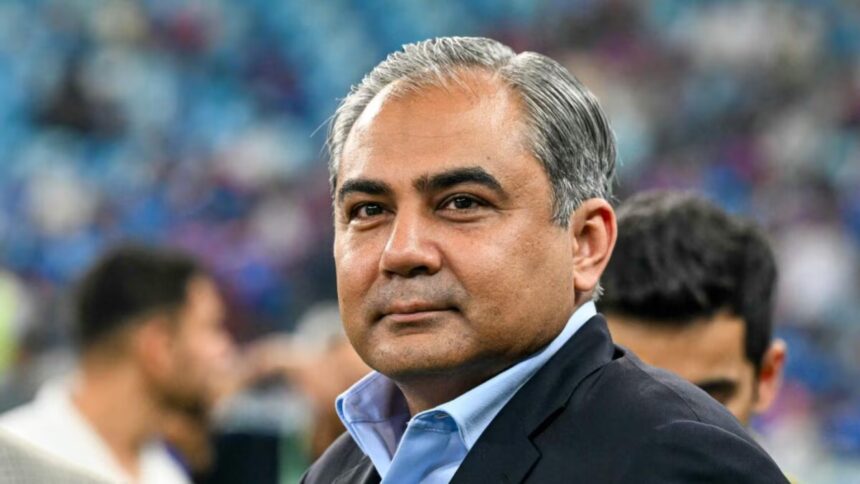
The 2025 Asia Cup was expected to end as a celebration of cricketing excellence, but three days after India defeated Pakistan in the final to secure their ninth title, the tournament has instead descended into a swirl of controversies that refuse to subside. What should have been remembered as a showcase of Indian dominance on the field is now tainted by an unprecedented governance standoff at the Asian Cricket Council, with its president Mohsin Naqvi at the center of the storm. The post-final presentation ceremony turned into a theatre of politics, leaving India still waiting for its rightful trophy and winner’s medals, and the cricketing world debating whether administrative one-upmanship has irreparably scarred the tournament’s reputation.
The crisis that has unfolded goes beyond a simple delay in logistics. The events since the final in Dubai reveal a deep and deliberate attempt by Mohsin Naqvi to undermine the Board of Control for Cricket in India (BCCI), an episode that many in the cricketing community now regard as one of the ugliest administrative spats in recent memory. The lack of a straightforward handover of the Asia Cup trophy and medals has triggered diplomatic-like exchanges, emergency meetings, and public criticism, while Indian players and fans find themselves celebrating a hard-earned win without the silverware that symbolizes their triumph. The Asia Cup, always a volatile ground given the India-Pakistan rivalry, has now become a stage where cricket, politics, and governance clashed head-on.
The missing trophy and a stormy ACC meeting
At the heart of the controversy lies Mohsin Naqvi, who not only serves as president of the Asian Cricket Council but also heads the Pakistan Cricket Board. His dual role has sparked accusations of bias and conflict of interest, particularly in the manner he has handled India’s historic victory. According to sources privy to the stormy ACC meeting that followed the final, Mohsin Naqvi’s conduct was nothing short of dismissive. In what should have been a routine discussion about the tournament’s conclusion and logistical arrangements for the trophy presentation, the meeting instead spiraled into a clash of egos and agendas.
Reports suggest that Naqvi began his address without even acknowledging India’s championship win, an omission that did not go unnoticed. It was only after repeated interventions by BCCI treasurer Ashish Shelar that Mohsin Naqvi reluctantly offered a perfunctory congratulation. This deliberate avoidance of recognition, coupled with his refusal to address the issue of the missing trophy and medals, enraged Indian representatives. When the BCCI offered to handle all logistical arrangements for transporting the silverware to India and only requested Mohsin Naqvi’s cooperation in dispatching it to ACC headquarters, the ACC chief allegedly deflected and stalled, creating a deadlock.
The trophy’s absence is not a trivial matter of delayed courier services. In cricket, as in any sport, the symbolism of lifting the trophy on the day of victory is integral to the narrative of triumph. Yet the Asia Cup final ended with India celebrating without the coveted cup in hand. It later emerged that the delay of nearly an hour before the presentation ceremony stemmed from Mohsin Naqvi’s insistence on handing over the trophy himself, a demand India resisted given the political undertones and its refusal to engage in ceremonial symbolism with Pakistan. The deadlock forced organizers to proceed with an improvised ceremony, one that left a glaring void where the trophy should have been.
This unprecedented situation has since snowballed into a governance crisis. The Asia Cup, organized under the umbrella of the ACC, is supposed to embody regional cooperation in cricket. Instead, it has become a battleground for mistrust and brinkmanship. The BCCI, the most powerful board in world cricket, now finds itself stonewalled by a regional governing body whose president appears determined to politicize the sport. The longer the trophy remains out of India’s hands, the sharper the criticism grows—not only of Mohsin Naqvi but also of the ACC’s inability to enforce its own standards of professionalism.
From handshake snubs to hostile symbolism on the field
The trophy controversy did not emerge in a vacuum. Throughout the 2025 edition of the Asia Cup, the tournament was marked by a hostile atmosphere both on and off the field. India’s decision to enforce a no-handshake protocol with Pakistan—a stance born out of solidarity with victims of terror attacks in India—set the tone for strained relations. What began as a dignified and silent protest soon devolved into a game of gestures, taunts, and provocations, with Pakistani players resorting to cheap theatrics that further inflamed tensions.
The hostility was visible in moments both small and significant. From players refusing to share customary courtesies to heated exchanges during matches, the contest carried a bitterness rarely seen in cricket. Several Pakistani players faced fines for inappropriate conduct, both on and off the field, while social media amplified every incident into a storm of accusations and counter-claims. The hostility reached its peak during the final, where even the toss was conducted in unusual fashion, with two separate presenters interviewing the captains in a move that symbolized the division permeating the tournament.
For Indian players and fans, the victory in the final was sweet but bittersweet. The team dominated Pakistan on the field, winning decisively and underlining its supremacy in Asian cricket. Yet the absence of the trophy during the celebrations meant that iconic photographs and moments of triumph were denied to them. Cricket history is built on images of captains lifting trophies, of teammates surrounding the silverware, of fans seeing their heroes immortalized with the symbol of their win. India’s ninth Asia Cup title, however, remains visually incomplete, overshadowed by political maneuvering and administrative obstinacy.
The broader narrative is equally troubling. Instead of celebrating cricketing excellence, the tournament will be remembered for the antics of officials and the failures of governance. The Asia Cup, a tournament that has long been seen as a celebration of Asian cricketing powerhouses, has instead exposed deep fissures within the sport’s administration. The BCCI’s call for a clean, protocol-driven transfer of medals and trophies is not merely a demand for recognition but an attempt to restore order and dignity to a competition that has been dragged into the mud.
Mohsin Naqvi’s role in all of this remains central. His insistence on controlling the trophy presentation, his failure to acknowledge India’s win, and his subsequent stalling tactics have left him isolated within the cricketing fraternity. For many, his behavior exemplifies the dangers of allowing politics and personal ego to override the spirit of the game. The 2025 Asia Cup, instead of being remembered for India’s dominant cricket, will now stand as a case study in how administrative pettiness can overshadow athletic brilliance.