Campaign Rhetoric Peaks as BJP Targets TMC Governance
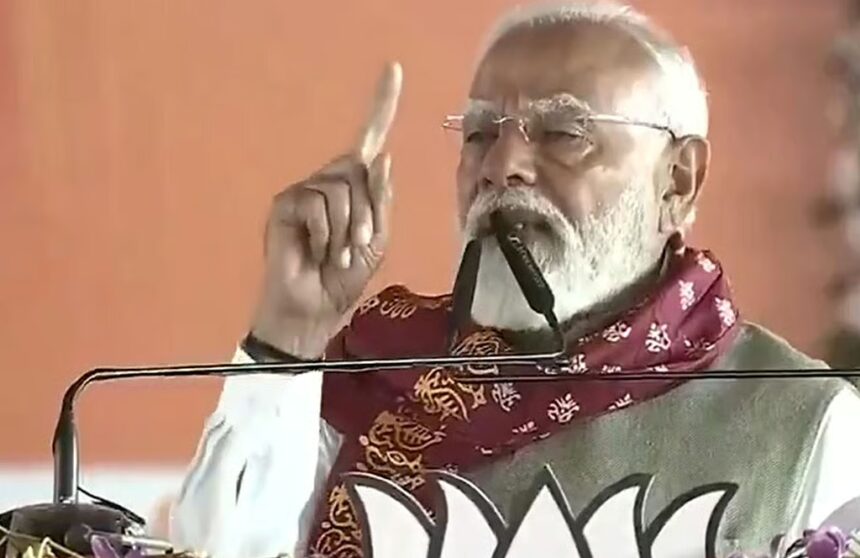
The political temperature in West Bengal has risen sharply as the West Bengal Assembly Elections 2026 enter a crucial phase. Prime Minister Narendra Modi, addressing rallies in Dum Dum and Jadavpur, delivered a pointed critique of the ruling All India Trinamool Congress, claiming that its political dominance is nearing an end. He used the phrase that the “lamp of TMC is flickering,” suggesting that public support is waning.
Modi argued that the first phase of polling has already reflected a “wave of change,” citing the high voter turnout as a sign of public eagerness for a new government. He accused the state administration of fostering corruption, unemployment, and a culture of intimidation, alleging that democratic institutions have weakened over the years.
The campaign messaging from the BJP has focused heavily on governance issues. Modi emphasized that women’s safety would be a priority if the Bharatiya Janata Party comes to power. He claimed that crimes against women have increased under the current regime and promised strict action against offenders. He also highlighted economic concerns, stating that job creation and industrial growth have lagged behind expectations.
During his visit, Modi also engaged in symbolic outreach by taking a boat ride in the Hooghly River and interacting with local residents. Such gestures are seen as efforts to connect with voters on a personal level and reinforce the party’s grassroots presence.
BJP Leadership Projects Confidence of Electoral Victory
Union Home Minister Amit Shah reinforced the party’s optimism, stating that the BJP is set to form the next government in the state. Addressing a press conference, Shah said that the anti-incumbency sentiment has intensified since the previous election and that the party is witnessing unprecedented support across constituencies.
Shah also addressed concerns raised by the ruling party about “outsider leadership,” asserting that the next Chief Minister would be a leader rooted in Bengal, fluent in the local language, and representative of the state’s identity. This statement was aimed at countering the narrative that the BJP lacks local leadership.
He further claimed that the BJP is likely to secure a decisive majority when the results are declared on May 4. According to Shah, the party’s internal assessments suggest strong performance in the first phase, with voters responding positively to its promises of development and governance reforms.
Senior BJP leader Suvendu Adhikari added to the intensity of the campaign by calling the election a “last opportunity” to remove the current government. His remarks, including references to ideological concerns, sparked political debate and drew criticism from opposition parties.
The BJP has also emphasized issues such as infiltration, corruption, and alleged irregularities in governance. Leaders have promised structural reforms, including transparency in administration and stricter law enforcement measures.
TMC Counters BJP Claims, Highlights Welfare and Regional Identity
Chief Minister Mamata Banerjee and leaders of the All India Trinamool Congress have rejected the BJP’s claims, asserting that the high voter turnout reflects public support for the incumbent government rather than dissatisfaction.
TMC leaders argue that their welfare schemes, including financial assistance programs and infrastructure development, have strengthened their connection with voters. They maintain that the electorate values continuity and stability over change.
Banerjee has also raised concerns about alleged financial dues from the central government, claiming that pending funds have affected state-level development projects. She has accused the BJP of attempting to influence the narrative through aggressive campaigning and rhetoric.
The party has focused on regional identity as a central theme, emphasizing Bengal’s cultural and political uniqueness. TMC leaders have framed the election as a choice between preserving the state’s identity and adopting an external political model.
High voter turnout in the first phase, which crossed 90 percent in several constituencies, has been interpreted differently by both sides. While the BJP sees it as a sign of anti-incumbency, the TMC considers it evidence of strong grassroots mobilization in its favor.
As the election progresses toward the second phase scheduled for April 29, both parties are intensifying their outreach efforts. Campaigns have become more competitive, with rallies, roadshows, and direct voter engagement playing a crucial role.
The outcome of the election will depend on how voters interpret key issues such as governance, development, identity, and leadership. With counting set for May 4, the political landscape in West Bengal remains dynamic and closely contested.