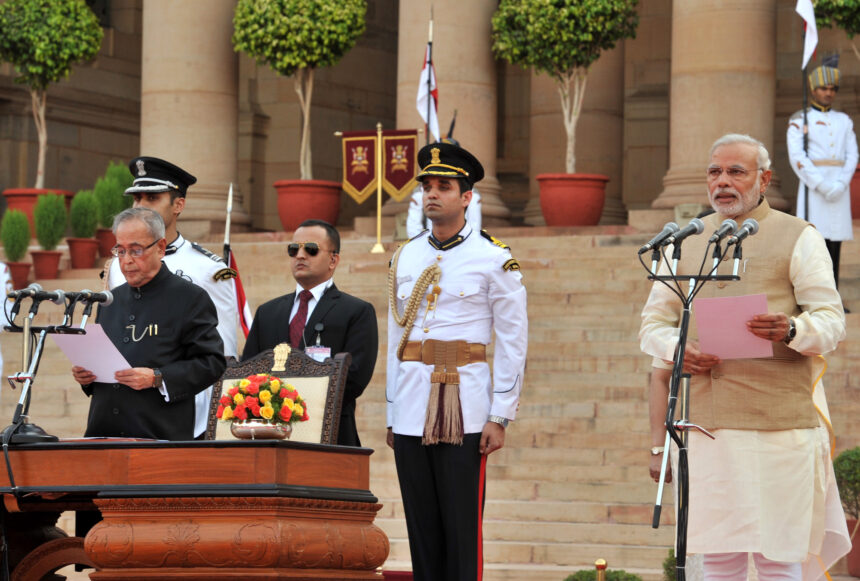
From New Delhi to Liverpool, May 26 has marked transformative moments — one in the corridors of political power, and the other in the halls of musical history.
May 26, 2014: A Defining Political Moment for India
The evening of May 26, 2014, witnessed a moment that would reshape the trajectory of Indian politics for the foreseeable future. On this day, Narendra Damodardas Modi, leader of the Bharatiya Janata Party (BJP), took oath as the 15th Prime Minister of India, marking a seismic shift from a decade-long Congress-led rule.
The ceremony, held at the forecourt of Rashtrapati Bhavan, was not just symbolic — it was strategic. Modi’s swearing-in was attended by over 4,000 dignitaries, including South Asian leaders like Pakistan’s Prime Minister Nawaz Sharif and Sri Lankan President Mahinda Rajapaksa, a diplomatic outreach never before seen at such events in India.
Modi, who was then 63, took the oath in Hindi, dressed in his signature kurta-waistcoat ensemble, promising to uphold the Constitution and serve the people of India without bias. His rise to national leadership followed a landslide victory in the 2014 general elections, where the BJP alone won 282 seats, the first single-party majority since 1984. With its NDA allies, the coalition reached 336 seats, while the once-dominant Congress managed a historic low of 44 seats.
This was more than just a victory — it was a political reset. Modi’s ascent represented the arrival of a new era in Indian politics: rooted in Hindutva politics, strong leadership narratives, and development-centric messaging.
As a political figure, Modi brought with him over 12 years of experience as Gujarat’s longest-serving Chief Minister, during which he had built a reputation — controversial to some and commendable to others — for rapid infrastructure development and governance efficiency. His slogan “Minimum Government, Maximum Governance” became the guiding philosophy of his first cabinet, which was considerably leaner than its Congress predecessor.
This marked not only a generational shift — Modi being the first PM born after Independence — but also a paradigm shift in the style of governance, with a sharper focus on centralization, digitalization, and mass communication through platforms like social media.
May 26, 1967: A Musical Revolution with Sgt. Pepper’s Lonely Hearts Club Band
While May 26 made political history in India in 2014, it had already made musical history decades earlier — on May 26, 1967, when The Beatles released their groundbreaking studio album, Sgt. Pepper’s Lonely Hearts Club Band.
Often cited as the first true “concept album”, it marked the Beatles’ conscious decision to move beyond the screaming crowds of live performances and into the realm of artistic experimentation. As Paul McCartney later remarked, “All that boy stuff, all that screaming — we didn’t want it anymore.”
This album not only altered the musical identity of The Beatles, but also redefined rock music itself. Packed with bold experimentation, psychedelic sounds, and lyrical depth, Sgt. Pepper’s became a milestone for what studio music could accomplish.
The album’s iconic cover — designed by Peter Blake and Jann Haworth — featured the band in flamboyant costumes, surrounded by cardboard cut-outs of historical and cultural icons. It is still considered one of the most influential album covers of all time.
Commercially, it was a juggernaut. It topped the UK Albums Chart for 27 weeks and the US Billboard 200 for 15 weeks. Critically, it won four Grammy Awards, including the coveted Album of the Year — the first rock LP to receive the honour.
But Sgt. Pepper’s impact went far beyond sales and awards. It marked a cultural transformation, aligning with the broader counterculture movement of the 1960s, and influencing generations of musicians to come. It wasn’t just an album; it was a statement.
Conclusion: Two Events, One Date — A Legacy of Change
May 26 thus remains an enduring symbol of transformation, both in India’s political realm and in the global music scene. One event reshaped how power is exercised in the world’s largest democracy; the other redefined how music could be conceived and consumed.
Together, these milestones reflect the spirit of evolution — of breaking from tradition to forge new paths.