Newswise — Synthetic aperture radar is widely valued because it can capture high-resolution images in all weather and at all times of day. Despite these advantages, SAR images are still difficult to interpret physically: complex 3D structures are compressed into 2-dimensional (2D) signatures, and often manifest as strong scattering, such as as bright points or lines. Existing approaches, including manual scattering-center annotation, forward simulation, and inverse fitting, can be labor-intensive, computationally demanding, or limited in physical interpretability and generalization. Differentiable rendering has opened new possibilities. However, SAR still requires forward models that can handle shadowing and complex scattering behavior to achieve sufficient fidelity. Driven by these needs, establishing a direct mapping between strong scattering information in SAR images and 3D target geometry has become an essential research focus.
Researchers from the Aerospace Information Research Institute of the Chinese Academy of Sciences, the Aerospace Information Technology University, the Suzhou Aerospace Information Research Institute, and related laboratories reported (DOI: 10.34133/remotesensing.1030) the study in the Journal of Remote Sensing, published on February 19, 2026. The team worked to address a central challenge in the SAR field: how to connect bright scattering in a 2D radar image with the actual 3D structures that produced it. Their solution is a novel method that maps strong scattering information directly to 3D target geometry using a customized differentiable SAR simulator.
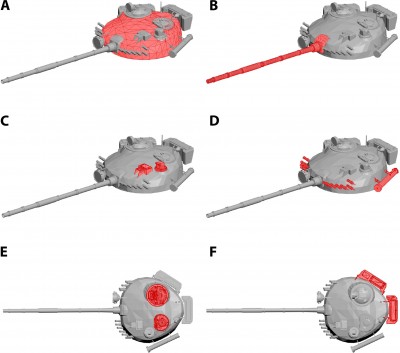
The core advance of this approach lies in forming what the authors call prominent scattering regions to explicitly represent this mapping. Instead of relying on manual labeling or purely black-box fitting, the simulator uses physically meaningful operators and reveals the importance of different locations on the target in contributing to the scattering at a given viewing angle by adjusting the scattering intensity attributes of target vertices. The framework worked on both a simple radar-reflector scene and a complex T72 tank model. For the simple target, it outperformed soft-rasterizer-based differentiable rendering, reducing average LPIPS by nearly 0.35 while increasing PSNR by 13.63 dB, NCC by 0.509, and SSIM by 0.469. The study also reports processing times under 7 minutes for the simple target and under 10 minutes even for the complex one.
The simulator works in two linked stages. In forward simulation, it transforms the target into the SAR sensor coordinate system, computes facet-level scattering geometry, applies shadow constraints to determine visibility, and accumulates scattering information to generate a simulated SAR image. In inverse mapping, it compares that image with the ground-truth SAR image data and uses backpropagation plus gradient descent to update a scattering-intensity attribute for target vertices, while keeping the underlying geometry fixed. To preserve differentiability, the team approximated scattering with a Blinn–Phong model rather than more complex non-differentiable electromagnetic formulations. The ground-truth SAR image data were generated with RaySAR across 24 viewing angles, with 124 × 124 pixels at 0.2 m range and azimuth resolution.
The research team’s findings suggest that SAR interpretation can move beyond recognizing targets in 2D images toward explaining which exact 3D structures generate dominant scattering. In that sense, the method offers not only better simulation fidelity but also a more physically interpretable framework for target analysis, especially when analysts need to understand why a SAR image looks the way it does.
The experiments were implemented in PyTorch and trained on an NVIDIA GeForce RTX3060 GPU. The authors tested two target types: a simple scene built from typical radar reflectors and a complex T72 main battle tank model. To preserve key scattering features, these ground-truth images were simulated with relatively low background noise to preserve key scattering features. Image quality and similarity were evaluated using Learned Perceptual Image Patch Similarity (LPIPS), Peak Signal-to-Noise Ratio (PSNR), Normalized Cross-Correlation (NCC), and Structural Similarity Index Measure (SSIM), while optimization used the Adam algorithm with a learning rate of 0.005.
The study lays the foundation for developing a new generation of more interpretable SAR analysis tools, with possible applications in target understanding, scattering-mechanism analysis, and high-fidelity SAR simulation. The authors also note current challenges at high elevation angles, where projection compression can make strong scattering features overlap. Future work may incorporate viewing-angle-aware strategies, geometric correction, and richer training data to improve robustness. If successful, such advances could strengthen remote-sensing workflows for defense, surveillance, and Earth observation where understanding target structure matters as much as detecting it.
###
References
DOI
Original Source URL
https://spj.science.org/doi/10.34133/remotesensing.1030
Funding information
This research was supported by the Strategic Priority Research Program of the Chinese Academy of Sciences, grant nos. XDB0870000 and XDB0870100.
About Journal of Remote Sensing
Journal of Remote Sensing, an online-only Open Access journal published in association with AIR-CAS, promotes the theory, science, and technology of remote sensing, as well as interdisciplinary research within earth and information science.
https%3A%2F%2Fwww.newswise.com%2Farticles%2Fmapping-radar-scattering-onto-3d-targets%2F%3Fsc%3Drsla