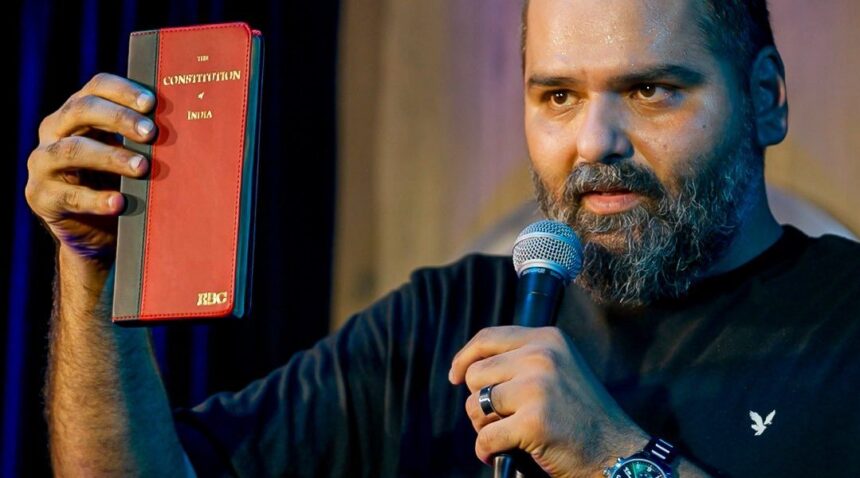
Comedian Kunal Kamra has approached the Bombay High Court seeking the quashing of an FIR filed against him for a joke made during a stand-up performance, which was allegedly aimed at Maharashtra Deputy Chief Minister Eknath Shinde. Kunal Kamra, who filed the plea on April 5, contends that the legal action against him violates his constitutional rights, including freedom of speech, the right to profession, and the right to life and liberty.
Legal plea and court proceedings
Kunal Kamra’s petition, filed through advocate Meenaz Kakalia, argues that the FIR infringes upon his fundamental rights guaranteed under Articles 19 and 21 of the Constitution. The plea is expected to be heard by a bench headed by Justice Sarang Kotwal on April 21. The comedian, who resides in Tamil Nadu, had previously been granted interim transit anticipatory bail by the Madras High Court in connection with the case.
The FIR against Kunal Kamra was registered under sections 353(1)(b) (statements conducing to public mischief) and 356(2) (defamation) of the Bharatiya Nyaya Sanhita. The complaint was filed by Shiv Sena MLA Murji Patel following a stand-up act that sparked political outrage.
The incident and fallout
The controversy erupted after Kunal Kamra posted a clip on Instagram from one of his performances in March. In the video, he parodied a popular song from the 1997 film “Dil Toh Pagal Hai,” and in a veiled manner, referred to Eknath Shinde as a “gaddar” or traitor. The routine also included jabs at Shinde’s political rebellion against Uddhav Thackeray.
The act triggered strong reactions from Shinde’s supporters and Shiv Sena workers. Following the show’s release, a group allegedly vandalized the Habitat studio in Mumbai, where Kunal Kamra had performed. Twelve individuals were arrested in connection with the violence and were later granted bail. Despite being summoned three times, Kunal Kamra did not appear before the Mumbai police for questioning.
Reacting to the incident, Maharashtra Deputy CM Devendra Fadnavis stressed that while humour and satire are welcome, the freedom of expression should not lead to what he described as “tyranny.” His remarks reflected the administration’s position on the thin line between satire and perceived defamation in political commentary.