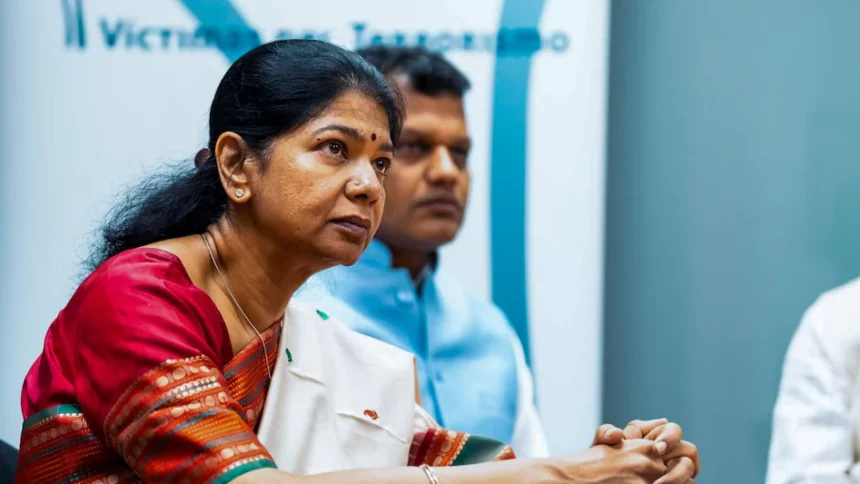
During a press conference in Spain, DMK MP Kanimozhi offered a pointed and thoughtful response to a question on India’s national language amid an ongoing row between the Centre and Tamil Nadu. Representing India in an all-party delegation aimed at exposing Pakistan-sponsored terrorism abroad, Kanimozhi said, “India’s national language is unity in diversity.” Her statement has since gone viral on social media, drawing praise across political lines for its clarity and inclusivity.
The delegation, led by Kanimozhi, is part of a larger initiative involving seven multi-party teams visiting 33 countries. Their objective is to present India’s case on global platforms, particularly highlighting the threat posed by cross-border terrorism. Kanimozhi’s group is scheduled to visit Spain, Greece, Slovenia, Latvia, and Russia as part of this effort. Other members of her delegation include Rajeev Rai from the Samajwadi Party, Mian Altaf Ahmad of the National Conference, BJP’s Brijesh Chowta, Prem Chand Gupta from RJD, AAP’s Ashok Kumar Mittal, and former diplomats Manjeev Singh Puri and Jawed Ashraf.
Centre vs DMK on National Language Debate
The language issue surfaced following the implementation of the BJP-led Centre’s National Education Policy, which includes a three-language formula making Hindi mandatory across all states. The DMK, which leads the government in Tamil Nadu, has strongly opposed the move, calling it an attack on India’s federal structure and an imposition of Hindi. When asked about this during the Spain visit, Kanimozhi refrained from engaging in direct criticism, instead offering a broader message: “What we want to tell the world is that India stands for unity in diversity—and that is our greatest strength.”
Her diplomatic response drew attention not only for its tone but also for redirecting the global narrative to India’s inclusive identity at a time when the country is actively countering Pakistan’s misinformation campaigns abroad.
India’s Push Against Pakistan-Based Terrorism
Speaking further on the mission, Kanimozhi emphasised the distinction between terror incidents in India and those in other nations. She pointed out that India’s situation is unique as the terrorism it faces is state-sponsored. “We have been able to explain to the world that the terror attacks in India are backed by a neighbouring country. Our government and the Prime Minister have made it clear—we will no longer differentiate between a terror group and a nation that supports terrorism,” she said.