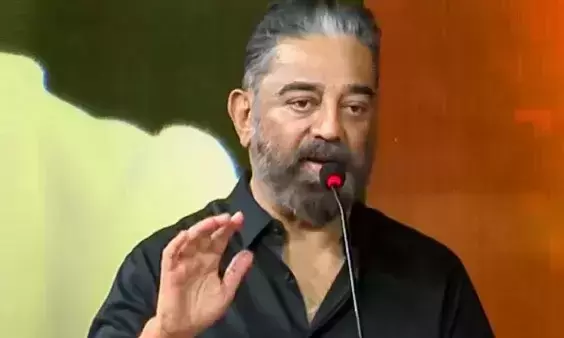
Actor-turned-politician Kamal Haasan has strongly criticized the central government over the issues of Hindi imposition and delimitation, accusing it of attempting to turn India into a “Hindia” by imposing the language on non-Hindi speaking states. Speaking at a meeting of Tamil political parties, Kamal Haasan warned that Tamil Nadu would not accept any attempt to enforce Hindi and demanded that the central government address concerns over the delimitation process fairly.
Kamal Haasan’s remarks echoed those made by Tamil Nadu Chief Minister MK Stalin in 2019, when he had firmly rejected the idea of Hindi as a unifying language for India. At the meeting, Tamil parties passed a resolution against the alleged Hindi imposition and sent it to Prime Minister Narendra Modi, emphasizing their opposition to any attempts to enforce the language in southern states.
The controversy gained momentum after Union Education Minister Dharmendra Pradhan recently warned that funds might be withheld if Tamil Nadu did not implement the three-language policy. This sparked strong reactions from DMK leaders, including Stalin’s son and state minister Udhayanidhi Stalin, who declared that Tamil Nadu was prepared for another ‘language war’ if necessary. Kamal Haasan supported this stance, reminding the Centre that Tamil Nadu had a history of protesting against linguistic imposition and would continue to do so if pushed.
Beyond the language issue, Kamal Haasan also voiced concerns over delimitation, which involves redrawing the boundaries of parliamentary constituencies based on population changes. Southern states, particularly Tamil Nadu, fear that a population-based delimitation exercise would disproportionately favor northern states, leading to reduced representation for the south in Parliament. These concerns stem from the fact that Tamil Nadu and other southern states have successfully controlled their populations, whereas northern states have seen higher population growth rates.
Kamal Haasan argued that rather than redistributing parliamentary seats based on population, the Centre should increase the number of legislative assembly members proportionally across all states. With Tamil Nadu set for an Assembly election next year, this demand holds particular significance.
He questioned the need for frequent changes to a system that is already functioning effectively, warning that the country’s federal structure could be at risk if non-Hindi speaking states are disproportionately affected. The resolution submitted to Prime Minister Modi by Tamil political parties demanded that any future delimitation process should be based on the 1971 population census and maintained for another 30 years to encourage responsible population control measures nationwide.
In response to growing concerns, Union Home Minister Amit Shah recently assured Tamil Nadu and other southern states that they would not lose parliamentary seats under any new delimitation process. However, Chief Minister Stalin remains unconvinced, arguing that even if southern states do not lose seats, an increase in northern states’ representation would still shift the balance of power disproportionately in favor of the Hindi-speaking regions.
As the debate over Hindi imposition and delimitation intensifies, Tamil Nadu leaders, including Kamal Haasan, continue to push for a fair and balanced approach that safeguards the interests of all states while maintaining the country’s federal structure.