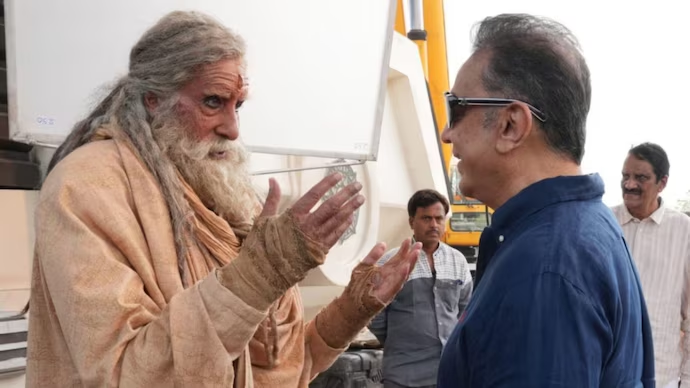
The sequel to Kalki has officially gone on floors in Hyderabad, bringing together two legends of Indian cinema—Amitabh Bachchan and Kamal Haasan—for their first on-screen collaboration in nearly four decades, a reunion that has stirred nostalgia and anticipation across the film industry.
The announcement of the shoot for Kalki 2 has generated widespread excitement, but it is the reunion of Bachchan and Haasan that has elevated the moment into a cinematic milestone. Their last collaboration dates back to 1985 in the film Geraftaar, a project remembered for its powerful ensemble cast and strong box-office performance. The prospect of the two veterans sharing screen space again after nearly 40 years carries both emotional and historical significance for audiences across generations.
Amitabh Bachchan confirmed the reunion through a post on his personal blog, expressing his enthusiasm about working once again with Kamal Haasan. Reflecting on their previous collaboration, he mentioned Geraftaar as the last time the two had acted together. The candid note immediately resonated with fans who associate both actors with some of the most defining moments in Indian cinema.
The filming of Kalki 2 commenced in Hyderabad, where the cast and crew have begun early production schedules. Though plot details remain under wraps, the sequel is expected to expand the ambitious cinematic universe established by its predecessor. The presence of Bachchan and Haasan suggests that the narrative will continue to blend scale, gravitas and star power.
A reunion rooted in cinematic legacy
The 1985 film Geraftaar holds a special place in Indian film history. Directed by Prayag Raj, it featured an ensemble that included Amitabh Bachchan, Kamal Haasan and Rajinikanth. At a time when multi-starrer films defined box-office success, Geraftaar stood out for uniting leading stars from different linguistic film industries. It symbolised a pan-Indian cinematic collaboration long before the term became mainstream.
The renewed collaboration in Kalki 2 mirrors that earlier moment of cross-industry synergy. Bachchan, often regarded as the towering figure of Hindi cinema, and Haasan, celebrated for his versatility across Tamil and other Indian languages, represent distinct yet overlapping cinematic legacies. Their reunion bridges eras, styles and regional industries, reinforcing the evolving nature of Indian filmmaking.
For audiences who grew up watching their earlier performances, the news rekindles memories of a time when star power defined theatrical experiences. For younger viewers, it introduces a collaboration shaped by decades of artistic evolution. Both actors have continued to reinvent themselves across generations, maintaining relevance in an industry that constantly shifts in tone and technology.
Bachchan, in his blog post, also addressed his absence from his customary Sunday Darshan interaction with fans, explaining that work commitments had kept him occupied. His message, emphasising dedication to work before rest, underscored the professional discipline that has defined his decades-long career.
Kamal Haasan, meanwhile, remains one of the most respected figures in Indian cinema, known for balancing mainstream appeal with experimental storytelling. His participation in Kalki 2 adds weight to the sequel’s ambitions and signals a continuation of large-scale storytelling anchored by strong character portrayals.
Why this collaboration resonates beyond nostalgia
The reunion carries significance beyond its nostalgic appeal. Indian cinema in recent years has increasingly embraced large-scale productions that cut across linguistic and regional boundaries. Films now aim for pan-Indian releases, with multilingual casting becoming more common. The presence of Amitabh Bachchan and Kamal Haasan together reflects this broader industry shift toward integrated storytelling.
Their earlier film Geraftaar was notable for uniting stars from Hindi, Tamil and Kannada cinema in one narrative. That collaboration helped expand audience reach across regions. Kalki 2 appears to extend that spirit, positioning itself as a project that transcends linguistic divides and appeals to a nationwide and global audience.
The impact of this reunion also lies in the symbolic passing of eras. Both actors have witnessed and shaped multiple phases of Indian cinema—from the dominance of theatrical releases in the 1970s and 1980s to the digital and streaming transformations of the 21st century. Seeing them together once more offers a sense of continuity in an industry often defined by rapid turnover.
Beyond Bachchan and Haasan, Kalki 2 is expected to feature a strong ensemble cast, further strengthening its pan-Indian appeal. The sequel’s production schedule in Hyderabad suggests that major studio infrastructure is being leveraged to mount a film of considerable scale.
Social media platforms were quick to react to images from the set, with fans celebrating the reunion as a historic cinematic moment. The phrase “history repeating itself” has frequently accompanied discussions around the project, underscoring the rarity of such collaborations.
In an industry where generational shifts are constant, the reunion of Amitabh Bachchan and Kamal Haasan stands as a reminder of the enduring power of star charisma. Their shared screen presence in Kalki 2 is poised to become one of the defining attractions of the film, blending legacy with contemporary storytelling ambition.