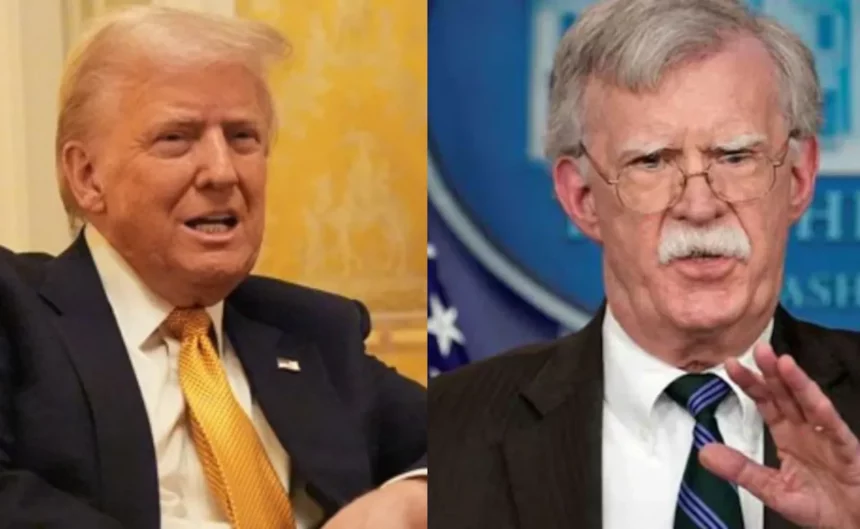
Former United States National Security Advisor John Bolton has once again voiced sharp criticism of former President Donald Trump, this time over the imposition of tariffs on India. Bolton argued that Trump has “lost the bigger strategic picture,” suggesting that while the tariffs targeted India, other countries like Russia and China, which maintain substantial economic and strategic leverage, remained largely unaffected. Bolton’s remarks highlight growing concerns about the long-term impact of the Trump administration’s unilateral trade measures on America’s strategic relationships and global influence.
Trump’s Tariffs and India: A Strategic Blind Spot
John Bolton, who served as the US national security adviser under Trump, emphasised that the tariffs on India represented a significant miscalculation in terms of global strategy. “Trump has lost the bigger strategic picture. I think he has done it again by sanctioning India. He hasn’t gone after Russia directly or China, which buys more Russian oil than India,” Bolton remarked, underlining the selective approach of the tariffs and the potential consequences for US-India relations.
Bolton’s critique reflects a broader concern among foreign policy experts that Trump’s economic measures often prioritized short-term political gains over long-term strategic objectives. By imposing tariffs on India, a critical partner in balancing regional power dynamics in Asia, Bolton argues that Trump undermined decades of efforts to strengthen alliances and counterbalance the influence of China in the Indo-Pacific region. He warned that such unilateral trade actions risk alienating countries that play crucial roles in global security architecture, while failing to exert meaningful pressure on nations whose actions pose more direct strategic challenges.
India, according to Bolton, responded to these tariffs with a combination of restraint and back-channel diplomacy. He lauded India’s approach, noting that the country avoided engaging in public disputes, which could have escalated tensions further. “I think that’s the best way to deal with somebody like Trump. If you take the bait and get into a public back-and-forth with him, it’s not going to make things any easier,” Bolton explained. By relying on measured diplomacy, India managed to maintain stability in bilateral relations, even as economic tensions simmered.
Bolton’s observations highlight the delicate balance that nations like India must navigate when dealing with leaders whose policies may be unpredictable or driven by domestic political calculations rather than long-term strategic considerations. India’s measured response, Bolton argued, was both pragmatic and necessary to preserve strategic autonomy while safeguarding its interests in trade and defence cooperation with the United States.
Long-Term Implications for US-India Relations and Global Strategy
Bolton further argued that Trump’s tariffs “shredded” decades of Western efforts to align India away from its historical Cold War ties with the Soviet Union. For decades, the United States had sought to build India into a strategic partner capable of countering the growing influence of China in Asia. Bolton noted that unilateral punitive measures risked eroding the trust and goodwill that underpin such partnerships.
India’s strategic significance, Bolton emphasized, extends beyond trade. As a rapidly growing economy with significant military capabilities and a crucial role in regional security frameworks, India has become a cornerstone of US efforts to ensure stability in the Indo-Pacific. By imposing tariffs without adequately considering broader geopolitical implications, Bolton suggested that Trump’s administration disrupted ongoing initiatives to strengthen collaborative security, intelligence sharing, and economic cooperation between the two nations.
Moreover, Bolton highlighted the contrasting responses to different global actors. While India faced tariffs, countries like China continued to maintain robust trade relations with the United States despite ongoing tensions, and Russia remained largely insulated from direct sanctions related to energy trade. This selective approach, Bolton argued, not only weakened America’s negotiating position but also undermined its credibility as a consistent and reliable strategic partner.
Bolton’s critique also extended to the broader philosophy of Trump’s foreign policy, which he characterized as reactive and transactional. The former adviser noted that policymakers must weigh the potential long-term repercussions of economic measures on strategic alliances. “You cannot approach complex geopolitical relationships solely through the lens of short-term trade deficits or political optics,” he warned, emphasizing that the interplay of economic and security interests requires careful calibration to avoid unintended consequences.
Reflecting on India’s approach, Bolton underscored the importance of restraint, diplomacy, and measured engagement in managing relations with unpredictable partners. By maintaining discretion and avoiding public confrontation, India preserved its strategic leverage while signaling that it would not be coerced into concessions through unilateral measures. This, according to Bolton, was a critical demonstration of statecraft, highlighting how smaller and medium-sized powers can navigate asymmetric relationships with global superpowers.
Bolton’s insights also underscore the complexity of US-India relations in the context of a rapidly shifting global order. With China asserting its influence across Asia, and Russia maintaining strategic ties in key regions, India’s alignment with the United States has become increasingly significant. By miscalculating the strategic importance of India, Bolton argued, Trump risked undermining American efforts to build a coalition capable of maintaining regional stability and countering potential adversaries.
John Bolton, who resigned from his post as national security adviser due to differences with Trump over foreign policy, has consistently been vocal about the importance of long-term strategic thinking. His criticism of the tariffs on India is consistent with his broader argument that America must prioritize alliances, regional partnerships, and multilateral cooperation over transactional and ad hoc policies. He has repeatedly emphasized that strategic vision should guide economic and military decisions, warning that reactive policies can have ripple effects that compromise national security objectives.
In conclusion, Bolton’s observations serve as a reminder of the delicate balance required in international relations. Trade policies, sanctions, and tariffs cannot be viewed in isolation but must be integrated within a broader framework of strategic priorities. For India, Bolton’s remarks validate the cautious and measured approach it adopted during Trump’s presidency, highlighting the country’s emphasis on preserving sovereignty, maintaining strategic partnerships, and ensuring long-term stability in the Indo-Pacific region.
The critique of Trump’s tariffs is not merely an economic argument but a commentary on global diplomacy, strategic foresight, and the consequences of short-term policymaking. Bolton’s perspective underscores the need for American policymakers to engage with partners like India thoughtfully, acknowledging both the economic and security dimensions of bilateral relations, and avoiding actions that could inadvertently weaken strategic alignments that have taken decades to build.