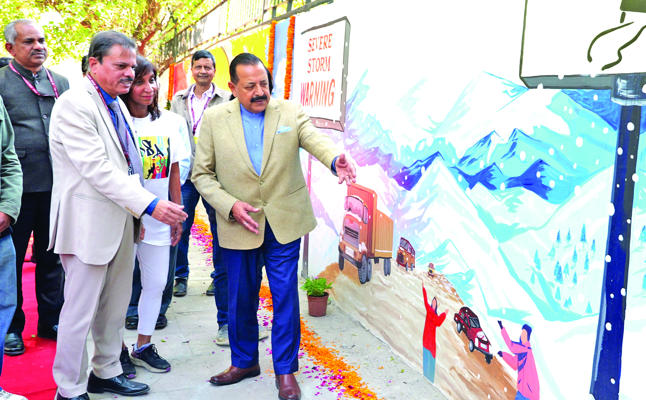
Union Minister of State for Science and Technology and Minister of State for the Prime Minister’s Office Jitendra Singh inaugurated India’s first open-air art wall museum at Mausam Bhawan in New Delhi on Tuesday. This unique artistic initiative marks the 150-year journey of the India Meteorological Department and serves as a vibrant visual representation of India’s advancements in weather science.
Developed in collaboration with Delhi Street Art, the project transforms the walls of the India Meteorological Department’s headquarters on Lodhi Road into a large-scale exhibition, bringing meteorology to life through powerful imagery. The artwork showcases India’s rich meteorological history, the evolution of weather forecasting, and the impact of climate science on various sectors, including agriculture, disaster management, and daily life.
Speaking at the inauguration ceremony, Jitendra Singh praised the India Meteorological Department’s contributions in providing timely and accurate weather forecasts that have played a crucial role in India’s socio-economic growth. He highlighted the department’s role in leveraging cutting-edge technology to address the challenges posed by an ever-changing climate. By merging art and science, he said, this initiative would engage the public and enhance awareness about meteorology’s significance in everyday life.
The Mausam Bhawan special art showcase features 38 unique murals illustrating pivotal meteorological events, scientific breakthroughs, and the India Meteorological Department’s crucial role in issuing early warnings for extreme weather conditions such as cyclones and monsoons. The artwork also highlights advancements in technology, including satellites and radars, which have significantly improved weather predictions and disaster preparedness.
Jitendra Singh acknowledged the efforts of Delhi Street Art and its late founder Yogesh Saini, whose vision transformed public spaces into creative hubs. He emphasized that art is a powerful medium for communication and that this project effectively bridges the gap between scientific knowledge and public understanding. He also noted that the India Meteorological Department’s pioneering efforts have strengthened disaster risk management and contributed to economic sectors such as aviation, marine industries, and agriculture by equipping stakeholders with accurate forecasts.
Muthusamy Ravichandran, Secretary of the Ministry of Earth Sciences, highlighted that this artistic initiative aligns with the India Meteorological Department’s broader efforts to engage the public and foster awareness about the importance of meteorology. He stated that presenting scientific knowledge through creative means can make complex meteorological concepts more accessible to people.
The murals also pay tribute to India’s cultural and literary heritage by incorporating references to Kalidasa’s Meghaduta and Tansen’s legendary ability to influence weather through music. Other artworks depict India’s diverse climatic zones, weather safety guidelines, and the scientific evolution of meteorology. The Ministry of Earth Sciences emphasized that this initiative reflects a blend of art and science aimed at educating and inspiring future generations.
Jitendra Singh reiterated the government’s commitment to strengthening India’s meteorological capabilities through continuous investment in research, technology, and infrastructure. He praised the efforts of the India Meteorological Department’s scientists and the artistic team for creating an initiative that not only informs but also captivates the public’s imagination.