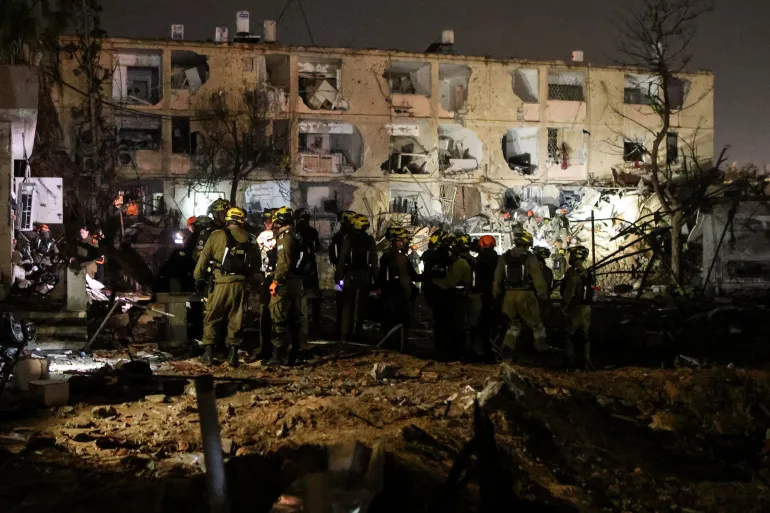
A dramatic escalation in the ongoing conflict between Iran and Israel has triggered global alarm after Iran launched one of its most significant missile attacks, targeting areas near Dimona Nuclear Facility in southern Israel. The strike, which reportedly hit residential areas in Dimona and Arad, has raised serious questions about the next phase of the conflict and whether it could spiral into a nuclear confrontation. Israeli Prime Minister Benjamin Netanyahu described the situation as “a very difficult evening,” highlighting the scale and impact of the attack. Reports indicate that hundreds were injured, while Iran has claimed a significantly higher casualty figure, reflecting the intensity of the strike and the uncertainty surrounding the ground situation. The fact that missiles landed close to one of Israel’s most sensitive nuclear sites has heightened global concern, as it represents a potential red line in the conflict.
Why Dimona Strike Has Escalated Nuclear Concerns
The targeting of areas near Dimona is particularly significant because the facility is widely believed to be at the core of Israel’s undeclared nuclear program. Although Israel maintains a policy of nuclear ambiguity, meaning it neither confirms nor denies possessing nuclear weapons, Dimona has long been associated with its nuclear capabilities. The strike marks the first time Iran has reportedly fired long-range missiles in close proximity to this sensitive location, raising questions about the effectiveness of Israel’s advanced air defence systems and the evolving capabilities of Iran’s missile arsenal. The inability to intercept some of these missiles has added to concerns within Israel’s security establishment and among global observers. The development has also intensified speculation about whether Israel might consider more extreme measures, including the potential use of nuclear weapons, if it perceives an existential threat. While there has been no official indication of such a move, the proximity of the attack to Dimona has brought the possibility into sharper focus.
Israel’s Nuclear Doctrine and the ‘Samson Option’ Debate
Israel’s nuclear policy is often described as one of deliberate ambiguity, designed to deter adversaries without explicitly confirming its capabilities. However, analysts frequently refer to the concept known as the “Samson Option,” which suggests that Israel could resort to nuclear weapons if its survival as a state were at risk. This doctrine implies a last-resort response rather than a first-strike policy. Experts emphasize that nuclear weapons are primarily seen as deterrents, not tools for active warfare. Despite this, statements by certain political figures and analysts have fueled debate about whether such an option could be considered in extreme circumstances. The recent escalation, combined with the scale of Iranian attacks, has revived discussions about how far Israel might go to defend itself. However, most strategic experts believe that any decision to use nuclear weapons would carry catastrophic consequences and is therefore highly unlikely unless the situation deteriorates dramatically.
Possible Military Scenarios and Global Impact
The current situation suggests multiple potential scenarios for how the conflict could evolve. Israel may intensify its conventional military operations, including air strikes and possibly ground incursions, to neutralize Iran’s capabilities. Reports indicate that Israeli leadership has already acknowledged the limitations of air strikes alone, hinting at the possibility of broader military strategies. On the other hand, Iran has demonstrated that its missile capabilities remain intact despite sustained attacks. The use of long-range missiles and the ability to bypass air defences indicate a level of resilience that could prolong the conflict. Iran has also made it clear that it will continue retaliatory strikes, framing the conflict as a fight for survival. If the situation escalates further, Iran could expand its attacks to include more strategic targets or disrupt critical global trade routes, increasing pressure on the international community to intervene. The potential consequences of a nuclear escalation would be devastating, including massive loss of life, environmental damage, and long-term geopolitical instability. It could also draw major global powers such as the United States, Russia, and China into a broader confrontation, significantly increasing the risk of a global crisis.
As the situation continues to evolve, the strike near Dimona marks a critical turning point in the Iran-Israel conflict. While immediate responses are likely to remain within conventional military limits, the underlying risks of escalation cannot be ignored. The coming days will be crucial in determining whether diplomatic efforts can de-escalate tensions or whether the conflict moves toward a more dangerous and unpredictable phase with far-reaching global consequences.