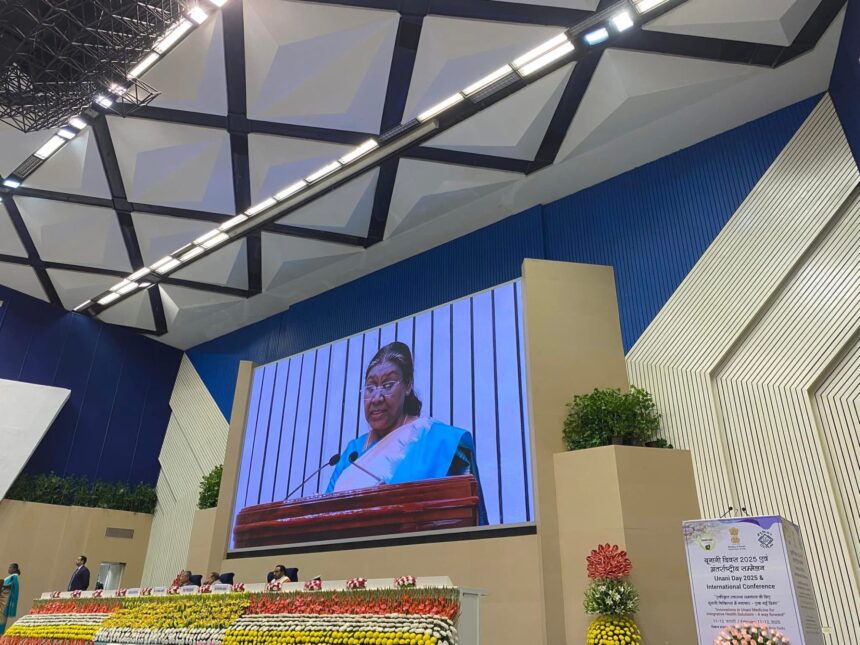
The International Conference on “Innovations in Unani Medicine for Integrative Health Solutions – A Way Forward,” organized by the Central Council for Research in Unani Medicine under the Ministry of Ayush, Government of India, successfully concluded at Vigyan Bhawan, New Delhi. The conference was part of the Unani Day 2025 celebrations and was held in a hybrid format, bringing together experts from across the world to discuss advancements in Unani medicine and its role in modern healthcare.
The event was inaugurated by President Droupadi Murmu in the presence of Jitendra Singh, Minister of State for Science and Technology (Independent Charge), and Prataprao Jadhav, Minister of State for Ayush. The conference featured high-level discussions and scientific sessions covering critical topics, including “Harnessing Artificial Intelligence and Machine Learning for Ayush/Traditional Medicine,” “Unani Medicine for Globalized Health,” and “Advancements in Regimental Therapies.” Experts from academia, industry, and research organizations engaged in deliberations on the potential of Unani medicine in addressing contemporary health challenges.
A key highlight of the conference was the official transfer of patented technology developed by the Central Council for Research in Unani Medicine. Innovations such as a Unani toothpaste for dental care and a specialized regimen for vitiligo treatment were handed over to leading companies, including Dehlvi Naturals and Hamdard Laboratories, marking a significant step in the commercialization of Unani-based healthcare solutions. These advancements reflect the council’s commitment to integrating Unani medicine with modern scientific research and expanding its accessibility to the global healthcare market.
The valedictory session saw an address by Monalisa Dash, Joint Secretary, Ministry of Ayush, who emphasized the rich heritage and holistic principles of Unani medicine. She underscored the importance of continued collaboration among stakeholders to enhance scientific validation and ensure wider global reach for Unani practices. The need for evidence-based research, she noted, remains crucial in positioning Unani medicine as a viable integrative healthcare solution.
N. Zaheer Ahmad, Director General of the Central Council for Research in Unani Medicine, reiterated the organization’s dedication to pioneering advanced research in Unani medicine. He highlighted the council’s ongoing efforts in promoting evidence-based practices, which have helped elevate the global recognition of Unani medicine. The conference concluded with the launch of new books and educational videos on Unani medicine, as well as the introduction of a barley-based Unani diet, further reinforcing the commitment to holistic and preventive healthcare solutions. The successful completion of the event reaffirmed Unani medicine’s potential to contribute significantly to integrative health and wellness on a global scale.