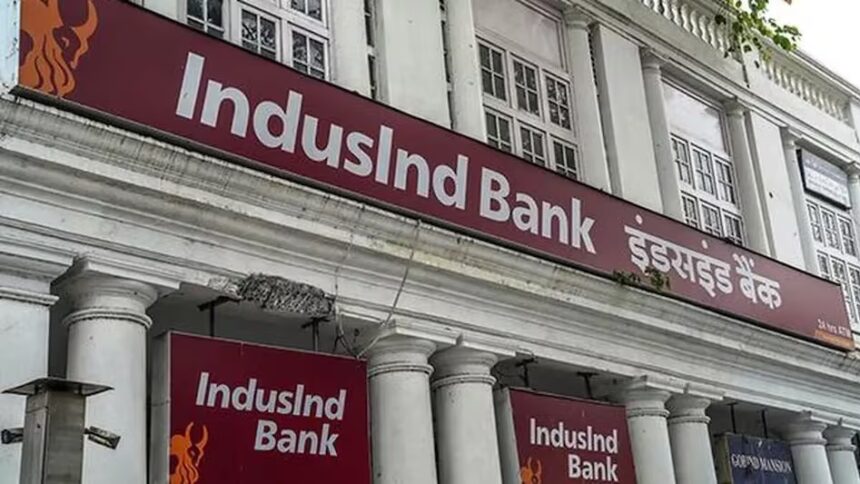
IndusInd Bank shares witnessed a sharp decline of nearly 3% in intraday trading after global brokerage firm Goldman Sachs downgraded the stock to a ‘sell’ rating, citing concerns over weak growth prospects and the potential for lower returns in the coming years. The downgrade reflects a cautious outlook on the bank’s fundamentals and signals a challenging period for the private lender in an increasingly competitive market environment.
Goldman Sachs, in its report, stated that IndusInd Bank has turned into a “weak franchise,” adding that it expects the bank to deliver lower earnings and return ratios going forward. The brokerage also revised its earnings per share (EPS) estimates for the bank, reducing them by 25% for FY26 and by 17% for FY27. This revision indicates Goldman Sachs’ lack of confidence in the bank’s ability to sustain growth and profitability at previously expected levels.
Target Price Revised Downwards
Goldman Sachs has set a target price of Rs 700 for IndusInd Bank, indicating a potential downside of 20.3% from its current market levels. The revised target reflects the brokerage’s concerns around the bank’s core operations, asset quality, and its ability to manage margins effectively amid a dynamic economic environment. The downgrade and revised target price have contributed to market caution around the bank’s stock, which has already been under pressure in recent sessions.
The global brokerage noted that while the bank has shown improvements in certain operational areas, challenges remain in scaling up its growth trajectory sustainably. Goldman Sachs’ report highlighted concerns over slower deposit growth, rising competition within the banking sector, and the bank’s asset quality performance, which could weigh on its near-term outlook. These factors have led to reduced expectations for the bank’s net interest margins and overall profitability in the coming quarters.
Concerns Over Return Ratios and Growth Prospects
The brokerage’s outlook also included a cautious view on the bank’s return on assets (RoA) and return on equity (RoE), suggesting that these ratios may remain under pressure due to subdued earnings performance. Goldman Sachs emphasized that while the broader banking sector in India continues to show resilience, IndusInd Bank’s relative positioning has weakened, making it less attractive compared to its peers.
The downgrade comes amid a period where Indian banks have generally benefited from stable credit demand and a supportive interest rate environment. However, Goldman Sachs believes that IndusInd Bank’s ability to capitalise on these trends is limited due to structural and operational challenges, which could hinder its growth momentum in the medium term.
Following the downgrade, investors are likely to watch IndusInd Bank’s upcoming quarterly earnings closely for any signs of improvement in operational metrics and clarity on its strategy to address growth concerns raised by the brokerage. The focus will be on the bank’s commentary regarding deposit mobilisation, loan growth, asset quality management, and its broader plans to enhance shareholder returns in a challenging environment.