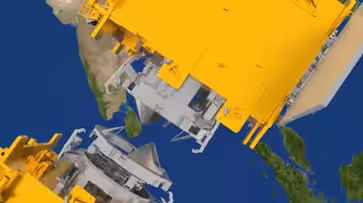
India’s SpaDeX Mission: A Historic Leap in Space Exploration
On January 16, 2025, India added another feather to its space exploration cap with the successful completion of its first-ever space docking mission, SpaDeX (Space Docking Experiment). This landmark achievement by the Indian Space Research Organisation (ISRO) demonstrated India’s technological prowess and strengthened its position as a global space leader.
The SpaDeX mission involved two satellites, Chaser and Target, performing complex docking and undocking maneuvers in orbit. This flawless demonstration of autonomous docking systems paves the way for advanced space technologies, including in-orbit refueling, satellite maintenance, and modular space assembly, ensuring cost-effective and sustainable solutions for future missions.
Technological Breakthroughs
The SpaDeX mission showcased ISRO’s ability to innovate with advanced sensors and real-time navigation systems, enabling precise satellite alignment in microgravity. Compared to global giants like NASA and Roscosmos, ISRO’s cost-effective approach has emerged as a beacon of hope for developing nations aspiring to enter the space domain.
The docking technology demonstrated by SpaDeX is critical for extending satellite lifespans, reducing the need for replacements, and optimizing operational costs. This is a significant milestone for sustainable and reusable spacecraft projects, contributing to a greener and more efficient future in space exploration.
Strategic and Geopolitical Significance
SpaDeX enhances India’s geopolitical standing by positioning ISRO as a reliable partner for space diplomacy and international collaborations. The technology aligns with India’s broader strategic goals, including countering China’s space ambitions through platforms like QUAD and BRICS. Moreover, SpaDeX’s dual-use capabilities strengthen national security by enhancing satellite-based surveillance and communication systems.
Economic Implications
The success of SpaDeX opens doors to billion-dollar contracts in satellite servicing, assembly, and in-orbit repairs. With the global space economy projected to reach $1 trillion by 2025, India is poised to play a significant role. SpaDeX’s innovations also align with futuristic projects like space tourism and commercial space stations, showcasing India’s readiness for the next frontier in space commerce.
Scientific and Exploratory Benefits
Docking technology, as demonstrated by SpaDeX, will be instrumental in future lunar and Martian missions. It enables modular assemblies, resource sharing, and effective space debris management, ensuring a cleaner and safer orbital environment. Additionally, integrating artificial intelligence and robotics into docking systems expands the scope of advanced space exploration.
Inspiration for Future Generations
SpaDeX’s success is a moment of pride for every Indian. It serves as an inspiration for the youth to pursue careers in STEM (Science, Technology, Engineering, Mathematics) fields, proving that dedication and innovation can make the impossible achievable.
Challenges and the Road Ahead
While SpaDeX is a significant milestone, ISRO faces challenges in refining precision-based tasks like alignment and synchronization. The organization is also committed to adopting environmentally friendly launches and carbon-neutral initiatives. ISRO’s long-term vision focuses on building space stations, interplanetary habitats, and deep-space exploration.
Global collaborations with agencies like NASA and ESA for joint projects further strengthen ISRO’s capabilities. Partnerships with Indian startups such as Skyroot and Agnikul are also bolstering India’s space ecosystem, making it future-ready for ambitious projects like Artemis Accords and Mars Sample Return missions.
SpaDeX is more than just a technological achievement; it is a symbol of India’s growing influence in the global space arena. This milestone not only highlights ISRO’s capabilities but also serves as a testament to India’s aspirations for sustainable and impactful space exploration. What do you think about India’s space future? Share your thoughts in the comments!
Watch full video here: https://youtu.be/eBq-O1vL-x4