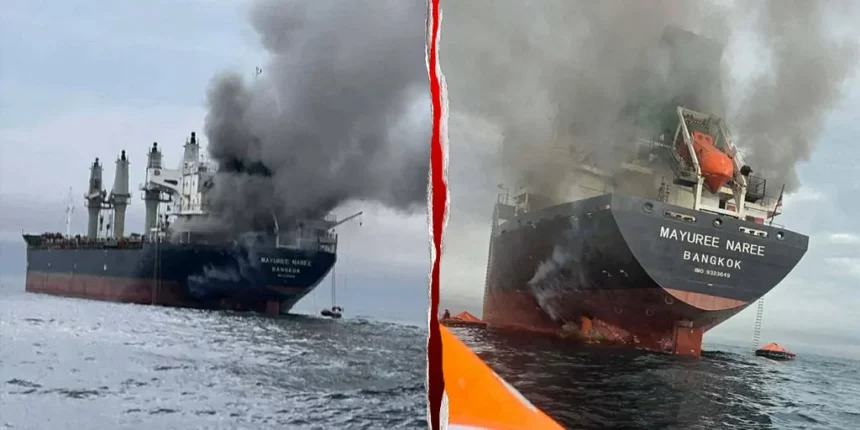
An Indian cargo vessel travelling from Dubai to Yemen sank in the Strait of Hormuz after reportedly getting caught in crossfire between Iranian and American naval forces, triggering fresh concerns over the safety of commercial shipping routes amid escalating tensions in West Asia. The incident resulted in the death of one Indian crew member while 17 others were rescued safely after dramatic emergency operations in international waters.
The cargo ship, identified as MSV AL FAIZE NOORE SULEMANI-I, belonged to Salaya in Gujarat’s Dwarka district and was transporting general cargo from Dubai to Mukalla port in Yemen when the tragedy occurred late on the night of May 7.
According to officials associated with the Indian Sailing Vessels Association, the vessel came under severe damage after naval firing intensified in the Strait of Hormuz, one of the world’s most strategically sensitive maritime routes. The ship reportedly started taking on water rapidly before eventually sinking into the sea.
The deceased crew member was identified as Altaf Talab Ker, who was working inside the engine room at the time of the incident. Reports indicated that he suffered critical injuries during the firing and died before rescue operations could be completed.
The remaining 17 crew members, including a security gunman who was onboard the vessel, were rescued by another passing cargo ship identified as MSV Prem Sagar-I. The rescue operation prevented a much larger tragedy and ensured the surviving crew members were brought safely back toward Dubai.
The incident has once again highlighted the growing risks faced by civilian and commercial vessels operating in and around the Strait of Hormuz amid rising military tensions involving Iran, the United States and allied naval forces.
According to Adam Bhai, General Secretary of the Indian Sailing Vessels Association, the vessel was passing through the Strait of Hormuz around 1 AM when heavy firing reportedly broke out between Iranian and American naval units operating in the region.
The Gujarat-based cargo ship allegedly became trapped in the middle of the confrontation and sustained severe structural damage. Water rapidly entered the vessel, making survival operations increasingly difficult for the crew members onboard.
The Strait of Hormuz remains one of the world’s most important maritime oil and trade corridors. A significant portion of global crude oil exports and commercial shipping traffic passes through the narrow waterway connecting the Persian Gulf with international sea routes.
Any military escalation in the region immediately creates risks for commercial vessels, oil tankers and cargo operations. Shipping companies and maritime authorities across the world have remained on high alert in recent weeks because of fears regarding naval confrontations, missile attacks and possible disruptions to global trade routes.
The latest tragedy involving the Indian cargo ship has intensified concerns within India’s maritime sector regarding the safety of Indian sailors and commercial vessels operating near conflict zones.
The rescued crew members reportedly reached Dubai Port safely late on May 8 after being evacuated by the assisting vessel. Videos of the rescued sailors were also reportedly shared with media outlets by maritime association officials.
As news of the sinking spread in Salaya and surrounding coastal communities in Gujarat, grief and shock spread rapidly among local residents and the fishing community. Salaya has historically remained closely connected with maritime trade and commercial sailing activities, with several families dependent on shipping-related occupations.
The Indian Sailing Vessels Association has now approached Indian diplomatic authorities in Dubai seeking urgent assistance regarding the incident. Officials have reportedly requested support from the Indian Embassy for handling legal formalities, repatriation arrangements and the welfare of the surviving crew members.
Among the key demands raised by the association are arrangements for the final rites of the deceased crew member Altaf Talab Ker, assistance in obtaining official documents including the death certificate and post-mortem report and ensuring the safe return of the rescued sailors to India.
The association has also called for stronger international maritime protection measures for Indian commercial vessels travelling through sensitive geopolitical regions.
Indian authorities are understood to be actively coordinating with diplomatic officials and maritime agencies following the incident. The process of bringing the surviving crew members back to India has reportedly already been initiated.
The tragedy comes at a time when geopolitical tensions across the Gulf region remain extremely high due to continuing confrontation involving Iran, the United States and regional security alliances.
The Strait of Hormuz has increasingly become a focal point of international concern because even minor military incidents in the region can rapidly escalate into broader maritime security crises affecting energy markets, shipping routes and global trade systems.
Shipping companies operating through the Gulf region have already been facing rising insurance costs, enhanced naval monitoring and increased operational risks because of geopolitical instability.
Commercial maritime operators remain especially vulnerable during military escalations because civilian cargo vessels often travel through heavily monitored strategic sea lanes used simultaneously by naval forces.
Industry experts say the latest incident demonstrates how quickly regional military tensions can directly threaten civilian lives and commercial shipping operations.
India has significant strategic interests in maintaining stability across Gulf maritime routes because a large share of the country’s crude oil imports and international trade passes through the region.
Thousands of Indian sailors and maritime workers are also employed across commercial shipping networks connected to the Middle East, making regional security an important issue for Indian authorities.
The sinking of the Gujarat cargo vessel may now trigger fresh discussions regarding naval escort systems, emergency maritime coordination and safety advisories for Indian ships travelling through conflict-sensitive waters.
Global shipping companies have increasingly started reviewing operational routes and security protocols because of fears regarding missile attacks, drone threats and accidental involvement in military confrontations.
The incident also reflects the broader economic and humanitarian consequences of prolonged geopolitical instability in West Asia. Beyond diplomatic and military tensions, regional conflicts continue affecting civilian workers, international trade and global shipping networks.
As investigations into the incident continue, attention is expected to remain focused on maritime security conditions in the Strait of Hormuz and the risks facing commercial vessels operating near active military zones.
For the families of the crew members involved, however, the tragedy has already left a lasting emotional impact. While 17 sailors survived the sinking through timely rescue efforts, the death of Altaf Talab Ker has become a painful reminder of the dangers faced by civilian maritime workers caught in the middle of international conflicts.