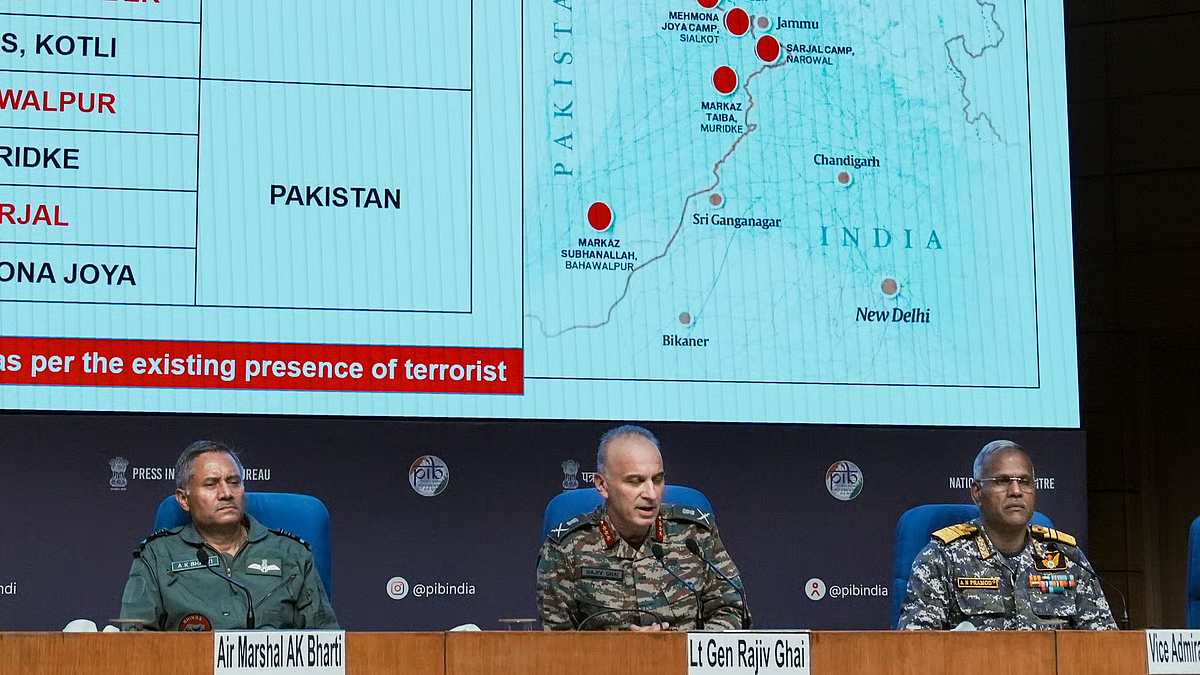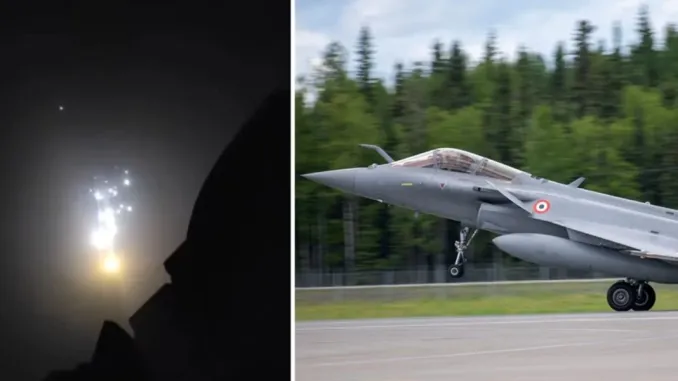
In a significant display of military might, India’s air defence system successfully thwarted multiple attacks from Pakistan, including the downing of a Pakistani Mirage fighter jet. This event took place during escalating tensions between the two nations following India’s Operation Sindoor on May 7, targeting terror facilities in Pakistan-occupied Jammu and Kashmir (PoJK) and other areas. The visuals of the destroyed Mirage jet were revealed in an audio-visual (AV) presentation ahead of a press briefing by India’s top military officials. This destruction showcased the effectiveness of India’s air defence infrastructure and its ability to repel threats posed by Pakistan’s military.
Pakistan’s Attacks and Indian Response
The footage shared by Indian military officials showed the wreckage of a Mirage fighter jet, which had been downed by India’s advanced air defence systems. The Indian military’s Integrated Air Command and Control System, coupled with Akash missiles and other indigenous technologies, played a key role in countering a series of attacks from Pakistan. These included missile strikes, drones, and fighter jet incursions into Indian airspace. The Director General of Air Operations, Air Marshal AK Bharti, confirmed that the Indian air defence system had repelled nearly all of these attacks.
According to Air Marshal Bharti, Pakistan had launched multiple offensive actions, but India’s sophisticated defence measures successfully neutralized the threat. The use of Akash missiles and other homegrown systems ensured that the enemy’s air strikes were effectively blocked. These developments highlight the growing strategic capability of India’s military in defending its airspace from cross-border assaults.
Indian Strikes on Pakistani Airbases
While India effectively neutralized Pakistan’s aerial assaults, the situation was not as favorable for Pakistan. During the same press conference, the Indian military showcased the aftermath of their successful airstrikes on Pakistani airbases. Two significant airbases, Kanir and Rahim Yar Khan, were severely damaged by the Indian Air Force’s precision strikes. The damage was so extensive that large craters were left on the runways, rendering them temporarily unusable. These strikes were aimed at debilitating Pakistan’s ability to launch further attacks on Indian soil.
Additionally, the Indian military also showed how strategic airports like Udhampur, Pathankot, and Bhuj played a crucial role in the logistical operations, ensuring smooth coordination for air operations during high-alert periods. The visuals of the Pakistani airbases, including the effects of the Indian strikes, were circulated through media channels, amplifying the impact of India’s air superiority during this confrontation.
The Indian military’s recent successes underscore its growing capacity to defend its borders and assert its dominance in aerial combat scenarios. With modernized air defence systems and strategic capabilities, India continues to enhance its preparedness for any future escalations with its neighbor.