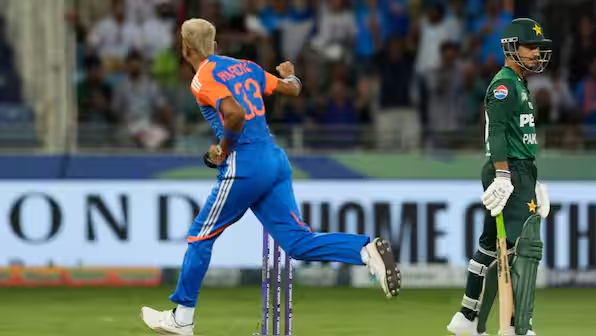
The ICC T20 World Cup once again pivots around its most anticipated fixture as India and Pakistan prepare to clash in Colombo. After days of political uncertainty, boycott rhetoric, and intense negotiations, the tournament’s most commercially significant match has survived off-field turbulence, reaffirming its place on cricket’s global calendar.
For the International Cricket Council (ICC), broadcasters, and stakeholders, the restoration of the India–Pakistan encounter represents more than sporting continuity. It safeguards what remains cricket’s most valuable commercial asset — a rivalry that consistently commands unparalleled global attention.
Political Tensions and Scheduling Uncertainty
Less than a week ago, doubts surrounded the match’s viability. Statements emerging from Pakistan’s political leadership triggered widespread uncertainty. Pakistan Prime Minister Shehbaz Sharif reiterated his country’s position of standing by Bangladesh, raising questions over participation against India.
What followed was a flurry of diplomatic engagement. Back-channel discussions, ICC interventions, and government-level consultations culminated in a decisive tripartite meeting in Lahore involving the ICC, the Pakistan Cricket Board (PCB), and the Bangladesh Cricket Board (BCB).
Publicly, officials emphasised protecting the “spirit of cricket.” Privately, the financial implications were difficult to overlook.
Industry estimates have valued the India–Pakistan fixture at approximately $250 million, underlining why stakeholders pushed for resolution. With the impasse resolved, organisers and broadcasters can proceed with renewed certainty.
Commercial Gravity of the Rivalry
India versus Pakistan remains cricket’s single largest revenue driver. Across formats, the contest guarantees exceptional television ratings, digital engagement, and advertising returns.
The ICC’s scheduling strategy in recent years — frequently placing the two teams in the same group at global tournaments — has amplified both sporting drama and commercial impact. The approach ensures at least one high-profile meeting while preserving the possibility of knockout-stage rematches.
However, it also means that one game often overshadows broader tournament narratives.
On-Field Context: Form and Momentum
From a purely cricketing perspective, both teams enter the contest in strong form. India and Pakistan have navigated their early Group A fixtures efficiently, each registering two wins.
Yet historically, this rivalry rarely hinges on points tables or net run rate. The match exists within its own emotional and psychological ecosystem, shaped by decades of history, pressure, and unpredictability.
India carry a notable competitive edge, both statistically and psychologically. Their three Asia Cup victories over Pakistan showcased contrasting strengths — disciplined bowling control, authoritative batting displays, and tactical dominance.
Preparation and Conditions
Team preparations reflect differing circumstances. India arrived in Colombo only on Friday night, allowing limited time for acclimatisation. The squad managed a single practice session ahead of the match. Concerns surrounding Abhishek Sharma’s health have eased following recovery from illness.
Pakistan, operating under the hybrid tournament model introduced last year, have been based in Colombo for several weeks. The extended stay has provided greater familiarity with local conditions, particularly at the R. Premadasa International Cricket Stadium (RPICS).
The pitch has been described as slow and demanding, favouring spin-heavy strategies.
Squad Strengths and Tactical Subplots
India’s lineup presents formidable balance. The top order offers explosive scoring potential, while the middle order provides depth and stability. The spin unit adds variety, complemented by a pace attack spearheaded by Jasprit Bumrah.
Despite perceived gaps, Pakistan remain a dangerous opponent. Their squad composition suggests adaptability to Colombo’s spin-friendly surface. The team fields five specialist spin options — Usman Tariq, Saim Ayub, Abrar Ahmed, Shadab Khan, and Mohammad Nawaz.
Usman Tariq’s unconventional stop-and-pause bowling action has already generated discussion, adding intrigue to the tactical battle against India’s versatile batting unit.
Psychological Dimensions of the Rivalry
Pakistan’s recent history against India reflects narrow margins rather than decisive gaps. Following their commanding victory in the 2021 T20 World Cup, Pakistan came close to sustaining momentum but faltered in high-pressure moments in Melbourne (2022) and New York (2024).
Those defeats highlighted the fragile divide between control and hesitation — a recurring theme in India–Pakistan contests.
Intensity Beyond the Venue
A neutral venue does little to temper intensity. Indian supporters have travelled despite soaring airfares and accommodation costs, reinforcing the fixture’s extraordinary pull.
Off-field narratives inevitably accompany players onto the field. However, for a few hours, the focus returns to cricket — skill, strategy, and execution under pressure.