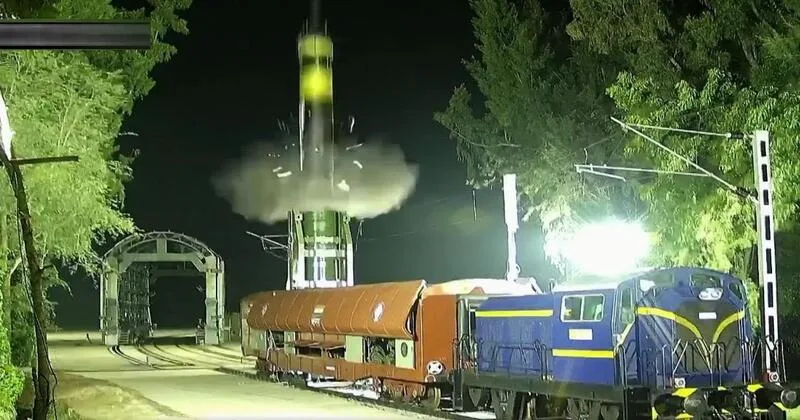
India has marked a historic step in its missile development program by successfully testing the next-generation Agni-Prime intermediate-range ballistic missile from a rail-based mobile launcher system, an achievement hailed by Defence Minister Rajnath Singh as the first of its kind for the country’s strategic arsenal. The test, conducted by the Defence Research and Development Organisation (DRDO) in collaboration with the Strategic Forces Command (SFC), positions India among a handful of global powers capable of deploying canisterised missiles on mobile platforms, thus strengthening its deterrence posture and operational flexibility in times of crisis.
A Landmark Rail-Mobile Launch and its Strategic Significance
The Agni-Prime missile, designed to cover ranges up to 2,000 kilometers, was successfully launched on Thursday from a specially engineered rail-based system that can travel across the Indian rail network without requiring special modifications or restrictions. Unlike conventional road-mobile or silo-based launchers, this rail-based platform offers cross-country mobility, rapid deployment, and the ability to launch with minimal visibility, significantly enhancing survivability and response time.
In a statement posted on social media, Defence Minister Rajnath Singh congratulated DRDO, SFC, and the armed forces for achieving this milestone. He described the test as not only a technological breakthrough but also a strategic advancement that reflects India’s ability to integrate missile systems with diverse deployment platforms. According to Singh, this capability now places India within an exclusive club of nations able to field canisterised ballistic missiles from rail-based systems, a feat previously associated with nuclear powers like Russia, China, and the United States.
The Agni-Prime missile itself represents the latest addition to India’s family of Agni-series ballistic missiles, which form the backbone of its strategic deterrent. Developed as a two-stage, solid-fuelled, canisterised missile, Agni-Prime incorporates several advanced features, including improved guidance systems, lighter composite materials, and higher accuracy. The canisterisation ensures greater shelf life, faster deployment, and simplified storage, making the missile not just more survivable but also highly responsive.
Rail mobility, however, adds an entirely new layer of operational advantage. India’s vast railway network provides unmatched coverage and mobility, allowing missile units to disperse quickly, remain concealed, and deploy from unexpected locations. In the event of conflict, this makes detection by adversaries far more difficult, ensuring the credibility of India’s second-strike capability. For a country that follows a declared “no first use” nuclear policy, survivability of its deterrent forces is critical, and the rail-mobile Agni-Prime significantly enhances that dimension.
This development also comes at a time of shifting regional security dynamics. With China rapidly modernising its missile forces and Pakistan continuing to expand its arsenal, India’s advancement in mobility and readiness underscores its determination to maintain strategic balance. Experts note that the ability to launch from rail-mobile platforms could deter adversaries from contemplating pre-emptive strikes, as the missile systems would be dispersed and difficult to neutralise in one go.
Technological Advancements and the Road Ahead for Agni-Prime
The Agni-Prime program was conceived as part of India’s effort to modernise its missile inventory and replace older versions with lighter, more accurate, and technologically advanced systems. Compared to earlier Agni variants, the Agni-Prime is smaller, more manoeuvrable, and designed with next-generation avionics. Its improved navigation and guidance systems allow for enhanced accuracy, reportedly bringing its circular error probability (CEP) down to a few meters, which is remarkable for intermediate-range ballistic missiles.
The missile’s two-stage solid propulsion, coupled with lighter composite motor casings, makes it easier to transport and quicker to launch. Its range of up to 2,000 kilometers places major strategic and military assets of both China and Pakistan within reach, covering high-value targets while maintaining flexibility in deployment. The canisterised system ensures that the missile is hermetically sealed, reducing maintenance and allowing it to be stored in operational readiness for extended periods.
The rail-mobile launcher, however, is the real highlight of this test. DRDO engineers designed the system to be compatible with India’s existing railway infrastructure, which means the launcher can move seamlessly across the national rail grid. Unlike some countries that require dedicated military rail networks, India’s system can operate covertly within civilian rail corridors, further complicating adversary surveillance. The mobility reduces dependence on fixed silos or visible road convoys, both of which are easier to track through satellite or aerial reconnaissance.
The decision to pursue a rail-based system is not without precedent. During the Cold War, both the Soviet Union and the United States experimented with rail-mobile intercontinental ballistic missiles (ICBMs) to ensure survivability against a first strike. China has more recently deployed similar systems. India’s adaptation of this concept with the Agni-Prime reflects a careful study of these models, tailored to its own geographical and strategic needs. With its extensive and diverse railway system, India can achieve flexibility that few other nations can match.
For DRDO and the armed forces, this success also demonstrates growing confidence in indigenous defence capabilities. The Agni-Prime project builds on decades of research and development, particularly under the Integrated Guided Missile Development Programme (IGMDP) launched in the 1980s. The program produced earlier versions of Agni missiles as well as Prithvi, Akash, and Nag. Each successive Agni variant has brought improvements in range, accuracy, and reliability. The Agni-Prime continues this trajectory, embodying lessons learned and incorporating modern technologies to meet evolving security needs.
The rail-mobile launch test is also a validation of India’s strategic vision. In an era where missile defence systems are becoming increasingly sophisticated, dispersal, mobility, and concealment are essential to maintain credible deterrence. By developing a system that can be launched from anywhere along a railway line, India has signaled that its deterrent will remain credible under any circumstances, further reinforcing its doctrine of assured retaliation.
Beyond deterrence, the test reflects India’s aspiration to be counted among technologically advanced military powers. By joining the ranks of nations with rail-mobile missile capabilities, India has underscored its place in the evolving global strategic landscape. Defence analysts argue that such developments also bolster India’s case for greater participation in international regimes governing nuclear and missile technology, as they highlight the country’s maturity, responsibility, and technological prowess.
The successful test is likely to be followed by further trials to validate the system under different operational conditions. The Strategic Forces Command will eventually induct the missile into active service once reliability and performance are fully demonstrated. Integration with command and control systems, training of personnel, and coordination with railway authorities will be critical steps in the process of operationalising this new capability.
The timing of the test has not gone unnoticed in the broader geopolitical context. Tensions along the Line of Actual Control with China and instability in Pakistan both form part of the security calculus that informs India’s missile development. While officials maintain that the Agni-Prime is part of a long-term program and not directed against any specific country, its capabilities speak for themselves. With a range covering much of South Asia and parts of East Asia, the missile provides India with a versatile tool for strategic deterrence.
At the same time, India continues to emphasize its commitment to responsible defence practices. The government has reiterated its adherence to the “no first use” nuclear doctrine and its stance on non-proliferation. By focusing on survivability and assured retaliation rather than aggressive first-strike postures, India presents its missile development as a stabilising factor rather than a destabilising one. This careful messaging aims to reassure the international community while simultaneously strengthening national security.
The success of the rail-based Agni-Prime test is therefore not just a technological achievement but a strategic signal. It conveys India’s resolve to maintain credible deterrence, its confidence in indigenous capabilities, and its readiness to innovate in response to evolving threats. As DRDO, SFC, and the armed forces continue to refine and operationalise this system, the Agni-Prime is set to play a pivotal role in India’s strategic arsenal for decades to come.