India has firmly rejected reports of cash or cryptocurrency payments to Iran for safe passage through the Strait of Hormuz after recent firing incidents involving Indian vessels heightened tensions.
India on Wednesday categorically denied allegations that it made any payments—either in cash or cryptocurrency—to Iran to secure safe passage for its ships through the strategically critical Strait of Hormuz. The clarification came amid escalating tensions in the region following reports that Iranian forces fired upon Indian vessels attempting to cross the narrow maritime corridor earlier this month.
The Indian government’s response follows an incident on April 18 when two India-flagged vessels were forced to retreat after coming under fire while navigating the Strait of Hormuz. The episode has raised concerns about maritime safety, global energy supply chains, and the potential misuse of misinformation during periods of geopolitical instability.
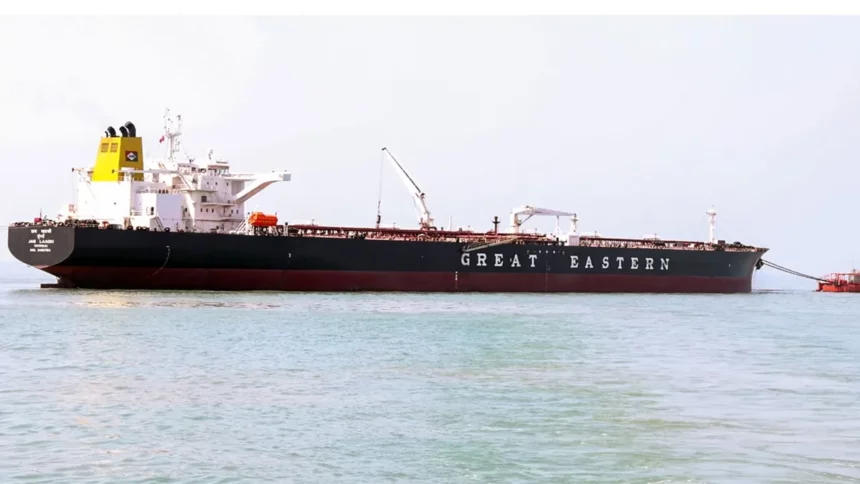
At the center of the controversy is the motor vessel Sanmar Herald, an Indian tanker whose captain was heard in an audio clip pleading with Iranian forces to cease firing. The recording, which has circulated widely, captured the captain stating that the vessel had prior clearance to pass through the strait. Despite this, the ship reportedly came under fire, forcing it to turn back to safer waters.
The incident has since become a focal point in a broader narrative involving alleged financial transactions, cyber scams, and geopolitical tensions. However, Indian authorities have strongly refuted claims that any payments were made to Iranian entities or intermediaries in exchange for safe passage.
Speaking at a press briefing, Mukesh Mangal, Additional Secretary in the Ministry of Ports, Shipping and Waterways, dismissed the allegations as “fake news.” He clarified that no Indian vessel, including Sanmar Herald, had made any payments to individuals claiming to represent Iranian authorities or the Islamic Revolutionary Guard Corps (IRGC).
“We have verified the information with the ship’s owner, and there is no truth to these claims,” Mangal stated. “There is no evidence that any payment—whether in US dollars or cryptocurrency—was made to secure passage. The reports circulating on social media are completely baseless.”
The denial was echoed by Chennai-based Sanmar Shipping, the company that owns Sanmar Herald. In an official statement, the company categorically rejected reports suggesting that it had fallen victim to a cryptocurrency scam. It reiterated that no such transaction had taken place and that it continues to work closely with Indian authorities to ensure the safety of its vessel and crew.
The controversy gained traction after reports emerged suggesting that scammers were offering shipowners fake guarantees of safe passage through the Strait of Hormuz in exchange for cryptocurrency payments. According to maritime risk consultancy Marisk, at least one vessel may have been targeted by such fraudulent schemes, raising concerns about cyber vulnerabilities in the shipping industry.
However, Indian officials have emphasized that there is no connection between these alleged scams and the firing incident involving Indian ships. “There is absolutely no link between the reports of cyber fraud and the events that occurred on April 18,” Mangal said. “These narratives are being wrongly conflated, leading to unnecessary confusion.”
The Ministry of Ports, Shipping and Waterways, in coordination with the Ministry of External Affairs, has been closely monitoring the situation in the region. Officials have indicated that decisions regarding vessel movement through the Strait of Hormuz are made after careful assessment of security conditions.
The April 18 incident is part of a larger pattern of disruptions in the region following the escalation of hostilities in West Asia. Since the outbreak of conflict on February 28, maritime traffic through the Strait of Hormuz has been significantly affected, with several commercial vessels stranded in the Persian Gulf.
The strategic importance of the Strait of Hormuz cannot be overstated. It serves as a critical chokepoint for global energy supplies, with nearly one-fifth of the world’s oil and liquefied natural gas passing through its narrow waters. Any disruption in this corridor has immediate and far-reaching consequences for global markets.
The recent tensions have already led to a spike in energy prices and concerns over supply shortages in several parts of the world. Countries heavily dependent on energy imports have been particularly vulnerable, with some forced to consider rationing measures to manage limited supplies.
Iran’s strategic position along the Strait of Hormuz gives it significant leverage in times of conflict. Its ability to disrupt or control maritime traffic in the region has long been viewed as a key factor in geopolitical calculations.
The current situation has also highlighted the challenges faced by the global shipping industry in navigating high-risk zones. Shipowners and operators must contend not only with physical threats such as military action but also with emerging risks like cyber fraud and misinformation.
Experts warn that the proliferation of fake news and unverified reports can exacerbate tensions and lead to misinformed decisions. In this case, the rapid spread of claims about cryptocurrency payments created confusion and raised questions about the integrity of maritime operations.
Indian authorities have urged stakeholders to rely on official sources for accurate information and to exercise caution when dealing with unverified claims. The government has also reiterated its commitment to ensuring the safety of Indian vessels and seafarers operating in the region.
Diplomatic efforts are ongoing to address the broader conflict and restore stability in the region. While India has maintained a neutral stance, it has consistently called for de-escalation and dialogue to resolve differences.
The incident involving Sanmar Herald underscores the complex interplay between geopolitics, maritime security, and information warfare. It also highlights the importance of robust communication channels and coordinated responses among governments, shipping companies, and international organisations.
As the situation continues to evolve, the focus remains on ensuring safe navigation through the Strait of Hormuz while addressing the underlying causes of instability.
For India, the stakes are particularly high. As one of the world’s largest importers of crude oil, any disruption in energy supply routes has direct implications for its economy. Ensuring uninterrupted access to critical energy corridors is therefore a top priority.
At the same time, the government must navigate a complex diplomatic landscape, balancing its relationships with key stakeholders in the region while safeguarding its national interests.
The denial of payment allegations is part of a broader effort to maintain transparency and counter misinformation. By addressing these claims promptly, Indian authorities aim to prevent the spread of false narratives that could undermine confidence in the country’s maritime operations.
Looking ahead, the incident is likely to prompt a reassessment of security protocols for vessels operating in high-risk areas. Enhanced coordination between governments, increased reliance on verified intelligence, and the adoption of advanced technologies may become essential components of maritime strategy.
The role of cyber security in the shipping industry is also expected to come under greater scrutiny. As digital systems become increasingly integral to maritime operations, the risk of cyber threats—including scams and data breaches—will need to be addressed proactively.
In conclusion, India’s firm denial of cash or cryptocurrency payments to Iran for passage through the Strait of Hormuz underscores its commitment to transparency and adherence to international norms. The incident serves as a reminder of the challenges posed by geopolitical tensions and the importance of accurate information in navigating complex global scenarios.