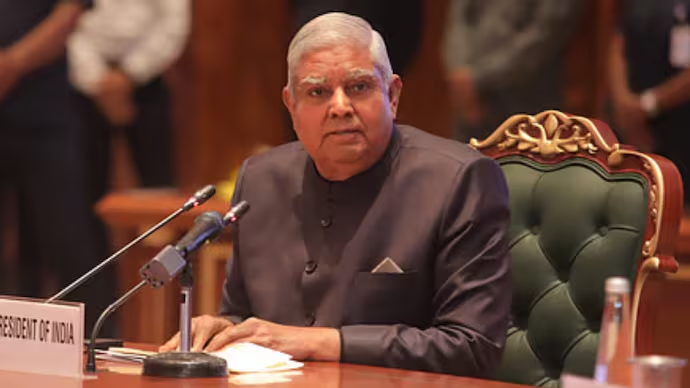
The sudden resignation of Vice President Jagdeep Dhankhar has set the stage for a fresh electoral battle in Parliament, with the Opposition’s INDIA bloc preparing to field a joint candidate despite the ruling NDA’s numerical advantage. While the NDA holds a clear majority, the INDIA bloc sees this election as an opportunity to send a strong political message and reaffirm its presence in the national narrative ahead of crucial political developments.
Sources within the bloc indicated that while the numbers are not in the Opposition’s favour, the intent is to avoid ceding the field uncontested and to showcase unity among its parties. Congress president Mallikarjun Kharge confirmed that the bloc would take a collective decision on the candidate, emphasising that the INDIA parties will meet soon to finalise their strategy for the vice presidential election.
Jagdeep Dhankhar, who also served as the Chairman of the Rajya Sabha, resigned on Monday, citing health concerns and medical advice as reasons for stepping down. His resignation letter was submitted to President Droupadi Murmu, creating a vacancy that now demands a vice-presidential election to fill the post.
The Numbers and the Stakes
In the vice presidential election, the winning candidate requires a simple majority of the votes cast by members of both Houses of Parliament. The effective strength of both Houses currently stands at 782, with 392 votes required to secure a win if all members cast their vote.
The NDA, led by the BJP, currently enjoys the support of 293 members in the Lok Sabha and around 130 in the Rajya Sabha, bringing its effective strength to approximately 423 members. On the other hand, the INDIA bloc has the support of 234 members in the Lok Sabha and 79 in the Rajya Sabha, taking its tally to around 313 members, while the remaining seats are held by non-aligned parties and independents.
Despite the evident numerical advantage of the NDA, leaders within the INDIA bloc believe it is important not to shy away from the contest, irrespective of the result. This stance is intended to reinforce the bloc’s narrative of standing up to the government on significant democratic processes and maintaining active participation in the electoral mechanisms of the country.
A Test of Opposition Unity
The upcoming election is also seen as a test of the INDIA bloc’s unity, particularly after the general elections where the Opposition made significant gains but still fell short of forming the government. The vice-presidential election offers the bloc another platform to showcase its collective strength and to prepare its organisational machinery for future political challenges.
There is also a sentiment within the bloc that participating in the election will help it maintain momentum among its cadre and supporters, projecting confidence and readiness for democratic battles ahead, rather than conceding space to the ruling alliance without a contest.
Mallikarjun Kharge’s statement that the INDIA bloc will decide its course of action collectively underscores the emphasis on internal consensus-building within the alliance, which comprises parties with diverse interests and regional priorities. Leaders within the bloc are reportedly in touch with other Opposition parties and independents to explore potential support, even as they acknowledge the uphill battle in terms of numbers.
The vice-presidential election, in which all members of the Lok Sabha and Rajya Sabha, including nominated members, cast their votes, is also a crucial event in the parliamentary calendar. It serves as a reminder of the Opposition’s commitment to participate in democratic processes and hold the government accountable while using every opportunity to strengthen its position within the corridors of power.
As discussions within the INDIA bloc continue, the choice of the candidate will be crucial in reflecting the bloc’s strategy and messaging for the coming months. The candidate’s profile will likely be chosen to appeal to a broad spectrum of parties within the bloc, reinforcing the message of unity while challenging the NDA on the principles of democratic contestation.
For the NDA, the vice-presidential election is expected to be a relatively straightforward affair given its parliamentary numbers, but it will also be an opportunity to demonstrate stability and the capacity to manage legislative priorities efficiently under the leadership of Prime Minister Narendra Modi.
As the date for the election is announced and nominations begin, the political discourse around the vice-presidential election will shape narratives in Parliament, influencing future debates and alliances in the run-up to other state and national-level contests.
In the coming days, the INDIA bloc’s meetings and subsequent decisions will reveal how the Opposition intends to engage with the NDA within Parliament, maintaining its relevance while striving to protect and strengthen democratic institutions and processes within the country’s governance structure.