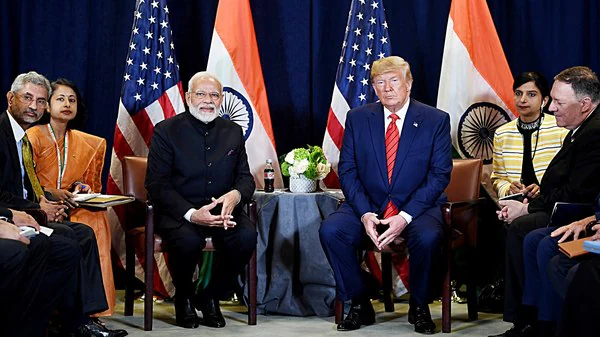
India and the United States are set to engage in crucial trade negotiations this week, with discussions expected to extend beyond tariff reductions to broader market access across key sectors. The US is urging India to lower tariff barriers on American goods in a comprehensive manner rather than through incremental changes. In return, Washington is willing to consider mechanisms that address India’s concerns, such as quota restrictions to safeguard Indian farmers and small industries.
The talks will be led by Brendan Lynch, Assistant Trade Representative from the US, and Rajesh Agarwal, Additional Secretary from India’s Commerce Ministry. This first in-person discussion will span three days in New Delhi, setting the stage for future negotiations. The urgency behind the discussions is heightened by the approaching April 2 deadline set by former US President Donald Trump for imposing reciprocal tariffs on Indian exports.
Sources familiar with the negotiations indicate that the US seeks a broad-based agreement encompassing agricultural products, alcoholic beverages, and automobiles rather than focusing on select individual items. India, on the other hand, is looking to protect its domestic industries, particularly small and medium-scale enterprises, while showing flexibility on items that are not produced domestically.
India’s approach to these negotiations aligns with recent free trade agreements (FTAs) signed with Australia and the United Arab Emirates (UAE). The India-Australia Economic Cooperation and Trade Agreement (ECTA) and the India-UAE Comprehensive Economic Partnership Agreement (CEPA) include tariff rate quotas (TRQs) that allow a specific quantity of goods to be imported at concessional rates. A similar framework could be considered in the India-US trade pact to balance the interests of both nations.
In an effort to demonstrate goodwill, India has already made some tariff reductions. In February, it slashed duties on motorcycles and bourbon whiskey, two items of significance to American industries. Additionally, India has proposed eliminating the 6% Equalisation Levy, commonly known as the Google Tax, on online advertisements. However, officials note that these gestures, while positive, may not be substantial enough to prevent potential US trade actions.
Reports also suggest that India is open to cutting tariffs on more than half of US imports worth $23 billion as part of the first phase of the proposed trade deal. In an internal analysis, Indian officials estimated that reciprocal US tariffs could impact 87% of India’s total exports to the US, which amount to $66 billion annually.
The deal under discussion would see India reducing tariffs on 55% of US imports currently subject to duty rates ranging from 5% to 30%. Some of these duties could be significantly lowered or even eliminated, affecting goods worth over $23 billion. However, specific details and final agreements remain under discussion, with both sides seeking a balanced approach to trade liberalization.
As the negotiations progress, India and the US will aim to finalize a framework by September 2025, as outlined in the February 13 joint statement by Prime Minister Narendra Modi and former President Trump. While both countries recognize the economic benefits of an expanded trade relationship, balancing domestic interests with international commitments remains a key challenge.