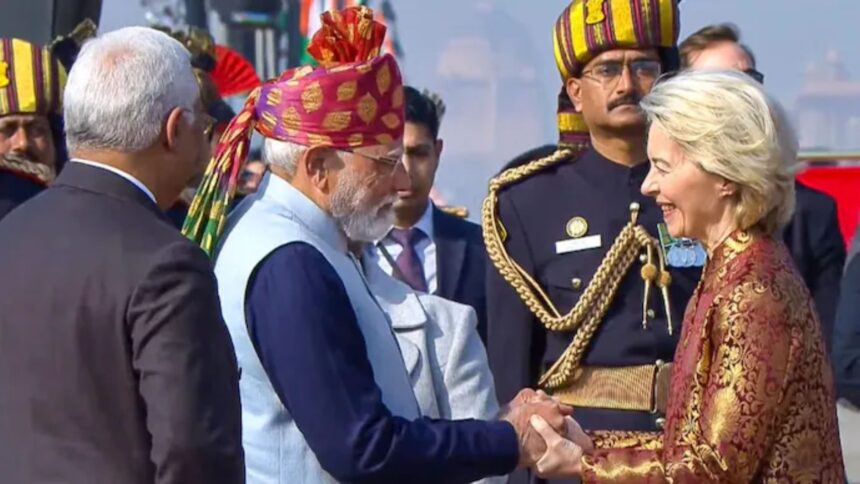
India and the European Union have wrapped up negotiations on a long-awaited free trade agreement, marking a decisive moment in global economic diplomacy as both sides seek to recalibrate partnerships in a changing geopolitical environment. Finalised after nearly two decades of intermittent talks, the agreement is being described as transformative in scale and ambition, linking one of the world’s fastest-growing major economies with a 27-nation bloc that remains a central pillar of global trade. The deal reflects not only commercial priorities but also strategic intent, as India and the EU look to diversify economic ties, strengthen supply chains, and reduce vulnerability to external political and trade pressures.
Two decades of negotiation culminate in a broad and strategic economic framework
The conclusion of the India–EU trade agreement brings closure to one of the most complex and protracted negotiation processes in recent trade history. Discussions began almost twenty years ago but were repeatedly stalled by disagreements over tariffs, market access, regulatory standards, and protections for sensitive domestic sectors. The renewed momentum that led to the agreement reflects shifting global realities, including the need for resilient trade partnerships and the growing importance of India as a manufacturing and consumption hub.
At the heart of the agreement is a significant expansion of market access on both sides. The European Union, which counts India among its largest trading partners, gains improved entry into India’s vast consumer market for a range of industrial goods. India, in turn, secures enhanced access to European markets for key export sectors that employ millions, including textiles, pharmaceuticals, chemicals, and engineering goods. The agreement is designed to progressively reduce tariffs rather than eliminate them overnight, allowing domestic industries time to adapt while still signalling long-term openness.
One of the most closely watched aspects of the deal involves automobiles. India has agreed to reduce high import duties on certain categories of European vehicles, a longstanding demand from EU negotiators. While these reductions are calibrated and phased, they represent a notable shift in India’s traditionally protective automotive policy. European manufacturers see this as an opportunity to deepen their presence in a rapidly growing market, while India expects increased investment, technology transfer, and competition that could ultimately benefit consumers.
Despite its breadth, the agreement deliberately excludes some sensitive sectors. Agriculture and dairy products, which support millions of livelihoods in India, remain largely outside the deal’s scope. This reflects New Delhi’s continued caution in exposing politically and socially sensitive areas to global competition. European negotiators have acknowledged these exclusions as part of a pragmatic compromise, prioritising overall progress over comprehensive coverage.
Political leadership on both sides played a crucial role in overcoming lingering deadlocks. Prime Minister Narendra Modi has framed the agreement as a cornerstone of India’s global economic engagement, aligning trade liberalisation with domestic manufacturing and employment goals. European leaders have similarly portrayed the deal as evidence of the EU’s capacity to forge ambitious partnerships beyond its immediate neighbourhood, particularly with emerging powers that will shape future global growth.
Geopolitical recalibration and economic impact reshape global trade dynamics
Beyond its commercial provisions, the India–EU trade agreement carries substantial geopolitical weight. Its timing is widely seen as a response to growing uncertainty in global trade, particularly amid strained relations with the United States and an increasingly fragmented international economic order. For both India and the European Union, the deal represents a strategic hedge against overdependence on any single market or partner.
In recent years, protectionist policies and tariff disputes have disrupted established trade flows, prompting countries to seek diversified and reliable partnerships. The India–EU agreement fits squarely into this trend, reinforcing a multipolar approach to global trade where economic relationships are spread across regions rather than concentrated. By deepening ties with India, the EU strengthens its engagement with the Indo-Pacific, while India reinforces its standing as a key bridge between developed and emerging economies.
The potential economic impact of the agreement is substantial. Combined, India and the EU account for a significant share of global output and trade. The removal of trade barriers is expected to stimulate bilateral commerce, encourage cross-border investment, and integrate supply chains more closely. European companies are likely to increase investment in Indian manufacturing, logistics, and services, attracted by market access and the promise of regulatory cooperation. Indian firms, particularly in technology and pharmaceuticals, are expected to benefit from smoother entry into highly regulated European markets.
Financial markets have responded with cautious optimism, reflecting expectations of long-term gains rather than immediate windfalls. Analysts note that the agreement’s benefits will unfold gradually as legal reviews, ratification processes, and phased tariff reductions take effect. Nonetheless, the clarity provided by a concluded deal is itself seen as a positive signal, reducing uncertainty for businesses planning long-term investments.
The agreement also reinforces a broader strategic alignment between India and Europe on issues beyond trade. While the deal is economic in nature, it sits alongside growing cooperation in areas such as technology standards, climate initiatives, and supply chain resilience. By anchoring their relationship in a comprehensive trade framework, both sides aim to build trust and institutional depth that can support collaboration across multiple domains.
As implementation approaches, attention will turn to how effectively the agreement balances liberalisation with domestic priorities. For India, the challenge lies in ensuring that increased competition supports rather than undermines local industry and employment. For the EU, the task will be to translate market access into tangible commercial success while navigating India’s complex regulatory environment. The outcome will shape not only bilateral relations but also perceptions of how large, diverse economies can negotiate equitable trade arrangements in an era of global uncertainty.