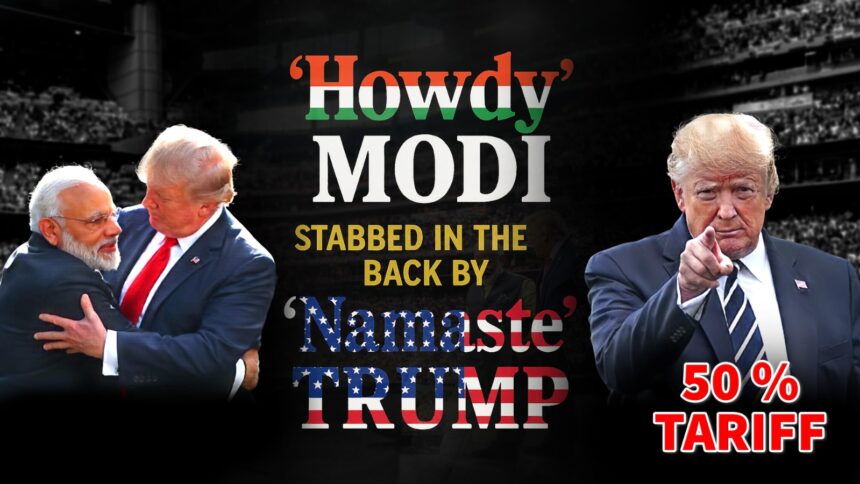
From Stadium Cheers to Tariff Tears
In February 2020, India and the United States staged one of the grandest spectacles in the history of their bilateral relationship. The event was called Namaste Trump. The venue was the newly built Motera Stadium in Ahmedabad, and the atmosphere was electric. Over one hundred thousand people filled the stands, waving Indian and American flags, chanting slogans, and celebrating the arrival of the then American president. Prime Minister Narendra Modi welcomed Donald Trump with the words of a trusted friend. Trump, in return, called India a loyal partner. The world watched as the two leaders embraced on stage.
That moment was meant to symbolize a new beginning. For many in India, it was proof that the country had finally secured a place at the table of global powers, with Washington as its closest ally. The scale of the event and the personal warmth on display were used to signal that the bond was not only strategic but also deeply emotional.
Five years later, the picture could not be more different. In August 2025, Donald Trump, now back in office, announced a sweeping decision that stunned New Delhi. His administration imposed tariffs of fifty percent on a wide range of Indian exports to the United States. The value of these exports was close to sixty billion dollars every year. The very industries that had thrived on American demand, from textiles to diamonds to seafood, suddenly found themselves crippled. The excitement of Namaste Trump has given way to a sense of betrayal. For many in India, it feels as if the country has been stabbed in the back.
The Promise of Friendship in 2020
The Ahmedabad rally was more than a political spectacle. It was carefully designed to cement an image of India and America standing shoulder to shoulder. The stadium had been upgraded, the city had been beautified, and cultural performances showcased India’s diversity. The message was direct and simple: India was ready to be America’s closest partner in the twenty-first century.
Modi presented the United States as India’s most trusted ally, and Trump reciprocated by calling India a true friend. For ordinary citizens who filled the stands, this was a moment of national pride. It seemed like a new era was beginning in which both countries would benefit economically and strategically. Defense ties, technology transfers, and increased trade were all expected outcomes of this so-called friendship. The rally created an expectation that America would stand by India in difficult times and reward the goodwill shown by millions of Indians.
That promise, however, has faded. The warm words spoken in Ahmedabad now sound hollow as the new trade barriers hit the very foundation of India’s export-driven economy.
The Tariff Shock of 2025
The announcement of fifty percent tariffs came like a thunderclap. For Indian exporters, it meant their products instantly became far more expensive in the American market. A shirt that might have been sold for ten dollars was suddenly priced at fifteen, not because of higher quality or production costs, but simply because of the duty imposed at the border. Buyers naturally looked elsewhere.
The pain has been unevenly distributed across industries. The textile and apparel hubs of Surat, Tiruppur, and Ludhiana have been particularly hard hit. These centers, known for producing clothes that reached every corner of the world, are now facing cancelled orders and shuttered factories. The diamond polishing industry in Surat, which handles ninety percent of the world’s rough diamonds, has witnessed workers leaving in droves as businesses collapse under the pressure. In Andhra Pradesh and Tamil Nadu, shrimp exporters who once supplied seven billion dollars’ worth of seafood to the United States are finding their livelihoods threatened. Leather workers in Kanpur and artisans in Jaipur are watching foreign buyers walk away.
Economists warn that the damage is not just sectoral. The overall economy could slow by nearly half a percentage point this year. A Barclays study has pointed out that nearly seventy percent of India’s exports to the United States now face serious risks. What makes the crisis particularly cruel is that pharmaceuticals and IT services, which remain largely untouched, employ fewer of the vulnerable workers. The blow has fallen on the very industries where millions of Indians toil daily to earn a basic livelihood.
Trump’s Words: From Affection to Accusation
Trade barriers alone would have been damaging enough. But what has deepened the wound is the rhetoric that has come along with them. Trump and his advisers have openly accused India of indirectly supporting Russia’s war effort by continuing to buy discounted oil. Former trade adviser Peter Navarro even went as far as to describe the conflict as “Modi’s war.” Such words are more than political soundbites; they shape perceptions in Washington and beyond, painting India as a problem rather than a partner.
Trump has also repeatedly told audiences in America that he personally prevented an India-Pakistan conflict by threatening tariffs and pressuring Modi to accept a ceasefire. India’s Ministry of External Affairs has denied these claims outright, stating that no such mediation took place. Yet the narrative persists in Trump’s speeches, which seem designed less to reflect reality and more to boost his image as a tough negotiator.
Adding to the confusion is Trump’s habit of offering praise and punishment in the same breath. Modi is occasionally described by him as a “terrific man,” but such compliments are quickly followed by justifications for harsh policies. The net effect is that the earlier warmth has been replaced by suspicion and hostility. For Indians who remember the scenes of embrace in 2020, the shift feels like a deliberate reversal.
How India’s Situation Differs from China’s
When observers look at these tariffs, they naturally recall the trade war between the United States and China from 2018 to 2020. At that time, Trump imposed tariffs on over three hundred and sixty billion dollars’ worth of Chinese goods. China responded aggressively with its own tariffs on American products such as soybeans and cars. The global economy trembled as supply chains were disrupted.
The comparison, however, only goes so far. China was targeted as an economic superpower and had the capacity to fight back. Its domestic market absorbed some of the losses, and its sheer scale gave it leverage. India, in contrast, finds itself in a much more vulnerable position. Its total exports to the United States amount to about eighty six billion dollars, and now seventy percent of that trade faces tariffs. The industries most affected are labor-intensive and cannot easily shift to new buyers.
While China was treated as a competitor, India is being treated as a scapegoat. This distinction is important. China was punished for its power. India is being punished despite its partnership. The humiliation comes not only from the economic cost but also from the perception that a supposed ally can be discarded when convenient.
India’s Dilemma as an Ally
For decades, strategists have described India as the lynchpin of America’s Indo-Pacific policy. That status now looks uncertain. India must ask itself whether it is truly seen as a strategic ally or merely a convenient scapegoat.
Part of the dilemma comes from India’s dependence on imported energy. Buying Russian oil at discounted rates is an economic necessity, but Washington frames it as a betrayal. Another part of the problem is the transactional nature of America’s relationship. When India aligns with American positions, it is praised. When it asserts independence, it is punished with tariffs and threats. For young workers in India, this means their jobs and futures are tied to geopolitical calculations far beyond their control.
If India continues to be treated as a tool of convenience, it risks being blamed in every crisis, regardless of the ground realities. The long-term strategic question is whether India will remain a junior partner that takes instructions or a confident power that charts its own path.
How India is Responding
Despite the pain, India is not standing still. Diplomatically, New Delhi has already begun lobbying in Washington for relief. Senior officials have met with the United States Trade Representative to argue that tariffs on critical sectors like textiles and gems are damaging not just for India but for the partnership itself. Statements to the media, including the Washington Post, have been blunt in pointing out that such measures are unsustainable for the future of bilateral relations.
At the same time, exporters are diversifying. Contracts with European and Middle Eastern buyers are being pursued aggressively. Analysts at NDTV and the Economic Times have noted a rise in interest from ASEAN and African markets, which could serve as partial buffers. Domestically, the government has introduced relief packages. Subsidies for diamond polishers in Surat, rebates for shrimp farmers in Andhra Pradesh, and new insurance schemes for small exporters are all being rolled out.
Experts such as former Chief Economic Adviser Arvind Subramanian have emphasized the need for long-term structural change. India must shift from low-value, labor-intensive exports to high-value goods like electronics, semiconductors, and green technologies. This transition will take time, but it is crucial for resilience.
There are also green shoots of innovation. Startups in Surat are working on blockchain-based diamond traceability systems that appeal to American buyers concerned about ethical sourcing. Seafood exporters in Andhra are experimenting with direct-to-consumer e-commerce models in Europe. These examples suggest that crisis is pushing Indian entrepreneurs to find creative solutions.
From Betrayal to Self-Reliance
The journey from Namaste Trump in 2020 to fifty percent tariffs in 2025 is a sobering lesson in global politics. It shows that friendships celebrated on stage can be fragile, and that in international relations, interests outweigh emotions.
India now faces the challenge of reducing its dependence on any single partner. The path forward lies in upgrading its exports, building self-reliance in technology and manufacturing, and unleashing the energy of its youth. The tariffs have caused immediate pain, but they may also force India to accelerate reforms that were long overdue.
Being stabbed in the back is painful, but it need not be the end of the story. It can be the beginning of a new chapter where India stands stronger, more independent, and more confident of its place in the world. The lesson of this crisis is clear: an Atmanirbhar Bharat is not just a slogan, it is a necessity.