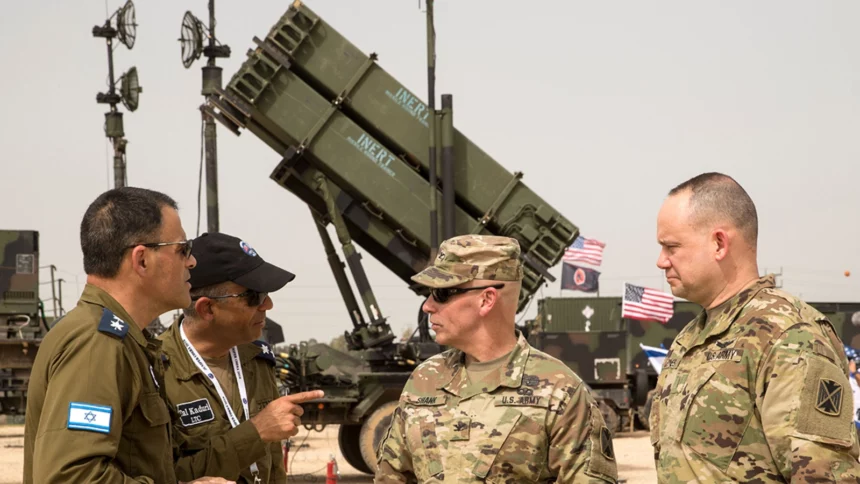
For over seven decades, the United States has been one of Israel’s strongest international allies—supporting it economically and, more significantly, militarily. What began as modest economic aid in the 1950s has grown into a massive military partnership worth billions, with Israel becoming the largest cumulative recipient of U.S. foreign assistance. In light of recent tensions between Israel and Iran, this longstanding financial and strategic alliance is once again under the spotlight.
From Modest Aid to Military Giant
According to the U.S. Foreign Assistance database, Israel began receiving American aid in 1951. That year, the support amounted to a mere $0.96 million in economic obligations, with no military aid involved. Throughout the 1950s and early 1960s, U.S. support remained primarily economic, averaging between $400 million and $600 million annually. It wasn’t until 1971 that a dramatic shift occurred—military aid surged to $3.2 billion, surpassing economic assistance for the first time. This pattern only deepened over time.
The turning point came after the 1973 Yom Kippur War. In 1974, U.S. military assistance skyrocketed to $12.45 billion, while economic aid held steady at $260 million. From then on, military funding became the dominant form of U.S. support to Israel, with economic aid gradually tapering off. By 2008, economic assistance had almost completely disappeared, while military aid held firm at over $3 billion annually.
In 2024, U.S. military assistance to Israel reached $6.64 billion—compared to a symbolic $0.01 billion in economic support. Cumulatively, from 1951 to 2024, the U.S. has provided Israel with $305.5 billion in aid, of which 72%—about $221.68 billion—was military assistance.
How Israel Compares With Other U.S. Aid Recipients ?
While Israel is the most prominent recipient of American military support, other countries have also received substantial U.S. aid—though not all to the same degree or in the same form. Egypt and Afghanistan, for example, received $93.93 billion and $109.88 billion respectively, a large share of which was military aid. Vietnam, Ukraine, and Iraq also fall into this group, with more than half of their U.S. assistance being military in nature.
In contrast, countries like India and Bangladesh have primarily benefited from economic aid. India received a total of $86.1 billion in U.S. assistance, but only $1.18 billion of it was military. Bangladesh, with $21.8 billion in aid, received just $0.35 billion in military support. This sharp contrast underscores the unique status of Israel in U.S. foreign policy.
Military Financing and Arms Sales to Israel
Much of Israel’s military assistance is funneled through the U.S. Foreign Military Financing (FMF) programme. Under this arrangement, Israel receives about $3.3 billion annually as direct grants to purchase American-made weapons and defense systems. As of October 2023, the Biden administration reported that Israel had nearly 600 active FMF cases, worth a combined $24 billion.
In terms of arms procurement, Israel ranks among the top recipients of U.S. weapons. Between 1950 and 2022, Israel purchased $53 billion worth of American arms—second only to Saudi Arabia, which imported $164 billion during the same period. These figures highlight the depth and longevity of the Israel-U.S. defense relationship.
From foreign policy alignment to billions in military aid and arms sales, the U.S.-Israel alliance has been one of the most enduring—and expensive—partnerships in modern history. As global geopolitical tensions rise, particularly with Iran, this relationship continues to shape regional dynamics and international strategies.