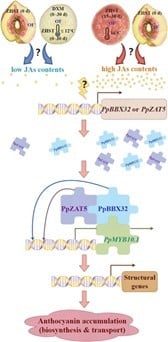
Anthocyanins are essential plant pigments responsible for the red, blue, and purple hues in fruits. Beyond their role in fruit coloration, they offer significant health benefits, including anti-aging and cancer-preventive properties. The biosynthesis of anthocyanins is influenced by both environmental factors like temperature and light, as well as internal genetic and hormonal cues. While the transcription factor PpMYB10.1 has been recognized as a key regulator of anthocyanin accumulation in peaches, the upstream factors governing its expression in response to temperature and tissue-specific signals have remained unclear. This gap in understanding underscores the need for comprehensive research into the mechanisms controlling anthocyanin accumulation in peaches.
Published (DOI: 10.1093/hr/uhae212) on July 30, 2024, in Horticulture Research, this study, led by researchers from Zhejiang University and the New Zealand Institute for Plant & Food Research, identifies two crucial transcription factors—PpBBX32 and PpZAT5—that regulate anthocyanin accumulation in peach fruits. By combining transcriptomic analysis, genetic transformation, and hormone treatments, the study uncovers the intricate interactions between these factors and PpMYB10.1, providing a clearer picture of how temperature and tissue types influence color development.
The study focused on two peach cultivars, ‘Zhonghuashoutao’ and ‘Dongxuemi’, which exhibit distinct anthocyanin accumulation patterns. Using RNA-Seq analysis, the researchers pinpointed PpBBX32 and PpZAT5 as essential regulators of anthocyanin biosynthesis. These transcription factors were found to directly activate the PpMYB10.1 promoter, forming a protein complex that enhances anthocyanin production. The study also revealed that methyl jasmonate (MeJA), a plant hormone, plays a critical role in boosting anthocyanin accumulation by upregulating PpBBX32 and PpZAT5 expression. This regulation was consistent across various fruit tissues and storage temperatures, demonstrating the complex relationship between environmental and internal factors. The findings were validated through transient expression assays in peach fruits and stable transformation in tobacco, where overexpressing PpBBX32 and PpZAT5 led to increased anthocyanin levels.
Dr. Changjie Xu, corresponding author of the study, emphasized, “Our findings not only expand our understanding of the molecular mechanisms behind anthocyanin accumulation in peaches but also open new possibilities for enhancing fruit quality through genetic and hormonal approaches. This research has far-reaching implications for the horticultural industry as well as human nutrition.”
The identification of PpBBX32 and PpZAT5 as key regulators of anthocyanin accumulation paves the way for developing peach varieties with enhanced coloration and nutritional value, which could increase both market appeal and consumer health benefits. Moreover, the discovery of MeJA’s role in regulating anthocyanin biosynthesis could lead to innovative post-harvest treatments, improving fruit quality during storage and transport. This research also lays the groundwork for studying anthocyanin regulation in other fruits, offering potential benefits across a wide range of crops. In sum, this study represents a major step forward in plant biology, with promising applications for agriculture and beyond.
###
References
DOI
Original Source URL
https://doi.org/10.1093/hr/uhae212
Funding information
This work was financially supported by the National Natural Science Foundation of China (32072542), Pao Yu-Kong International Fund, Zhejiang University, and the 111 project (B17039).
About Horticulture Research
Horticulture Research is an open access journal of Nanjing Agricultural University and ranked number one in the Horticulture category of the Journal Citation Reports ™ from Clarivate, 2022. The journal is committed to publishing original research articles, reviews, perspectives, comments, correspondence articles and letters to the editor related to all major horticultural plants and disciplines, including biotechnology, breeding, cellular and molecular biology, evolution, genetics, inter-species interactions, physiology, and the origination and domestication of crops.
https%3A%2F%2Fwww.newswise.com%2Farticles%2Fhow-peaches-get-their-color-scientists-discover-key-regulatory-genes%2F%3Fsc%3Drsla