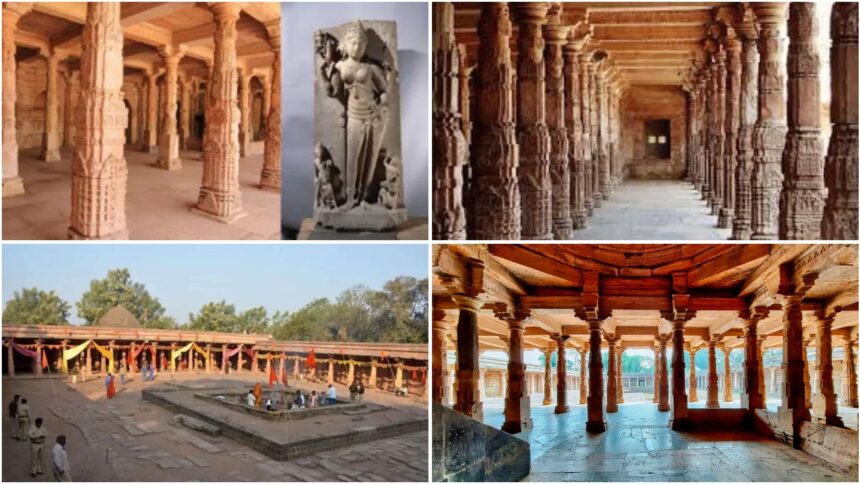
In a remarkable day marked by both cultural significance and broad public interest, the historic Bhojshala site in Madhya Pradesh witnessed the convergence of two distinct religious traditions in a single shared space, even as other news stories from around the world captured attention with dramatic developments including the United States’ exit from the World Health Organization and discussions about unpaid dues, underscoring the layers of social, political, and international issues shaping public consciousness at this moment.
Bhojshala: unity, tension, and security at a sacred site
The ancient Bhojshala complex in Madhya Pradesh’s Dhar district, a site with centuries of layered history, once again became the focus of intense cultural and religious attention as Basant Panchami festivities coincided with Friday prayers. In a rare and carefully managed event, both Hindu devotees and Muslim worshippers were permitted to practice their respective rites on the same day, a moment that came after legal directions and extensive administrative planning. On this occasion, Hindus gathered in large numbers to perform continuous prayers and rituals for Saraswati, the goddess of knowledge, marking Basant Panchami with traditional reverence, celebration, and fervent devotion that filled the precincts and surrounding streets with chants, rituals, and festive energy.
At the same time, a smaller group of Muslim worshippers were allowed to offer Friday prayers, or namaz, within designated spaces of the complex, a gesture intended to respect religious plurality and maintain communal harmony. The dual observances were conducted under the watchful eye of a large security apparatus, with thousands of personnel deployed across the district and around the historic site to ensure that peace and order were maintained throughout the day. The elaborate security preparations reflected both the sensitivities of the occasion and the recognition of the significance attached to Bhojshala by diverse communities.
The event drew attention not only because of the simultaneous rituals themselves but because of the long and sometimes contested history of the site. Over the years, various groups have laid claim to different aspects of the space, with debates centering on its character as both an archaeological monument and a location of ongoing religious sentiment. For many Hindu devotees, Bhojshala is associated with ancient temple traditions and reverence for goddess worship, while sections of the Muslim community regard the location as part of the Kamal Maula mosque complex where namaz has been offered historically.
What made this particular day notable was the official decision to allow both prayers and rituals in accordance with legal instructions meant to balance competing claims and community expectations. Administrative authorities worked to designate separate areas for each religious observance, supported by clear directives for how each would proceed without interference. While the festive energy of Basant Panchami drew thousands of Hindus to participate in processions, ceremonial fire offerings, and devotional chants, the smaller Muslim group offered their prayers with respect and solemnity in a space that had been prepared for that purpose.
Despite the extensive planning and significant security presence, the atmosphere remained largely peaceful, and reports indicated that the day passed without major incident. Officials characterized the coordination of the dual observances as a demonstration of disciplined cooperation and commitment to communal peace. For many observers, the success of the event lay not only in the absence of conflict, but in the willingness of diverse groups to exercise restraint and respect for one another’s traditions in a context that has sometimes been fraught with tension.
At the same time, voices from within the Muslim group expressed disappointment and frustration regarding certain aspects of how the day unfolded, with some participants stating that arrangements for their prayer were not fully realized in the way they had expected. These expressions of discontent underscored the challenge of managing shared spaces that carry deep emotional and historical significance for multiple communities, revealing that even days of peaceful coexistence can be accompanied by critiques of administrative processes and unmet expectations.
The events at Bhojshala drew commentary from local residents and visitors alike, with many reflecting on the cultural importance of Basant Panchami as a festival of renewal, learning, and spring’s arrival, and its layered connection to the history of the site. For those present, the rituals were not merely ceremonial but deeply symbolic, representing continuity with long-standing traditions that have shaped communal lifeways over generations.
Across conversations among attendees, there was also a consensus that the day’s observances signaled a moment of possibility, where respect for diversity became visible in the shared experience of a sacred location. These reflections suggested that while disputes over heritage and religious space remain complex, moments when multiple traditions coexist peacefully merit attention for the example they set in times of broader societal challenge. As Bhojshala stood adorned with garlands, processions, and prayer, the blending of cultural expression and religious ritual offered a reminder of the powerful role that ancient sites and shared history play in modern public life.
Global public health controversy and geopolitical shifts shape international discourse
Alongside these profound cultural narratives unfolding at home, international developments also attracted attention and sparked debate, particularly regarding the United States’ formal exit from the World Health Organization and the contentious question of unpaid dues to the global body. The move marked a significant shift in international public health cooperation, evoking strong reactions from allies, critics, and global health advocates alike. The decision to withdraw from the WHO was framed by the United States leadership as a response to broader critiques about funding, governance, and perceived imbalances in how the organization operates, but for many observers it raised concerns about global solidarity in confronting shared health challenges.
The backdrop to this decision involved allegations of financial disagreements, including claims that the United States had substantial outstanding dues while simultaneously asserting it had contributed more than required historically. The rhetoric surrounding the exit from the WHO underscored broader tensions about international institutions’ roles in coordinating responses to pandemics, disease outbreaks, and public health emergencies, especially in an era when global health systems remain under strain and vulnerable populations continue to face significant risk.
International reaction to this development was swift and varied, with some countries and experts warning that the withdrawal could weaken global health cooperation at a time when the world still grapples with the repercussions of recent pandemics and emerging health threats. Critics of the decision argued that disengagement from a central global health body could undermine collective capacity to detect new diseases, share data, and coordinate responses that transcend national borders. Supporters of the United States’ position, on the other hand, asserted that reforms within global institutions are necessary and that engagement must align with accountability and equitable governance.
These debates brought to the forefront questions about how nations balance national interests with commitments to multilateralism and collective well-being. The complexity of global health governance, combined with geopolitical considerations, highlighted the challenges of sustaining international cooperation in an increasingly fragmented political landscape. For policymakers, public health professionals, and citizens around the world, the implications of such shifts extend beyond funding commitments to encompass trust, shared responsibility, and the collective capacity to respond to crises that affect millions of lives.
The conversation about the WHO and international health cooperation did not occur in isolation but intersected with broader geopolitical dynamics, including shifting alliances, economic pressures, and debates about the future of multilateral engagement in a world marked by contestation and competition. The decision by one of the world’s largest economies to step back from a central coordinating body sent reverberations through diplomatic circles, prompting discussions about the future architecture of global governance and how nations might reinterpret or reaffirm their roles in shaping collective futures.
In public discourse, these developments stirred reflections on the meaning of national sovereignty versus global interdependence, particularly in areas like public health where localized actions can have far-reaching consequences. Observers pointed out that diseases do not recognize borders, and that effective responses often require shared information, resources, and strategies that outpace individual nations’ capacities. The interplay between national policy choices and global institutional frameworks thus became a subject of intense analysis and debate.
For citizens following these stories, the juxtaposition of international health policy shifts with local cultural celebrations highlighted the multifaceted nature of news in an interconnected world. While communities gathered at historic sites to reaffirm heritage and shared identity, political leaders and global institutions grappled with questions that shape collective futures on a much wider scale. In this landscape, narratives of tradition and modernity, local practice and global policy, coexisted as part of a larger conversation about how societies navigate change, uphold values, and sustain cooperation across diverse realms of human concern.