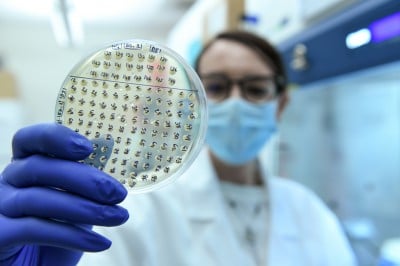
Newswise — Nutley, NJ, November 17, 2025 – Researchers from the Hackensack Meridian Center for Discovery and Innovation (CDI) and the Johns Hopkins Bloomberg School of Public Health are collaborating on a new federally-funded accelerator to develop next-generation drugs and diagnostics to battle antimicrobial-resistant fungal infections – a growing health scourge across the globe.
A five-year federal grant will establish a Center of Excellence in Translational Research (CETR) jointly between researchers from the Bloomberg School and the CDI, and other academic and commercial collaborators. The CETR expects to receive about $7 million annually, contingent upon the availability of funds, with the support coming from the National Institutes of Health’s National Institute of Allergy and Infectious Diseases (NIAID).
The CDI’s involvement is led by David Perlin, Ph.D., chief scientific officer and executive vice president, who is collaborating with principal investigator Arturo Casadevall, M.D. Ph.D., M.S., chair of Molecular Microbiology and Immunology, Bloomberg Distinguished Professor, and Alfred and Jill Sommer Professor and Chair at the Johns Hopkins Bloomberg School of Public Health.
The new accelerator consortium is complemented by other CETRs at the CDI dedicated to antiviral and antibacterial drug discovery led by Perlin, and funded by other major federal awards. The teams bring together seasoned translational research professionals from academic groups CDI, Johns Hopkins Bloomberg School of Public Health, and Rutgers University, along with biopharma partners Prokaryotics and Scynexis to speed development of transformative products.
“David Perlin is an expert in the fight against invasive fungal infection,” said Ihor Sawczuk, M.D., FACS, president of Academics, Research, and Innovation at Hackensack Meridian Health, founding chair of the Hackensack Meridian Health Research Institute, and associate dean of Clinical Integration and professor and chair emeritus of Urology at the Hackensack Meridian School of Medicine. “Through his leadership at the CDI and CETR groups, Dr. Perlin continues to unify institutions to advance the science of intervention in the face of such threats as drug-resistant fungi and infectious diseases.”
Invasive fungal infections pose a major—and often, fatal—health risk to immunocompromised individuals, including organ transplant recipients, patients with influenza or other viral and bacterial pneumonias, and patients with cancer. Current antifungal drugs are often rendered ineffective by aggressive strains such as Candida auris—considered “an urgent antimicrobial resistance threat” by the CDC— as well as Candida glabrata, and Aspergillus fumigatus. More than 3 million people across the world die each year as a result of fungal infections, according to the Center for Infectious Disease Research and Policy (CIDRAP).
The new CETR will continue to bring together experienced drug developers from academic and pharmaceutical/biotech teams: the Johns Hopkins Bloomberg School researchers and the CDI are joined by David Alland, M.D. at Rutgers University and Terry Roemer, Ph.D. at Prokaryotics, as well as industry experts at Scynexis and Cepheid Diagnostics.
“Fungi pose an existential threat to humanity,” said Dr. Casadevall. “This drug discovery group is going to unite top-notch talent and expertise to produce critical breakthroughs.”
Dr. Perlin, a board member of the Global Action for Fungal Infections (GAFFI), says bringing together academic and pharmaceutical partners drives science forward to address unmet clinical needs. As such, the team expects this alliance to ultimately result in a comprehensive portfolio of treatment deliverables to the U.S. Food and Drug Administration (FDA), including: two Investigation New Drug (IND)-ready, small molecule drug candidates; a novel, “lead optimized” immunotherapy; and a 510(k)-ready, point-of-care or near-patient diagnostic for bloodstream infections.
“This grant recognizes the power of collaboration in tackling the world’s most pressing health threats,” said Dr. Perlin. “In partnering with Johns Hopkins, other academic centers, NIAID, and biopharmaceutical companies, we will continue to translate cutting-edge scientific research into clinical solutions.”
The CETR will be guided by a Scientific Advisory Board composed of leading experts in antimicrobial research, drug development and clinical application. Members include Michael R. Hodges, M.D., Karen Shaw, Ph.D., Daria Hazuda, Ph.D., and Neil Clancy, M.D. Collectively, their expertise spans academia, clinical practice, and pharmaceutical innovation and product development, providing strong scientific leadership and direction for the program.
This research is supported by the National Institute of Allergy and Infectious Diseases of the National Institutes of Health under Award Number U19AI189183.
ABOUT HACKENSACK MERIDIAN HEALTH
Hackensack Meridian Health is a leading not-for-profit health care organization and New Jersey’s largest, most comprehensive, and integrated health network. Our network includes 18 hospitals, more than 500 patient care locations, and a complete range of services from innovative research and life-enhancing care to lifesaving air medical transportation. Our 38,000 team members and 7,000 physicians are committed to the health and well-being of the communities we serve, making Hackensack Meridian Health a distinguished leader in healthcare philanthropy.
Hackensack University Medical Center is the first-ever New Jersey hospital to be ranked a Top 20 hospital in the nation. It is also ranked #1 in New Jersey and the New York metro area by U.S. News & World Report, 2025-26. Hackensack Meridian Health is proud to be home to New Jersey’s #1 children’s hospital and the state’s only nationally-ranked cancer center, the John Theurer Cancer Center. To learn more, visit www.hackensackmeridianhealth.org.
ABOUT THE JOHNS HOPKINS BLOOMBERG SCHOOL OF PUBLIC HEALTH
The Johns Hopkins Bloomberg School of Public Health works to keep millions safe from illness and injury by pioneering new research, deploying knowledge in the field, and educating tomorrow’s public health leaders. The Bloomberg School was founded as the first independent school of public health in 1916 as part of Johns Hopkins University–the nation’s first research university. Today, Bloomberg School researchers work in settings from labs to communities to prevent disease, improve population health, and shape health policy in the U.S. and countries around the world.
ABOUT THE CENTER FOR DISCOVERY AND INNOVATION
The Center for Discovery and Innovation, a member of Hackensack Meridian Health, translates current innovations in science to improve clinical outcomes for patients. More than 34 laboratories, 200+ professional researchers and physician-scientists at the CDI have set their sights on cancer, infectious diseases, autoimmune disorders, and other acute and chronic diseases. Clinical need drives scientific insights and their application for these researchers, leading to the development of new diagnostics, therapies, and surveillance capabilities in response to emerging health challenges. The CDI harnesses cutting-edge advances in genetics, molecular biology, clinical immunology, imaging, and behavioral sciences to better diagnose, treat and prevent disease through personalized medicine approaches. For additional information, please visit www.hmh-cdi.org.
ABOUT HACKENSACK MERIDIAN HEALTH RESEARCH INSTITUTE (HMHRI):
HMHRI leads and organizes a connected ecosystem bringing together clinicians, scientists, and educators to respond to the health problems of our time, in real-time. HMHRI is dedicated to accelerating discovery, innovation, and translation of scientific breakthroughs that address unmet clinical needs.
https%3A%2F%2Fwww.newswise.com%2Farticles%2Fhackensack-meridian-cdi-and-johns-hopkins-researchers-receive-major-federal-funding-to-address-drug-resistant-fungal-infections%2F%3Fsc%3Drsla