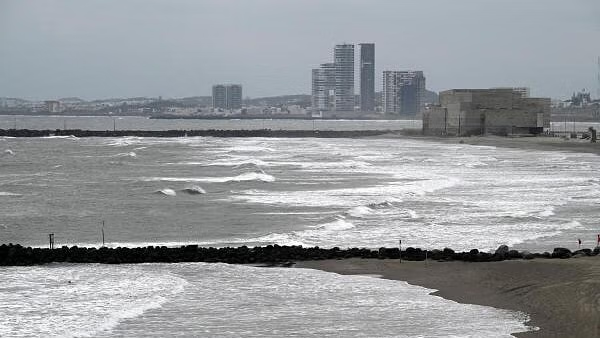
Google Maps will soon display the “Gulf of Mexico” as the “Gulf of America” for users in the United States, following an executive order issued by former President Donald Trump. The change, officially updated in the federal mapping database, was confirmed by Alphabet-owned Google on Monday. This renaming comes as part of a broader directive from the Trump Administration to alter the names of several American landmarks. The US Department of the Interior stated that the name changes had been made official and that the country’s Geographic Names System was working swiftly to implement the President’s order.
Google, in a post on X, emphasized its policy of aligning its map labels with official government sources when updates occur. However, the name change will not be universally applied. While users in the United States will see the body of water renamed as the Gulf of America, Google Maps users in Mexico will continue to see it labeled as the Gulf of Mexico. Outside of the two countries, the platform will display both names, acknowledging the international nature of geographic naming conventions.
This renaming is part of a broader effort by the Trump Administration to revert several name changes made in previous years. Another significant revision includes the renaming of Alaska’s tallest mountain. The peak, which had been officially named Mount McKinley in 1917 to honor the 25th President of the United States, William McKinley, was renamed Denali by the Obama Administration in 2015. As per the Interior Department, Trump’s directive has reversed this decision, officially reinstating the name Mount McKinley. Google Maps is expected to reflect this change in the near future.
The name alterations were among a series of executive actions signed by Trump just hours after taking office on January 20, fulfilling a campaign promise to restore what he termed “traditional American names.” The move has sparked reactions from leaders outside the US, including Mexican President Claudia Sheinbaum, who made a tongue-in-cheek remark earlier this month suggesting that North America be renamed “Mexican America,” referencing a historic name found on early maps of the region.
Google has followed similar naming policies in the past when dealing with contested geographical names. In situations where place names are disputed, the platform often adjusts its labels based on regional or political sensitivities. For instance, in Japan and South Korea, the water body between the two nations appears on Google Maps as “Sea of Japan (East Sea),” reflecting both perspectives. A similar controversy arose in 2012 when Iran protested Google’s decision to omit the name “Persian Gulf” from its maps. The body of water between Iran and the Arabian Peninsula was left nameless on Google Maps for a period, prompting threats of legal action from Iran. Eventually, Google opted for a dual-label approach, now referring to the waterway as “Persian Gulf (Arabian Gulf)” in different regions.
As the Gulf of America name change rolls out, it is expected to generate discussions regarding the impact of government policies on digital platforms and geographic representation. While the Trump Administration justified the renaming as a restoration of American heritage, critics argue that such changes reflect political motivations rather than geographic accuracy. Google’s response, which adheres to governmental updates while balancing international perspectives, highlights the challenges faced by global mapping services in navigating politically charged naming conventions.